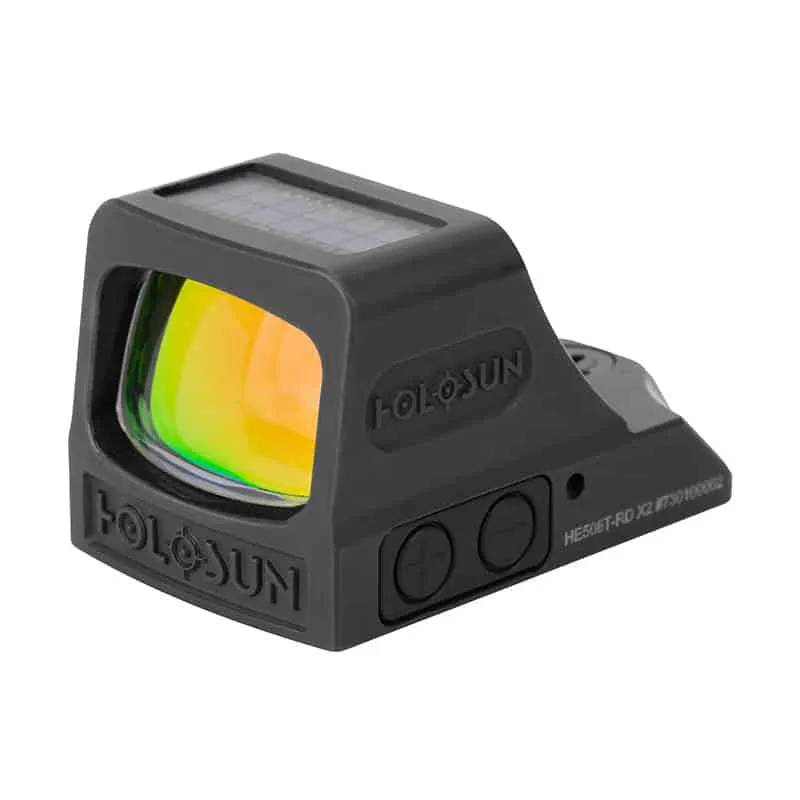
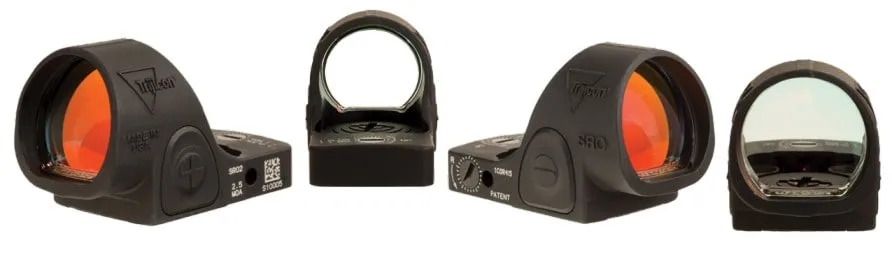
In this review of the Holosun 508T vs Trijicon SRO, we will do a side-by-side comparison of two of the most talked-about pistol red dot sights on the market.
We will cover all the top features for both reflex sights (window size, durability, price, reticle, and battery) along with the specifications and the most frequently asked questions, so you can get our recommendation as to which one fits your build.
These two sights come from different corners of the optics world. The Holosun HE508T-RD X2 is built by Holosun, the value-and-features leader in the red dot sight (RDS) space. The Trijicon SRO (Specialized Reflex Optic) comes from Trijicon, a long-time front runner with decades of duty-grade reputation behind its RMR line.
Both are open reflex micro red dot sights (MRDS) cut to the Trijicon RMR footprint, both are aimed squarely at pistol shooters, and both are excellent optics, but they were designed with two different missions in mind, and that drives just about every buying decision below. For the full hands-on details, see our complete Holosun HE508T review and our Trijicon SRO review.
Holosun 508T vs Trijicon SRO Review
First, let’s get the basic similarities out of the way.
Both are open-emitter reflex sights designed first and foremost for handgun use, and both share the industry-standard Trijicon RMR mounting footprint, so either optic drops onto the same optics-ready slides and uses the same family of mounting plates, so your pistol choice does not lock you into one sight or the other.
Both use multi-coated lenses, both offer night-vision (NV) compatible low-brightness settings, and both include an automatic brightness mode alongside manual control. Each one also uses a battery tray you can access without dismounting the sight, so you don’t re-zero every time you change the battery. And both are tough, lightweight, and waterproof; neither is the weak link in a quality pistol build.
So the real question is not “which is good,” it’s “which is right for what you are doing.” Now let’s get to the differences.
Window Size and Field of View
This is the first place the SRO makes its case. The Trijicon SRO sports a large, nearly round viewing window measuring .98” x .89”, one of the biggest Fields of View (FOV) in the class. The whole optic was engineered around that window. Trijicon’s pitch is speed, and the oversized window delivers: the dot seems to never leave the glass, which makes initial acquisition and rapid follow-up shots noticeably faster.
The Holosun HE508T has a more conventional rectangular window measuring roughly .63” x .91”. It is plenty large for fast, easy target acquisition and never feels cramped, but it is a smaller viewing surface than the SRO’s, and side by side the difference is obvious. Where the 508T trades a little glass, it gives you a tougher, more enclosed-feeling housing in return.
For pure speed and a heads-up, both-eyes-open shooting experience, the win here goes to the Trijicon SRO. That oversized round window is the single biggest reason shooters reach for this optic.
Durability and Build Quality
Now we flip the script. The Holosun 508T is machined from a single piece of titanium, and the X2 update squared off the previously rounded top of the housing to make an already rugged optic even more impact resistant. Holosun rates it IP67 (dust-tight and submersible to one meter for 30 minutes) with drain holes to clear water off the lens. This is a sight built to take drops, bumps, and thousands of rounds and hold zero; it is rated and marketed for duty carry.
The Trijicon SRO is no slouch. It is built from forged 7075-T6 aluminum, where the T6 tempering roughly doubles the tensile strength of untempered 7075, producing a rugged chassis that still weighs only 1.6 oz, and it carries an IPX8 rating, submersible to 10 feet. But Trijicon themselves repeatedly state the SRO is not intended for duty use, and the larger, more open window exposes more glass than a smaller, enclosed design. The SRO is plenty tough for competition and the field; it is simply not pitched as a hard-use duty optic the way the 508T is.
For ruggedness and hard-use reliability, the win goes to the Holosun HE508T. Single-piece titanium plus a duty-grade reputation is hard to beat.
Reticle
The two sights take opposite philosophies here. The Holosun 508T uses Holosun’s patented multi-reticle system: a 2 MOA dot, a 32 MOA circle, or the two combined as a circle-dot. You can switch on the fly: small precise dot for distance, big circle for fast close-range work. For reference, that 32 MOA circle covers roughly 32 inches at 100 yards. The 508T comes with a red or green Super-LED and 12 brightness settings (10 daylight, 2 NV).
The Trijicon SRO keeps it simple with a single crisp red dot, offered in your choice of 1 MOA, 2.5 MOA, or 5 MOA at purchase (models SRO1, SRO2, SRO3). There is no circle and no on-the-fly switching, but Trijicon’s glass and LED produce an exceptionally clean dot, and the SRO offers 8 brightness settings plus a super-bright setting, with the two lowest NV compatible.
If you value flexibility and want to tune your reticle to the task without buying a different optic, the win goes to the Holosun 508T. If you simply want the cleanest possible single dot, the SRO’s reticle is gorgeous, but it is one dot, fixed at purchase.
Battery and Operation
Both sights solved the most annoying part of pistol optics: neither requires removing the sight to change the battery. The 508T uses a side-loading CR1632 tray; the SRO uses a top-loading CR2032 tray. No lost zero on a battery swap for either one.
Battery life is rated differently. The Holosun 508T is rated up to 50,000 hours on the single 2 MOA dot (about 10,000 hours on the 32 MOA circle), driven by its Super LED, and it adds the Solar Failsafe dual-power system, a solar array that can run the optic in adequate light even with a dead battery. The Trijicon SRO is rated at three years of continuous-on use, which is excellent, but it has no solar backup.
Operation is intuitive on both, with side-mounted buttons. The 508T leans on automation: Shake Awake wakes the optic instantly on movement and sleeps it after 10 minutes of stillness, and Auto Mode uses the solar sensor to set brightness. The SRO uses lock-out (holds auto-brightness) and lock-in (holds your manual level so a bumped button won’t change it) modes.
On raw battery numbers the SRO’s three-year rating is strong, but the win here goes to the Holosun 508T for its longer dot runtime, Shake Awake, and, the clincher, the Solar Failsafe that keeps the optic running if the battery dies. For a sight you might bet your safety on, that redundancy matters.
Mounting and Sight Adjustment
Because both optics share the Trijicon RMR footprint, mounting is straightforward on either. The key practical difference is what comes in the box. The Holosun 508T includes a low Picatinny/Weaver rail mount, so it is ready to go on a rail out of the box and only needs an adapter plate for direct pistol mounting. The Trijicon SRO includes no mount; you will need to buy the correct RMR-pattern plate or kit for your firearm.
For sight adjustment, the 508T uses 1 MOA clicks with a +/-50 MOA range and ships factory-set to an approximate 25-yard zero; its screws are small and want a fine flat edge. The SRO uses tool-less 1 MOA adjustments you can turn with a coin or a spent casing, with crisp tactile detents and a generous 150 MOA range.
This one is close to a draw: the SRO has nicer tool-less adjusters and far more range; the 508T includes a usable mount and a head-start factory zero. Call it a draw, leaning SRO if you care most about the adjustment experience.
Holosun 508T vs Trijicon SRO Specifications
| Specification | Holosun HE508T-RD X2 | Trijicon SRO |
|---|---|---|
| Magnification | 1x | 1x |
| Reticle | 2 MOA dot / 32 MOA circle (multi) | 1, 2.5, or 5 MOA dot (single, fixed at purchase) |
| Window Size | .63” x .91” | .98” x .89” |
| Housing | Single-piece titanium | Forged 7075-T6 aluminum |
| Weight | 2.0 oz | 1.6 oz |
| Dimensions | 1.78” x 1.15” x 1.15” | 2.2” x 1.3” x 1.4” |
| Battery | CR1632 | CR2032 |
| Battery Access | Side-loading | Top-loading |
| Battery Life | Up to 50,000 hrs (2 MOA dot) | 3 years continuous |
| Solar Backup | Yes (Solar Failsafe) | No |
| Brightness Settings | 10 DL + 2 NV (12 total) | 8 + super bright (2 NV) |
| Motion Wake | Shake Awake | No |
| MOA Adjustment | 1 MOA per click | 1 MOA per click |
| Adjustment Range | +/-50 MOA | 150 MOA |
| Mount Footprint | RMR | RMR |
| Mount Included | Yes (low rail mount) | No |
| Waterproof Rating | IP67 (1m / 30 min) | IPX8 (to 10 ft) |
| MSRP | $430 | $599 |
Included With the 508T and SRO
Holosun HE508T:
- HE508T-RD X2 red dot sight
- Low rail mount
- T10 L-key
- User manual
- CR1632 battery
- Lens cloth
Trijicon SRO:
- Trijicon SRO (Specialized Reflex Optic)
- Trijicon logo sticker
- Lens cloth
- Two #6-32 flat head Torx cap screws (1/2” long)
- Torx head key
- Manual
- Warranty card
Pros vs Cons
Now let’s highlight the pros and cons for each, then take a look at the most frequently asked questions and our conclusion.
The Pros
The Holosun HE508T shines on value and toughness: a single-piece titanium housing, a flexible multi-reticle system, Shake Awake, and a Solar Failsafe backup, all for well under the SRO’s price. It is rugged enough for duty carry and ships with a usable rail mount in the box.
The Trijicon SRO shines on speed and clarity. Its oversized .98” x .89” round window is the fastest, most forgiving sight picture of the two, the single dot is exceptionally crisp, and the tool-less adjusters with 150 MOA of range make zeroing painless. Trijicon’s build quality and warranty reputation are long established.
Both share the RMR footprint, both let you change the battery without re-zeroing, and both are waterproof and night-vision capable.
The Cons
The Holosun 508T has a smaller viewing window than the SRO, its buttons are small and a little fiddly to work, and its windage/elevation screws want a fine flat edge to adjust cleanly.
The Trijicon SRO carries a premium price at the top of this comparison, does not include a mount in the box, and is explicitly not recommended by Trijicon for duty use. Its taller, more forward-sitting profile also won’t suit every slide or every set of rear iron sights.
Frequently Asked Questions
What are the major differences between the Holosun 508T and the Trijicon SRO?
The major differences are housing (508T single-piece titanium vs SRO forged 7075-T6 aluminum), window size (the SRO’s .98” x .89” round window is larger than the 508T’s .63” x .91”), reticle (the 508T’s switchable 2 MOA dot / 32 MOA circle vs the SRO’s single fixed dot), backup power (the 508T adds Solar Failsafe and Shake Awake; the SRO has neither), and price (roughly $430 vs $599).
Will the Holosun 508T and Trijicon SRO fit the same mounting plate?
Yes. Both optics use the Trijicon RMR footprint, so they accept the same RMR-pattern mounting plates and kits for optics-ready pistols. Note that the 508T includes a low rail mount while the SRO requires you to buy the correct plate separately.
Is the Holosun 508T good enough for duty carry?
Yes. The 508T is one of the few open reflex sights in this price range built and marketed for duty use, thanks to its single-piece titanium housing, IP67 rating, Shake Awake, and Solar Failsafe redundancy.
Why is the Trijicon SRO not recommended for duty use?
Trijicon designed the SRO for speed in competition and range use rather than hard-duty service, and the brand states this directly. The larger open window and taller forward-sitting profile prioritize sight picture over the maximally rugged, enclosed design you would want for a duty optic, a role Trijicon points toward the RMR for instead.
Which dot size should I pick on the SRO?
Dot size is personal preference. A larger dot (5 MOA) is faster for close-range work, a smaller dot (1 MOA) is more precise at distance, and the 2.5 MOA is a balanced middle choice that suits most pistol shooters.
Conclusion
In the Holosun 508T vs Trijicon SRO head-to-head, the Holosun HE508T-RD X2 is our overall pick for most shooters. It does almost everything the SRO does, adds a flexible multi-reticle, Shake Awake, and a Solar Failsafe backup, is rugged enough for duty carry, and comes in well under the SRO’s price with a mount in the box. Read the full Holosun HE508T review for the complete hands-on breakdown.
That said, the Trijicon SRO earns its place. If your priority is speed (competition, steel, fast-paced range work) nothing here beats that big round window for getting on the dot and keeping it there. If you want the fastest sight picture and Trijicon’s pedigree, and duty use isn’t part of the plan, the SRO is the optic to chase. See our complete Trijicon SRO review for the full details.
Pick the 508T for an all-around, do-everything, duty-capable pistol optic at a better price. Pick the SRO when raw speed is the whole point.