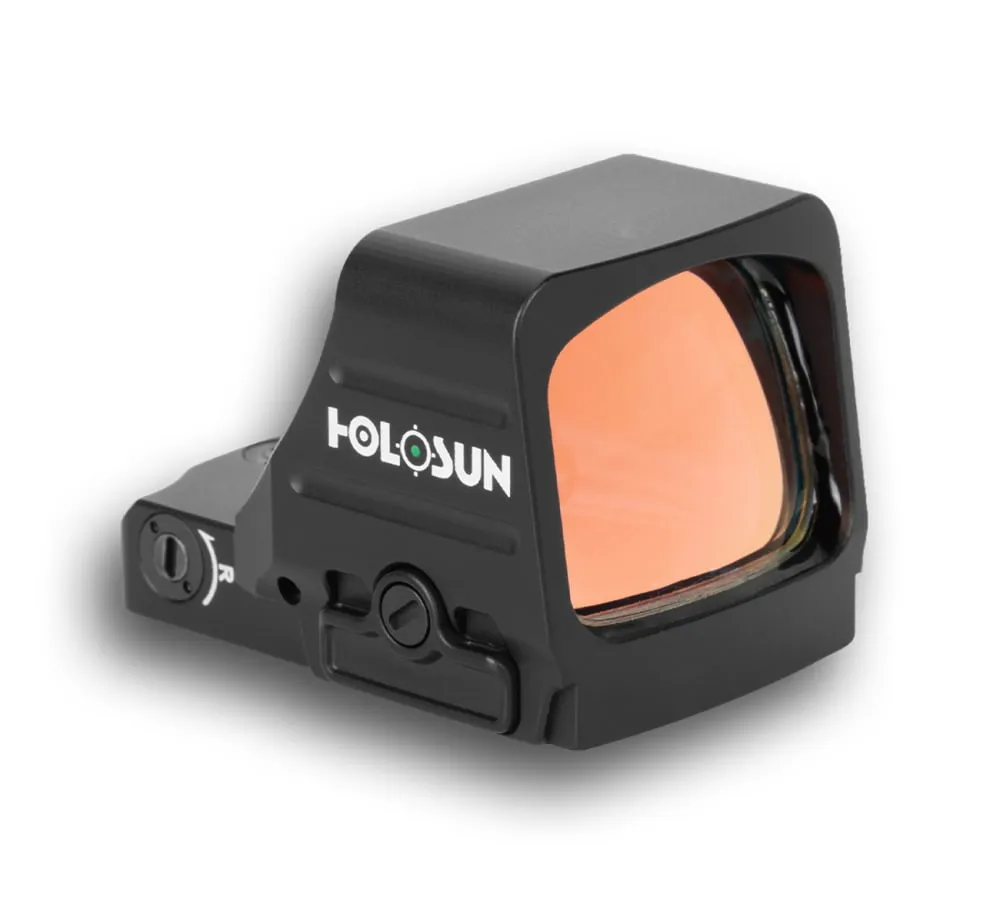
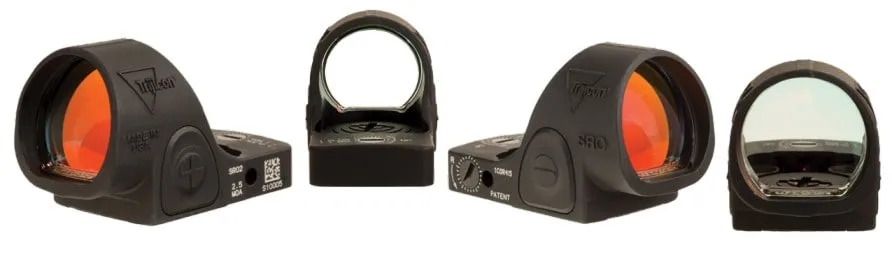
Two big-window open reflex sights, both cut to the Trijicon RMR footprint, both sold on the same promise: find the dot faster and move between targets without hunting for it. The Holosun 507COMP and the Trijicon SRO are the two most direct answers to that brief on this footprint, and if you are outfitting a competition pistol you are probably choosing between exactly these two.
They arrive at the answer differently, and about $128 apart at MSRP. Below we work through price, window, reticle, mounting, battery, the durability record, and warranty, then give you a straight verdict. For the full breakdowns, see our Holosun 507COMP review and our Trijicon SRO review.
Holosun 507COMP vs Trijicon SRO Review
Start with what they share, because it is a lot.
Both are open-emitter reflex sights built for pistols, both use the Trijicon RMR mounting footprint, and neither includes a mount in the box, so either way you are buying the correct plate or kit for your slide. Both offer night-vision compatible low settings alongside daylight brightness, both let you change the battery without pulling the optic and losing your zero, and both are adjustable at 1 MOA per click. Neither is a duty optic in the way the RMR is: Trijicon says so directly about the SRO, and the 507COMP is a competition variant of the 507 line rather than a hardened carry sight.
So this is not a good-versus-bad comparison. It is a question of which set of trade-offs matches the way you shoot.
Price
This is the cleanest split of the whole comparison. Holosun lists the green-reticle HE507COMP-GR at an MSRP of $470.58, with the red HS507COMP-RD priced below that. Trijicon lists the SRO at an MSRP of $599.
That is roughly a $128 gap before you shop, and both sights routinely street below list. It is not a budget-versus-premium gap, both of these are premium optics, but $128 is a case of ammo, a decent plate, or most of a match entry season.
Nothing about the SRO’s spec sheet explains the premium on its own. What you are paying for is Trijicon’s build reputation and the specific things the SRO does better, covered below.
Round one goes to the Holosun 507COMP.
Window and Sight Picture
Both of these exist because of their windows, so the details matter.
The 507COMP’s window measures 1.1 inches by 0.87 inches, roughly two thirds more glass than the standard 507C, and it is the first thing every published reviewer of the sight comments on. The SRO’s window measures .98 by .89 inches and is nearly circular, which is the shape Trijicon engineered the entire optic around.
The 507COMP has the wider view. The SRO has the rounder one, and roundness is not a cosmetic point: a circular window puts equal glass above, below, and to either side of the dot, so a slightly off index still finds the reticle in the same way from any direction. Shooters who love the SRO tend to talk about that symmetry rather than raw area.
Glass quality gets honest mixed notes on both. Reviewers running the 507COMP report a slight blue tint. On the SRO, Daniel Reedy at Primer Peak called the glass decent but not stellar, below Aimpoint, with minor edge distortion and a notch filter that darkens the upper half, while Kat Ainsworth Stevens at Pew Pew Tactical described the same glass as crystal clear. Reedy also observed a starburst on the small 2.5 MOA dot with his astigmatism, and IntelGoons reported a faint secondary dot appearing at certain sun angles.
Call this one a draw. More glass on the Holosun, better window geometry on the Trijicon.
Reticle
Opposite philosophies, and the biggest functional difference between the two.
The 507COMP stacks a 2 MOA dot with an 8, 20, or 32 MOA ring, giving four selectable sight pictures from one optic, switchable without disturbing zero. Holosun launched the feature as the Competition Reticle System and its current product pages call it the Performance Reticle System, so both names refer to the same thing. Brightness runs 12 settings, 8 daylight and 4 night-vision compatible. The rings map to real problems: an 8 MOA circle around the dot is a plate-rack tool, a 32 MOA circle is a close-range speed tool.
The SRO gives you one dot, chosen when you buy: 1 MOA (SRO1), 2.5 MOA (SRO2), or 5 MOA (SRO3). There is no ring and no switching. What you get instead is a single very clean aiming point and, at the 1 MOA end, a finer dot than anything the 507COMP offers. Brightness is 8 settings plus a super-bright mode, with the two lowest night-vision compatible.
There is a caveat on the Holosun side worth knowing before you buy: with every ring switched off, the bare 2 MOA dot can be easy to lose inside that large window, and Scott Conditt at The Armory Life, who liked the 2 MOA and 8 MOA ring pairing, found one of the other ring options less intuitive for his eye.
The win goes to the 507COMP on flexibility. Four sight pictures beat one, and you do not have to guess your dot size at checkout. The exception is the precision shooter who specifically wants a 1 MOA dot, which only the SRO offers.
Mounting and Adjustment
Footprint is a wash, as noted: both are RMR pattern, both need a separately purchased plate.
Adjustment is not a wash. The SRO uses tool-less windage and elevation screws you can turn with a coin or the rim of a spent casing, with crisp tactile detents and 150 MOA of total travel. The 507COMP adjusts at 1 MOA per click across roughly 30 MOA of windage and elevation. Chris Christian, reviewing the 507COMP for NRA Shooting Sports USA, settled a 25-yard zero in three corrections, so 30 MOA is plenty for a normal pistol mount, but the SRO’s range gives you far more room on an odd plate, a canted mount, or a non-pistol host.
The other practical difference is footprint on the slide. The SRO is 2.2 inches long and sits forward of its mounting base, which is why our review flags that it will not work with forward rear-sight apertures and is not recommended where it would overhang the chamber breach. The 507COMP is 1.8 inches long and 1.7 oz against the SRO’s 1.6 oz, so the Holosun is shorter and marginally heavier.
The win here goes to the Trijicon SRO. Tool-less adjusters with five times the travel are simply nicer to live with, and the 507COMP’s compactness only partly offsets it.
Battery and Operation
The 507COMP runs a side-loading CR1632 rated up to 50,000 hours, with Shake Awake sleeping the optic when it sits still and waking it instantly on movement, plus a lockout mode so a bumped button in a bag does not change your brightness. It has no solar backup; the standard 507C keeps that feature, the COMP does not.
The SRO runs a top-loading CR2032 that Trijicon rates at three years of continuous use on the red models. There is no motion wake. Instead you get lock-out mode, which holds auto-brightness, and lock-in mode, which holds your chosen manual level.
Two real-world notes on the SRO’s power belong here. Reedy at Primer Peak had an Energizer cell die at roughly four and a half months, far short of the three-year claim, and now recommends swapping every two to three months; another long-term owner, Uncle Zo, reported battery life had been great without giving a figure. Separately, Trijicon has advised that Duracell CR2032 cells with the bitter anti-chew coating can interfere with the battery contact in this family of sights and recommends Energizer cells instead. That guidance is a battery-chemistry caveat, not a recall.
Both sights swap batteries in place with no re-zero, which is the feature that matters most on match morning. On runtime, backup power, and automation, the win goes to the Holosun 507COMP.
Durability Evidence
This is where the two records look genuinely different, and it is worth being precise rather than repeating internet consensus.
For the 507COMP, three named reviews carry the useful data. Wyatt Sloan at Pew Pew Tactical ran roughly 2,150 rounds across a Walther PDP Pro-X, a Canik Rival-S, and a S&W TRR8 revolver with no flickering and no loss of zero. Justin Dyal, writing for American Rifleman, put approximately 3,000 rounds through a pistol-mounted unit over months with no zero shift, and went further: he struck the holstered pistol against a door post fifteen times per side and dropped the cased pistol about a dozen times per orientation from waist height, optic up and optic down, with zero unaffected throughout. Scott Conditt at The Armory Life reported a rock-solid zero across about 250 rounds on a Springfield Echelon.
Against that, one incident. Sloan’s sample fell from a short table, landed on its rear right corner, and developed a permanent stress crack near the top right of the glass. The reticle stayed fully visible and functional, but Holosun’s warranty treats that as physical damage rather than a defect, and Sloan concluded the housing could stand a durability revision. One cracked lens from one short drop is a single data point, not a pattern, but it is the only drop failure in the 507COMP’s published record.
For the SRO, the live-fire record is deeper. Uncle Zo logged about 5,000 rounds with a Staccato P over a competition span with no documented malfunction and zero still holding. IntelGoons ran about 3,000 rounds through a Glock 17 Gen 5 across six months with no failures. Reedy logged 1,997 rounds across two pistols including a GSSF match with no malfunctions. Ainsworth Stevens smashed hers against a cement lane barrier, tossed it repeatedly in a truck bed, and laid it hard on wood and concrete over months, and reported the optic looked entirely unphased and stayed on paper.
The SRO’s lens-fragility reputation is real and widely held, and Trijicon’s own positioning supports it: the company points hard-duty buyers at the RMR, and the Rokslide owner consensus is that the SRO was never marketed as the toughest option. Reedy states plainly that the housing is less durable than an Aimpoint ACRO or a Trijicon RMR while being fine for competition. Here is the part that usually gets left out: among the first-hand sources we drew on, nobody actually broke an SRO lens. The famous cracked-lens videos appear only second-hand, as the reason one forum owner chose an RMR instead. The single documented hard-use failure was the brightness and adjustment buttons ceasing to work on a unit run hard for four to five years, while the optic still powered on.
So the honest read: the SRO has the larger volume of published live-fire evidence and no first-hand lens break in it, while the 507COMP has the only documented drop failure of the pair and also the only documented deliberate drop and impact protocol, which it passed. Both records point the same direction for competition use and neither supports a hard-duty claim.
We call this one a draw, with better evidence depth for the SRO and a better controlled drop result for the 507COMP.
Warranty
Holosun’s terms are published and specific: a Limited Lifetime Warranty on the metal housing and optical system under normal personal use, with the illumination system covered for 10 years from the date of manufacture. You must register the optic with Holosun to activate coverage, and units bought from unauthorized resellers are excluded. The important boundary, given the cracked-lens incident above, is that this covers manufacturing defects and not physical damage.
Trijicon ships the SRO with a warranty card in the box. We were not able to confirm Trijicon’s published warranty terms for this specific model, so read the card that comes with your sight rather than assuming the coverage matches another Trijicon product.
The win goes to the 507COMP for clearly documented terms, with the caveat that those terms will not cover a dropped optic.
Holosun 507COMP vs Trijicon SRO Specifications
| Specification | Holosun HE507COMP-GR | Trijicon SRO |
|---|---|---|
| Magnification | 1x | 1x |
| Reticle | 2 MOA dot, plus 8 / 20 / 32 MOA rings (selectable) | 1, 2.5, or 5 MOA dot (single, fixed at purchase) |
| Window Size | 1.1” x 0.87” | .98” x .89” |
| Housing | CNC-machined 7075 T6 aluminum | Forged 7075-T6 aluminum |
| Weight | 1.7 oz | 1.6 oz |
| Dimensions | 1.8” x 1.3” x 1.3” | 2.2” x 1.3” x 1.4” |
| Battery | CR1632 | CR2032 |
| Battery Access | Side-loading | Top-loading |
| Battery Life | Up to 50,000 hrs (claimed) | 3 years continuous (claimed) |
| Solar Backup | No | No |
| Brightness Settings | 8 daylight + 4 NV (12 total) | 8 + super bright (2 NV) |
| Motion Wake | Shake Awake | No |
| MOA Adjustment | 1 MOA per click | 1 MOA per click |
| Adjustment Range | Approx. 30 MOA | 150 MOA |
| Mount Footprint | RMR | RMR |
| Mount Included | No | No |
| Waterproof Rating | IP67 | IPX8 (to 10 ft) |
| MSRP | $470.58 (green model) | $599 |
Included With the 507COMP and SRO
Holosun 507COMP:
- HE507COMP-GR sight with a CR1632 pre-installed
- Mounting and adjusting tool
- Screws for different mounting surfaces
- Lens cloth
- Instruction manual and warranty documentation
Holosun’s manual notes that the factory-installed cell may already be partially depleted from testing, so replace it before you rely on the optic.
Trijicon SRO:
- Trijicon SRO (Specialized Reflex Optic)
- Trijicon logo sticker
- Lens cloth
- Two #6-32 flat head Torx cap screws (1/2” long)
- Torx head key
- Manual
- Warranty card
Pros vs Cons
The Pros
The Holosun 507COMP brings the most glass of the pair, four selectable sight pictures from one optic, Shake Awake, a side-loading battery rated up to 50,000 hours, published warranty terms, and a price about $128 under the SRO at MSRP. Its published testing includes a deliberate impact and drop protocol that it passed with zero unaffected.
The Trijicon SRO brings a nearly round window that finds the dot the same way from any index, an exceptionally clean single dot available as fine as 1 MOA, tool-less adjusters with 150 MOA of travel, an IPX8 rating good for 10 feet of submersion, and the deepest published live-fire record of the two at roughly 5,000 rounds on a single unit.
Both share the RMR footprint, both swap batteries without losing zero, and both are night-vision capable.
The Cons
The Holosun 507COMP drops the solar backup that the standard 507C carries, offers only about 30 MOA of adjustment travel, shows a slight blue tint in the glass, and can bury its bare 2 MOA dot in the big window when no ring is engaged. It also owns the only documented drop failure between these two optics.
The Trijicon SRO is the pricier sight, locks your dot size in at purchase, has no motion wake, sits 2.2 inches long and forward of its base (which rules out pistols with forward rear-sight apertures), and draws mixed first-hand notes on glass, including edge distortion, a starburst on the small dot for one reviewer with astigmatism, and a faint secondary dot at some sun angles. Its published battery experience is inconsistent with the three-year claim in at least one case.
Frequently Asked Questions
Which sight has the bigger window?
The Holosun 507COMP, at 1.1 by 0.87 inches against the SRO’s .98 by .89 inches. The SRO’s window is nearly circular, though, so it presents glass more evenly around the dot even with slightly less total area.
Can I run either of these on a carry gun?
Neither is built for that job. Trijicon states the SRO is not intended for duty use and points hard-use buyers at the RMR. The 507COMP is a competition variant of the 507 line, and its larger housing works against you in a holster. If the RMR footprint is what you want in a carry-friendly package, the Holosun 507C is the more sensible choice.
Do they take the same mounting plate?
Yes. Both are cut to the RMR footprint and fit the same slides and RMR-pattern plates. Confirm you have the correct screws for whichever sight you buy, since neither ships with a mount.
Which dot size should I choose on the SRO?
Dot size is personal preference and it is fixed at purchase, so decide before you order. A 5 MOA dot is fastest up close, 1 MOA is the most precise at distance, and 2.5 MOA is the balanced middle. If you would rather not commit, the 507COMP’s selectable dot and ring combinations sidestep the question entirely.
Is the extra $128 for the SRO worth it?
Only for specific reasons: you want the round window, the tool-less 150 MOA adjusters, a 1 MOA dot, or the deeper waterproof rating. If none of those is your priority, the 507COMP does more for less.
Conclusion
Buy the Holosun 507COMP if you want the most capable competition dot for the money. It gives you more glass, four selectable sight pictures instead of one fixed dot, Shake Awake, a side-loading cell rated up to 50,000 hours, and clearly published warranty terms, all for roughly $128 less at MSRP. For the majority of shooters choosing between these two, that is the better buy. The full details are in our Holosun 507COMP review.
Buy the Trijicon SRO if the window shape, the adjusters, or the dot size are what you actually care about. A nearly circular window presents the reticle evenly no matter how your index drifts, the tool-less screws with 150 MOA of travel make zeroing painless on any host, and a 1 MOA dot is finer than anything the Holosun offers. It also carries the deepest published live-fire record of the pair. Our complete Trijicon SRO review covers the rest.
Neither one belongs on a duty gun. On a match gun, take the 507COMP unless one of the SRO’s three specific advantages is the thing that decides your shooting.