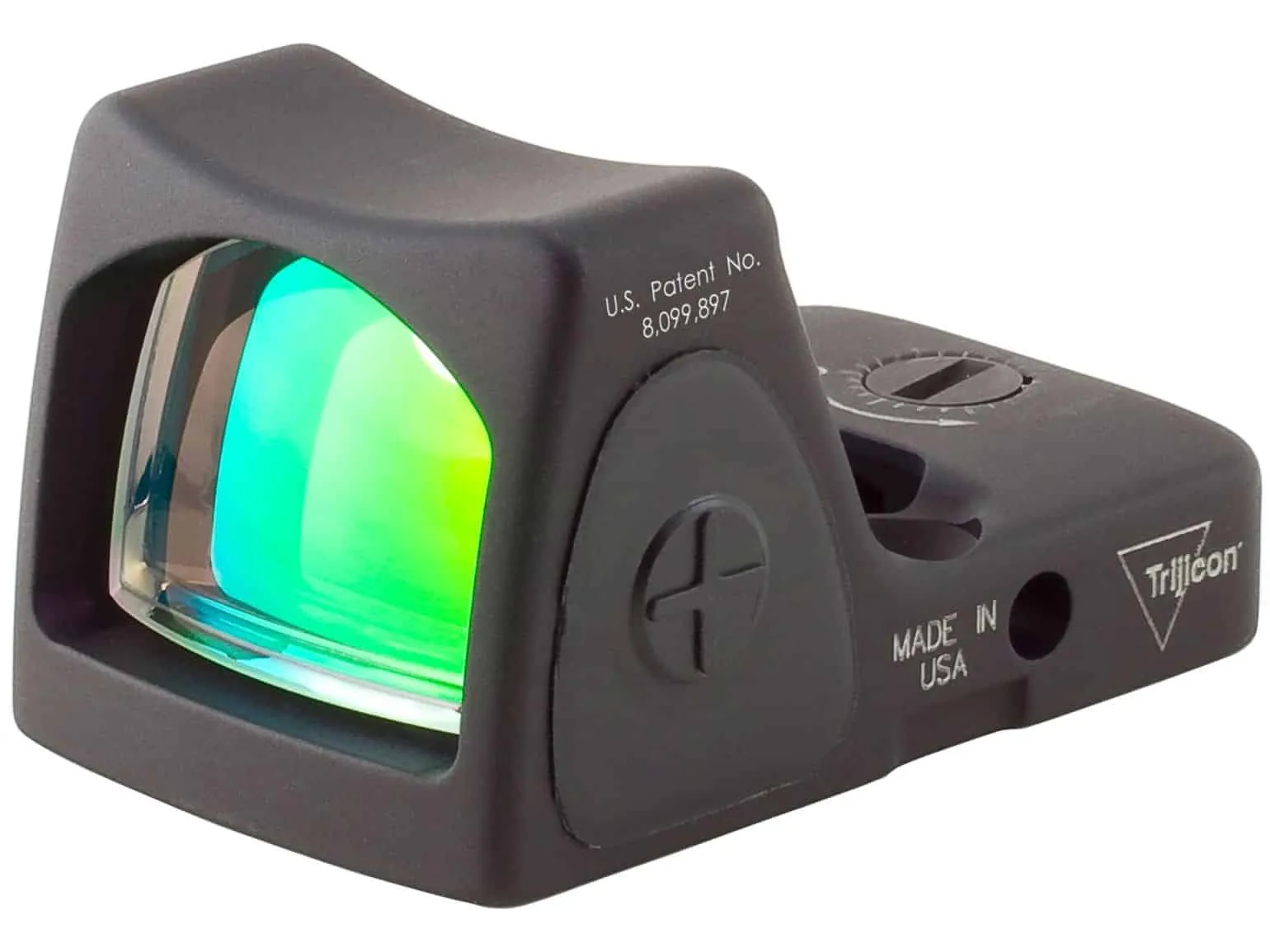
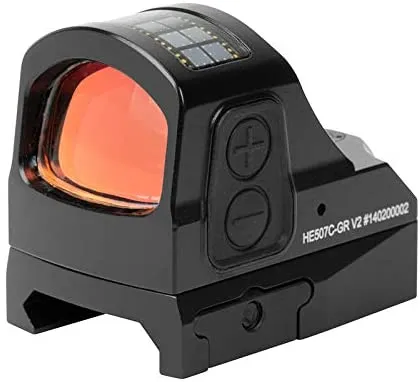
In this review of the Trijicon RMR vs Holosun 507C, we will do a side-by-side comparison of two of the most popular red dot sights on the market for pistols and beyond.
We will cover all the top features for both reflex sights as well as the specifications and frequently asked questions.
Be sure to read the whole review so you can get our recommendation as to which one of these optics is the best for your build and your budget.
The Trijicon RMR is manufactured by Trijicon, a Michigan-based optics company with a long track record of supplying sighting systems to the United States military. The Holosun HE507C-GR X2 comes from Holosun Technologies, a manufacturer that has earned a reputation in recent years for packing high-end features into optics at a far more accessible price point.
These two sights sit at very different price tiers, but they compete directly because they share the same mounting footprint and target many of the same shooters: handgun owners, competition shooters, hunters, and duty/everyday carry (EDC) users. That overlap is exactly why this is one of the most common head-to-head matchups in the red dot world.
If you want the full hands-on breakdown on either optic, we have complete standalone reviews for both. See our Trijicon RMR review and our Holosun 507C review for detailed testing notes, specs, and our affiliate purchase links. The comparison below covers both optics across durability, price, footprint, reticle, battery, and use-case so you can decide which one fits your needs.
Trijicon RMR vs Holosun 507C Review
First, let’s get the basic similarities of these two sights out of the way.
Both are Micro Red Dot Sights (MRDS) machined from 7075 aluminum, making them lightweight yet rugged. Both are built to take the repeated recoil stress of a slide ride pistol, and both have a low-profile, protrusion-free shape engineered for snag-free operation when drawing from a holster.
Both sights feature multi-coated lenses for sharp, clear image quality, and both are night vision compatible with dedicated low-brightness settings. Each is parallax-free with unlimited eye relief, allowing both-eyes-open, rapid target acquisition.
Critically, both sights share the same mounting footprint: the Holosun 507C was designed on the Trijicon RMR cut, so they fit the same milled slides and plates. The design and construction of these reflex sights make them suitable for pistol, shotgun, carbine, and rifle applications in almost any environment.
Okay, now that we got the basic similarities out of the way, let’s get to the differences between the optics.
Durability
This is the category where the Trijicon RMR earned its reputation, so we will start here.
The RMR Type 2 is forged from 7075-T6 aluminum and uses a patented chassis shape designed to reduce stress on the lenses by absorbing impact. Just as important, the Type 2 fixed the battery-contact failures that plagued the original Type 1 under heavy slide-ride recoil, making the current sight extremely reliable. It carries an IPX8 waterproof rating, good for 20 meters of submersion for an hour, and it was selected by the United States Special Operations Command (USSOCOM) for its Handgun Reflex Sight contract, about as serious a durability endorsement as exists.
The Holosun 507C is no slouch. It is CNC-machined from 7075 aluminum into a solid, rigid chassis that holds up well to the recoil of a slide-mounted pistol and to everyday range and hunting abuse. Its water Ingress Protection rating is IP67, which means continuous immersion to 1 meter for half an hour, more than enough for any realistic shooting environment, but a step below the RMR’s IPX8 depth rating.
Both sights are genuinely tough, and the vast majority of shooters will never push either to its limit. But when the question is which optic survives the most extreme, life-on-the-line abuse, the proven track record settles it.
The win here goes to the Trijicon RMR for its forged housing, deeper IPX8 rating, and battle-tested USSOCOM pedigree.
Price
Price is the Holosun’s home turf, and the gap is significant.
The Trijicon RMR Type 2 carries a manufacturer’s suggested retail price (MSRP) of around $549, placing it firmly in the premium tier. The Holosun 507C X2 comes in at roughly $309, squarely in the mid tier and a little over half the RMR’s cost.
That difference is not a small one. For the price of a single RMR, a shooter could nearly buy two 507C optics. The question is not whether the RMR is good (it clearly is) but whether its extra durability and brand pedigree justify the premium for your particular use.
For a recreational shooter, a hunter, or even many EDC users, that money saved can go toward a quality holster, a weapon-mounted light, ammunition, or training. For a professional whose life may depend on the optic, the price is simply not the deciding factor.
This round goes to the Holosun 507C, and it is not close. You get the same footprint and most of the capability for a substantially lower price.
Footprint
Here the two sights are effectively tied, and that is the whole point.
The Holosun 507C was built on the industry-standard Trijicon RMR footprint. As Holosun puts it, the sight will fit the RMR mounting footprint, so it drops onto the same milled slides and mounting plates as the RMR. In many cases you can use the same mounting plate, though you will typically need the correct screws for the Holosun.
The practical upshot is enormous flexibility. If your pistol slide is cut for an RMR (and a huge share of optics-ready pistols are) you can run either of these sights, and you can swap between them down the line without milling or buying a new slide. This is exactly why the RMR vs 507C question comes up so often: shooters are frequently choosing between two optics they could mount on the very same gun.
Both sights have a low, rounded, protrusion-free profile for snag-free carry. The 507C offers a 0.63 x 0.91 inch viewing window with a large-window feel, while the RMR keeps an equally clean low profile.
In the footprint category, we are going to call this a draw. Shared compatibility is a feature both sights benefit from, and it is the foundation of this entire comparison.
Reticle
The reticle is where the two optics take genuinely different philosophies.
The Trijicon RMR RM06 uses a fixed 3.25 Minute of Angle (MOA) red dot. It is a crisp, well-balanced dot size: small enough for solid precision at distance, large enough for fast close-quarters acquisition. The RMR offers eight brightness settings in manual mode and five in automatic mode, where it adjusts to ambient light on its own. (If you prefer a chunkier aiming point, the RMR is also available in a 6.5 MOA variant.)
The Holosun 507C counters with its Multiple Reticle System (M.R.S). You can run a 2 MOA dot for precision, a 32 MOA ring for rapid target acquisition, or both combined, and you can switch between them without re-zeroing, because the sight maintains Point of Aim (POA) / Point of Impact (POI). It also illuminates with Holosun’s Super Green LED, which the company designed to be roughly four times more efficient than a standard red diode. The 507C offers 12 brightness settings: 10 for daylight and 2 night-vision compatible. A green reticle is also a great option for shooters with protanomaly, a reduced sensitivity to red light.
The RMR’s single dot is excellent and arguably faster to pick up for a pure pistol shooter who wants no clutter. But the 507C’s switchable dot, ring, or dot-plus-ring gives you three aiming solutions in one optic, plus the choice of a highly visible green reticle.
This round goes to the Holosun 507C for reticle versatility: three reticle options and a high-efficiency green LED versus the RMR’s single fixed dot.
Battery
Battery handling is a clear, practical win for one side.
The Trijicon RMR is powered by a single CR2032 lithium coin battery that delivers a dependable 1-plus year of continuous runtime. You will know the battery is fading because the dot gradually dims. The catch, and it is the RMR’s most-cited drawback, is that the battery sits under the optic, so you must dismount the sight to change it, which then requires you to confirm or re-establish your zero.
The Holosun 507C runs on a CR1632 lithium coin battery backed by Holosun’s Solar Failsafe array, which can power the reticle from ambient light alone. Combined, that yields an operational battery life of up to 100,000 hours, so you will likely go years between changes. Better still, the 507C uses a side-access battery door, so you can swap the battery without removing the sight or disturbing your zero. The 507C also adds Shake Awake, which sleeps the optic when it sits still and instantly wakes it on movement, conserving power while staying ready.
The RMR’s runtime is perfectly respectable, and many shooters simply change the battery on a schedule and re-confirm zero. But the 507C is more convenient in every measurable way: longer life, solar backup, motion wake, and no dismounting.
This is an easy win for the Holosun 507C. Side-access batteries, up to 100,000 hours, solar backup, and Shake Awake beat a dependable-but-dismount-required design.
Trijicon RMR vs Holosun 507C Specifications
| Specification | Trijicon RMR (RM06) | Holosun 507C (HE507C-GR X2) |
|---|---|---|
| Magnification | 1x | 1x |
| Reticle | 3.25 MOA dot | 2 MOA dot / 32 MOA ring / both |
| Housing Material | Forged 7075-T6 aluminum | CNC-machined 7075 aluminum |
| Weight | 1.2 oz | 1.5 oz |
| Dimensions | 45mm x 28mm x 25mm | 1.8 x 1.2 x 1.6 in |
| Battery | CR2032 | CR1632 + solar |
| Battery Life | 1+ year continuous | Up to 100,000 hrs |
| Battery Access | Bottom (requires removal) | Side door (no removal) |
| Brightness Settings | 8 manual / 5 auto | 10 daylight + 2 NV |
| NV Compatible | Yes | Yes |
| Waterproof Rating | IPX8 (20m/1hr) | IP67 (1m/30min) |
| Footprint | RMR | RMR |
| MSRP | $549 | $309 |
Included with the RMR and 507C
Trijicon RMR:
- Trijicon RMR Type 2 adjustable LED 3.25 MOA reflex sight
- CR2032 lithium coin battery
- Allen wrench
- 2 x mounting screws
- Manual
Note that the RMR does not ship with a mount; you purchase the mounting solution that fits your platform separately.
Holosun 507C:
- Holosun HE507C-GR X2
- Picatinny mount
- CR1632 lithium coin battery
- Mounting screws
- T10L key
- Lens cleaning cloth
- User’s manual
Pros vs Cons
Okay, it’s time to highlight the pros and cons for each of these red dot sights. After we will take a look at the most frequently asked questions and provide our conclusion.
The Pros
The Trijicon RMR shines on raw durability: a forged 7075-T6 housing, an IPX8 waterproof rating, and a USSOCOM-selected track record that makes it the benchmark for hard-use reliability.
The RMR’s fixed 3.25 MOA dot is crisp and uncluttered, giving a fast, clean aiming point that many pure pistol shooters prefer.
The Holosun 507C shines on value, delivering most of the RMR’s capability at a little over half the price.
The 507C’s Multiple Reticle System gives you a 2 MOA dot, a 32 MOA ring, or both, all in one optic, plus a high-efficiency green LED.
The 507C’s battery setup is best in class for this matchup: up to 100,000 hours, a side-access door that does not require dismounting, Solar Failsafe backup, and Shake Awake.
Both sights share the RMR footprint, so either will fit an RMR-cut slide or plate.
The Cons
The Trijicon RMR carries a premium price and requires you to dismount the optic, and re-confirm zero, to change the battery.
The RMR ships without a mount, so factor the cost of the correct mounting solution into your purchase.
The Holosun 507C uses a CNC-machined housing with an IP67 rating rather than the RMR’s forged housing and IPX8 depth rating, so it gives up a measure of extreme hard-use margin to its pricier rival.
Frequently Asked Questions
What are the major differences between the Trijicon RMR vs Holosun 507C?
The major differences are: Durability (the RMR’s forged housing and IPX8 rating edge out the 507C’s machined housing and IP67 rating), Price (the RMR runs about $549 versus roughly $309 for the 507C), Reticle (the RMR has a single fixed 3.25 MOA dot while the 507C offers a switchable 2 MOA dot, 32 MOA ring, or both), and Battery (the 507C adds side access, solar backup, and Shake Awake, while the RMR requires dismounting to change the battery).
Will the Holosun 507C fit a slide milled for the Trijicon RMR?
Yes. The 507C is built on the RMR footprint and will fit slides and plates cut for the RMR. You will generally need the correct screws for the Holosun, but the cut itself is shared.
Which sight has the longer battery life?
The Holosun 507C, by a wide margin on paper: up to 100,000 hours thanks to its CR1632 battery and solar array, versus the RMR’s dependable 1-plus year of continuous runtime. The 507C also lets you change the battery without removing the sight.
Is the Trijicon RMR worth the extra money?
It depends on your use. For a professional or anyone who needs proven, life-on-the-line reliability, the RMR’s durability pedigree justifies the premium. For most recreational shooters, hunters, and many EDC users, the Holosun 507C delivers the bulk of the performance for a substantially lower price.
Are these sights covered by a warranty?
Trijicon backs the RMR with its limited lifetime warranty on the optic. Holosun covers the 507C with a lifetime warranty on the housing and lenses and a ten-year warranty on the LED and electronics from the date of manufacture. Be sure to register the Holosun to validate the warranty.
Conclusion
In the Trijicon RMR vs Holosun 507C head-to-head comparison, there is no single loser; there are two excellent optics aimed at two slightly different buyers.
The Trijicon RMR is the durability and reliability benchmark. If you need an optic for a hard-use duty pistol, a serious EDC setup, or any role where failure is simply not an option, the RMR’s forged housing, IPX8 rating, and USSOCOM-proven track record earn the rank-one spot and justify the premium price.
For most shooters, though, the Holosun 507C is the smarter buy. At a little over half the price, it delivers most of the RMR’s real-world performance while adding a switchable multi-reticle system, an easy side-loading battery good for up to 100,000 hours, Solar Failsafe backup, and Shake Awake. Because it shares the RMR footprint, you can even start with the 507C and step up to an RMR later on the same slide.
Choose the RMR when proven hard-duty reliability is the deciding factor. Choose the 507C when you want the best blend of capability, features, and value, which, for the majority of shooters, makes it the optic we would put on our own pistol.