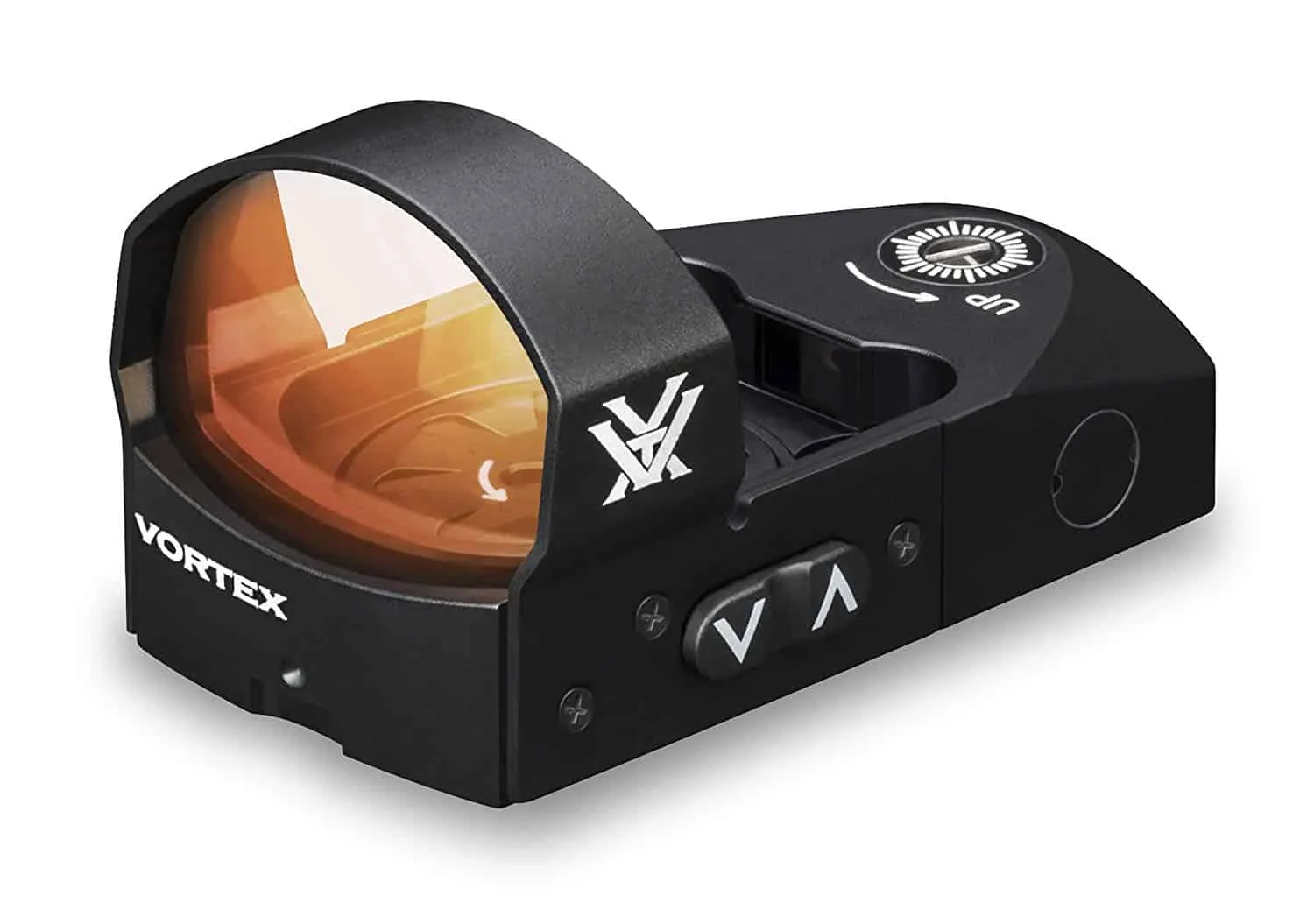
Short answer: the Venom is the better-equipped sight, the Viper is the one Vortex still lists, and neither is a plain current product any more.
Status first. Vortex’s own site marks the Venom “INACTIVE”, so most Venoms you find are used or remaining stock. The Viper is still listed at $369.99 but filed under “Limited Distribution”, a term Vortex does not define, and we found no Vortex statement that the Viper is discontinued. Both optics have full standalone reviews on this site: the Vortex Venom review and the Vortex Viper review.
What differs: the Venom offers a 3 MOA dot as well as 6 MOA, an auto brightness mode, and a CR1632 that changes under a top cap with the sight still on the gun. The Viper comes in 6 MOA only, sits lower at the rear of the body (0.33 in against the Venom’s 0.41 in on Vortex’s drawings), and has to come off its base before you can reach the CR2032. Both list at $369.99 and share the Docter footprint.
Who should buy which: take a used or leftover Venom if the price reflects its inactive status and you want those features. Take the Viper if you want the Vortex dot that is still listed, or you run a cutout slide where its lower rear body helps you co-witness with suppressor-height irons. Vortex’s VIP warranty covers both.
Both sights come from Vortex Optics of Barneveld, Wisconsin. Founded in 2004, Vortex makes scopes, binoculars and red dot sights, as well as related accessories.
Vortex Venom vs Viper at a Glance
| Vortex Venom (VMD-3103 / VMD-3106, inactive) | Vortex Viper (VRD-6) | |
|---|---|---|
| Status on vortexoptics.com | Marked “INACTIVE” | Filed under “Limited Distribution” |
| Vortex list price | $369.99 | $369.99 |
| Dot options | 3 MOA (VMD-3103) or 6 MOA (VMD-3106) | 6 MOA only |
| Window size | Not published by Vortex | Not published by Vortex |
| Height (Vortex drawing) | 1.02 in overall; rear of the body 0.41 in | 1.02 in overall; rear of the body 0.33 in |
| Width (Vortex drawing) | 1.11 in | 1.06 in |
| Weight (Vortex) | 1.05 oz (3 MOA, VMD-3103); 1.1 oz (6 MOA, VMD-3106) | 1.03 oz |
| Battery and access | CR1632 under a top cap; the sight stays mounted | CR2032 between the body and its base; the body comes off to change it |
| Battery life (Vortex) | Up to 150 hours on the highest setting; up to 30,000 hours on lower settings on the 2021 page, “up to 3,000 hours” on the current page | Up to 150 hours on the highest setting; up to 30,000 hours on lower settings |
| Brightness settings, per the manual | Auto and manual; auto mode powers down after 14 hours | Up and down buttons; the manual describes no auto mode |
| Footprint | Docter/Noblex | Docter/Noblex |
| What it fits | Docter-pattern slide cuts and plates, or the included Picatinny/Weaver mount; not an RMR-footprint optic | The same Docter-pattern cuts, plates and included mount; Vortex built it for cutout slides, to co-witness with suppressor-height irons |
Sources: Vortex’s Venom and Viper product pages, their dimension drawings and product manuals (fetched November 4, 2026), the Venom page as archived in October 2021, and Optics Trade for the footprint of the Venom and the Viper. Vortex’s own pages disagree on the Venom’s low-setting runtime: 30,000 hours in 2021 and on the Viper page today, 3,000 hours on the Venom page today.
Vortex Venom vs Viper Review
First, let’s get the basic similarities of these two sights out of the way.
Both sights are machined from aluminum, making them lightweight yet rugged. The exterior of each of these red dot sights is finished with a matte black anodized coating.
Additionally, the lenses are multi-coated with an anti-reflective coating that helps increase light transmission for a quality viewing experience.
The Venom and the Vortex Viper are easy to operate and are engineered to withstand recoil and impact forces. The design and construction of these reflex sights make them suitable for pistol, shotgun, carbine and rifle applications in almost any environment.
Vortex Optics stands behind the Venom and the Viper with their VIP Warranty to repair or replace the optic at no charge.
Okay, now that we got the basic similarities out of the way let’s get to the differences between the optics.
Optic Body Size
With respect to physical size, the Vortex Venom is just a tad bit larger.
Vortex’s drawings put the Venom at 1.9 inches long and 1.11 inches wide against the Viper’s 1.81 and 1.06. Both stand 1.02 inches tall overall, but the rear of the Venom’s body is 0.41 inches tall against the Viper’s 0.33.
That lower rear body is the Viper’s whole point. Vortex built it for handguns with cutout slides, so it can co-witness with suppressor-height iron sights. Vortex publishes no window size for either sight, so we are not putting a number on which one shows more glass.
The Venom weighs 1.05 oz in the 3 MOA model (1.1 oz in the 6 MOA model), while the Viper weighs in at 1.03 oz. Not enough of a difference here in weight that would have any real effect when shooting.
We are going to give the win to the Vortex Viper here for its lower rear body.
Red Dot Reticle
Both optics are illuminated via a red light-emitting diode (LED). The Venom red dot sight is available in a 3 MOA or a 6 MOA reticle model while the Viper is only available in a 6 MOA model.
The 3 MOA reticle option makes the Venom more suitable for shooting platforms where you intend to engage targets out to an intermediate-range. A small reticle dot does enable better precision at further distances.Dot size is a personal preference, but generally speaking, a larger dot is more suitable for close-quarters engagements that are more common with a pistol.
This round goes to the Vortex Venom with two reticle size options versus the Viper's single reticle size option.Operation
The optics have easy to reach side-mounted controls that are intuitive to operate. From these controls, you can turn the optics off/on and adjust the reticle brightness settings.
The Venom has 10 reticle brightness settings that can cover a wide array of light conditions. Vortex does not publish a brightness count for the Viper, which uses one button to step brightness up and one to step it down.
With the Venom, you get the additional functionality of an auto mode. When you place the Venom in auto mode the optic adjusts the reticle brightness based on the current ambient light conditions, and the manual says it powers down after 14 hours in that mode to save the battery. The Viper manual describes no auto mode and no automatic shutoff: you switch it off by holding the down arrow for five seconds.
Okay in Vortex Venom vs Viper operation the Venom takes the win. We know that not everyone likes auto-brightness, but it is there if you want it, and the auto shutoff protects the battery if you forget.Batteries
Vortex rates both sights at up to 150 hours on the highest brightness setting. On lower settings the numbers need a closer look. The Viper page says up to 30,000 hours. The Venom page said the same in 2021, but the current Venom page prints “up to 3,000 hours”, and Vortex has not said which figure is right. The table above names both.
The Vortex Venom utilizes a CR1632 lithium coin battery, while the Viper utilizes a CR2032 lithium coin battery.
The battery compartment for the Venom is a cap on the top of the optic, making access easy and battery changes simple and fast.
The Viper’s battery sits between the body and its base. To change it, the body comes off, which means confirming your zero afterward.
This is going to be an easy win for the Vortex Venom. Not having to remove the sight to replace the battery means no remount, and no zero check after one, at every battery change.
Sight Adjustment
The Venom and the Viper have similar elevation and windage adjustment controls. Each click of adjustment is equal to 1 MOA for both sights.
Vortex’s spec tables give the Viper 120 MOA of maximum adjustment for elevation and windage, and the Venom 130 MOA of maximum elevation and 100 MOA of maximum windage.
The Vortex Viper also incorporates locking screws for the elevation and windage adjustment to ensure the sight stays dialed in and you don’t lose your zero.
Access to the locking screws may be inhibited when employing the Viper on a pistol while maintaining the rear iron sights.
This round is going to the Viper, even if it is only by a slight margin, for the adjustment locking screws.
Mounting
The Vortex Venom and Vortex Viper red dot sights are suitable for almost any firearm application.
Out of the box, the Venom is ready to mount on a Picatinny spec base rail with the included low rail mount.
The Viper comes with a low rail mount that clamps to both a Weaver or Picatinny spec base rail.
When mounting on a pistol the Venom and Viper both use the Docter/Noblex footprint, the same pattern as the Burris FastFire. Neither is an RMR-footprint optic. Be sure to check the manufacturer for the proper mounting plate.
Both the Vortex Venom and the Viper mount well on pistols, with a few points to weigh.
When attempting to achieve co-witness with the Vortex Viper you may block the adjustment locking screw and will be unable to make windage or elevation adjustments. You could overcome this if you have your rear sights mounted forward of the optic.
The one advantage the Viper has when mounting on a pistol is its lower rear body. This makes the Viper better suited for a lower profile when using a dovetail type mounting plate.
Mounting is a draw.
Included with the Venom and Viper
Vortex Venom:
- Vortex Optics Venom Red Dot Sight (VMD-3103)
- Weaver / Picatinny mount
- T-15 Torx wrench
- Rain cover
- Lens cloth
- Mounting screws
- CR 1632 battery
- Screwdriver
Vortex Viper:
- Vortex Optics Viper Red Dot Sight (VRD-6)
- Weaver / Picatinny mount
- T-10 Torx wrench
- Rain cover
- Lens cloth
- CR 2032 battery
- Flathead wrench
Pros vs Cons
Okay, it’s time to highlight the pros and cons for each of these Vortex Optics red dot sights. After we will take a look at the most frequently asked questions and provide our conclusion.
The Pros
The Vortex Venom red dot sight shines when it comes to battery compartment location making battery changes simple and fast.
The Viper has a very low rear body that makes co-witness easy to achieve with suppressor-height iron sights on a cutout slide.
The Venom includes an auto mode reticle brightness feature that makes keeping the reticle level easy for any ambient light condition.
Both the Venom and Viper will mount on pistols cut for the Docter footprint, or on a Docter-pattern plate.
The Cons
The Venom is no longer an active Vortex product, so a new one is getting hard to find.
The Viper’s battery sits under the body, so you remove the body and re-confirm zero after each battery change.
The Vortex Viper only comes in a 6 MOA reticle size model limiting its effective employment at further distances.
Frequently Asked Questions
What are the major differences between the inactive Vortex Venom and the Viper?
The major differences are: Status (Vortex marks the Venom inactive and files the Viper under Limited Distribution), Size (the Venom is slightly larger and its rear body sits higher), Battery Type (the Venom uses a CR1632 while the Viper uses a CR2032), and Battery Compartment (the Venom’s battery is under a top cap while the Viper’s sits between the body and its base).
Is the Vortex Venom discontinued?
Vortex’s product page for the Venom carries an “INACTIVE” label, and it sits in the site’s Limited Distribution section. Vortex still prints a $369.99 list price there, but in practice you are shopping for used or remaining stock.
What mounting footprint does the Vortex Venom use?
The Vortex Venom uses the Docter/Noblex footprint, the same pattern as the Burris FastFire and the Vortex Viper.
Is the Vortex Venom waterproof?
The Venom according to Vortex Optics is waterproof, although they do not provide the specifics to derive the equivalent IPX rating.
Does the Vortex Venom have an auto shut off?
Yes, in auto mode. The Venom manual says the optic powers down after 14 hours in auto mode. The Viper manual describes no automatic shutoff.
Will the Vortex Viper fit on a Glock MOS?
The Vortex Viper will fit and mount on a Glock MOS with the proper plate, screws, and gasket.
Conclusion
In the head to head comparison, the Venom, now inactive, wins on features with a slight edge over the Viper: a 3 MOA option, auto brightness with a 14-hour shutoff, and a battery you can change without pulling the sight.
The catch is availability. Vortex marks the Venom inactive, so buy one only used or as remaining stock, at a price that reflects that. If you want a Vortex dot on the same footprint that Vortex still lists, the Viper is the one, and its lower rear body is a genuine advantage on a cutout slide. If you want a Docter-footprint dot that its maker still sells new, the Burris FastFire 3 is the alternative our Venom review points to.