Ever squint at a target through your red dot and wish you could just reach out a little further? A magnifier is the answer, and the Sig Sauer Juliet4 4x24mm is one of the better-regarded options for doing it without switching optics entirely.
This review walks through the Juliet4’s design, its glass, how the PowerCam mount operates, and how it fits onto a rifle or carbine. We will also cover what actual owners and reviewers say about living with one, then close with an honest read on where it fits in your setup.
Sig Sauer Juliet4 4x24mm Magnifier Review
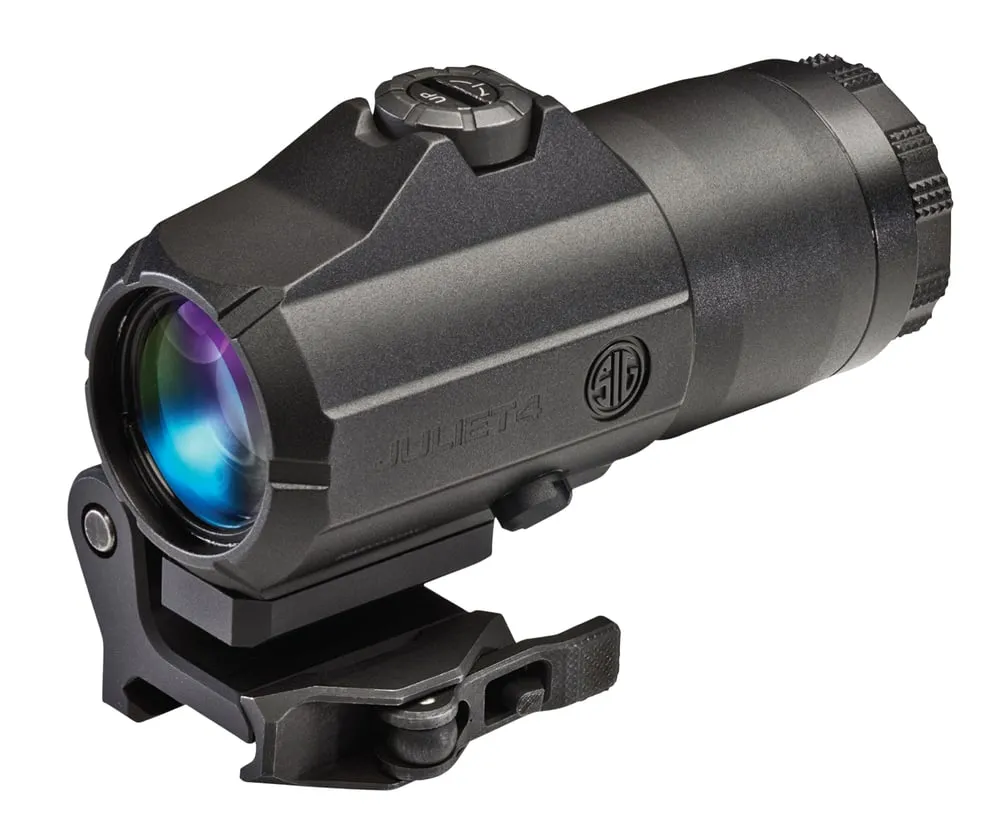
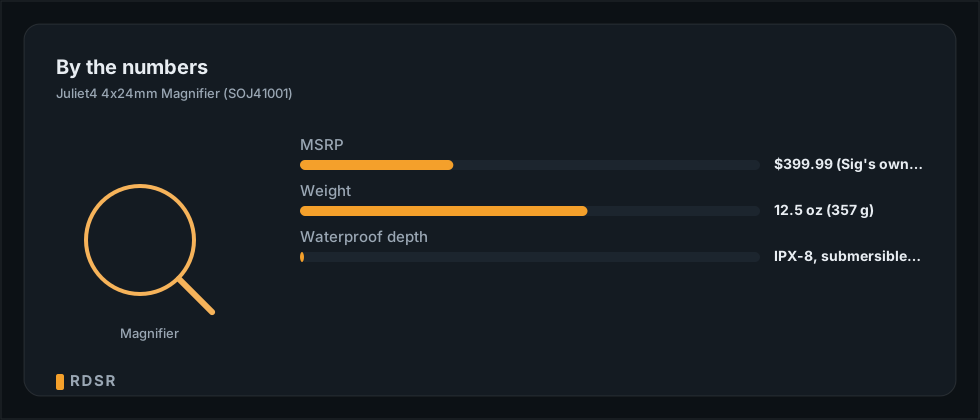
The Sig Sauer Juliet4 (SOJ41001) is a 4x24mm optical magnifier designed to sit behind an existing red dot sight and multiply your view of the target by four. Sig’s manual puts it at 4.23 in long, 1.92 in wide, and 2.80 in tall, with 65mm of eye relief, a 6mm exit pupil, and a 6.25-degree field of view; Sig’s product page lists the weight at 12.5 oz and gives the width as 2.1 in, one of a few places where Sig’s own two documents disagree. It mounts via Sig’s PowerCam 90-degree quick-release system on a standard M1913 Picatinny rail, and the manufacturer lists it with an IPX-8 An optic's Ingress Protection (IP) code from IEC 60529: the first digit rates dust (0 to 6), the second rates water (0 to 8). A digit shown as X was simply not tested.Full comparison → good to 20 meters for one hour. Sig’s own store lists the black SOJ41001 at $399.99 and the FDE SOJ41002 at $419.99; Sig does not publish a separate MSRP figure, and an earlier Sig listing carried a $519.99 list price against a sale price. Street prices have run below Sig’s number, so shop it rather than assuming the store price is the floor.
Sig Sauer built the Juliet4 as a companion piece, not a standalone sight. It has no illuminated reticle, no battery, and no brightness settings of its own; it simply magnifies whatever dot or reticle your primary optic is already projecting. That makes it a purchase you plan around an existing red dot rather than a first optic on its own.
Top Features
Design
The Juliet4 uses an aircraft-grade CNC aluminum housing built to survive riding on a rifle or carbine rail through hard use. Two thread-in lens covers and a flip-back rear cover protect the glass when the magnifier is not deployed. Sig’s manual rates the unit IPX-8, submersible to 20 meters for an hour. No first-hand source we found has tested that claim, so it is a documented manufacturer specification rather than a verified field result.
Optical Quality
Since the Juliet4 has no reticle of its own, its whole job comes down to glass quality, and that is where it earns its reputation. A first-hand owner on the Maryland Shooters Forum called the glass “a big step beyond the budget stuff,” and Ying Xu at BadAssOptic wrote that the unit “feels like a $700 optic” at a street price that was then just under $350. Both sources agreed the image stays clear and bright, with no reports of chromatic aberration, distortion, or dimming found in our research. The SpectraCoat fully multi-coated, dielectric-coated prism is the mechanism behind that clarity, and it is a meaningful upgrade over the coatings found on budget magnifiers in this price range.
Operation
There is no illumination to manage on the Juliet4, so operation centers entirely on the flip mechanism. The PowerCam mount rotates the magnifier 90 degrees to the side in one motion, taking it out of your sight picture instantly for close-range work, then swings back into place behind your red dot when you need the extra reach. A diopter adjustment of plus or minus 2 lets you dial the image to your own eye. The tradeoff for this system is eye relief. At 65mm, the Juliet4 asks for a specific head position: one owner on the Maryland Shooters Forum said its eye relief “really requires a NTCH cheek weld” in his experience, meaning nose to charging handle, and his advice to another member was to move the whole optic setup as far back on the rail as it will go. If your red dot sits well forward and you cannot slide it back, a magnifier with longer eye relief is the easier fit.
Reliability standing
Sig Sauer Juliet4 4x24mm Magnifier (SOJ41001)
Low confidence based on 5 sources, 2 first-hand.
- Warranty
- Covered by Sig's Electro-Optics Infinite Guarantee, printed in the owner's manual (s2, full text fetched 2026-08-27): unlimited lifetime, fully transferable, no receipt required. The printed terms exclude electronic components (moot for this passive, unpowered magnifier) and, per manual revision R01 (s5; the clause is absent from R00), the warranty applies to commercial customers only, not government/military/LE or non-US buyers. No forum warranty-claim report found to corroborate real-world service turnaround.
Aggregated from others' first-hand testing, not our own: this standing deliberately reaches past any one shooter's round count. We surface a sourced reputation tier rather than inventing a score the evidence cannot support.
Full reliability data →Mounting
The Juliet4 rides a standard M1913 Picatinny rail through its PowerCam quick-release mount, which includes recoil lugs for a repeatable return to zero after removal. Owners describe the cam-lock as solid and precise, both in how firmly it clamps down and in how consistently it returns to the same point of aim after being flipped or detached. Because it clamps to a generic Picatinny rail rather than a proprietary base, the Juliet4 sits behind essentially any rifle or carbine red dot, not just Sig’s own optics. The mount itself is another matter: BadAssOptic reports the Juliet4 does not drop into aftermarket magnifier mounts, specifically that it will not work with the Unity Tactical FTC G33 mount, so the PowerCam mount it ships with is the mount you are running.
Details
Included with your purchase:
- Sig Sauer Juliet4 4x24mm magnifier
- PowerCam quick-release mount with height-adjustment spacers (1.41 in, 1.53 in, 1.63 in) and mounting hardware
- Two thread-in lens covers and a flip-back rear lens cover
- 2.5mm hex adjustment tool
Warranty
Sig Sauer backs the Juliet4 with its Infinite Guarantee, and prints the terms verbatim in the Juliet4’s own operator’s manual: unlimited lifetime coverage, fully transferable, no warranty card, no receipt, no charge, with intentional damage, misuse, cosmetic damage, loss, theft, and unauthorized repair excluded. Sig’s separate 5-year electronic-component warranty is moot here, since the Juliet4 has no electronics to cover, which means the whole product sits under the lifetime term. What we could not find is a first-hand report of a completed claim on this specific magnifier, so the terms are documented and the claims experience is unknown.
Warranty standing
Sig Sauer warranty
Lifetime housing, 5-yr electronics, transferable
- Housing
- Lifetime
- Electronics
- 5 yrs
- Transferable
- Yes
- Receipt required
- No
- Registration
- No
- Support
- active
Warranty applies to COMMERCIAL customers only and does NOT apply to government, military, law enforcement, or non-US customers (verbatim from the official operator's manual). Non-US commercial customers must purchase through an authorized SIG SAUER dealer within their country of residence for the warranty to apply.
Customer Feedback
Documented feedback on the Juliet4 is limited compared to a mainstream red dot sight, since it is a niche accessory rather than a primary optic, but what exists is consistently positive. Owners on the Maryland Shooters Forum report running the Juliet4 on carbine classes, home-defense rifles, and dedicated SHTF builds with no complaints about the mount or the glass. BadAssOptic ran the Juliet4 behind an EOTech EXPS3 and compared its profile against a Holosun HM3X, reaching a similar conclusion on the glass: the optical quality outperforms its price point. Its caveats were about the package rather than the image, namely that 4x feels close to 3x in a noticeably longer body, that the housing eats some peripheral view, and that the mount is not swappable.
Glass quality: Both first-hand sources praised the clarity and brightness of the image, with the BadAssOptic reviewer going as far as comparing it to significantly pricier magnifiers.
Mount: Owners describe the PowerCam cam-lock as solid and repeatable, with no reports of the mount loosening or losing zero.
Minor QC note: One forum owner reported the clear plastic insert in the rear lens cover fell out of its own accord, a cosmetic small-parts issue rather than a structural or optical defect. The fix owners suggested was simply gluing the piece back in.
Eye relief: The recurring caution across both sources is that 65mm of eye relief wants a specific, repeatable head position, and that a red dot mounted well forward on the rail makes it harder to get.
Pros & Cons
Pros
- Glass quality that one first-hand reviewer said felt like a much pricier optic when they tested it
- PowerCam 90-degree mount flips out of the way in one motion for close-quarters work
- Owners describe the cam-lock quick-release mount as rock solid and repeatable
- SpectraCoat multi-coated, dielectric-coated prism keeps the sight picture bright and clear
- Backed by Sig Sauer's transferable, no-receipt Infinite Guarantee warranty
- M1913 Picatinny interface sits behind essentially any rifle or carbine red dot, rather than being tied to Sig optics
Cons
- Short 65mm eye relief demands a tight, consistent cheek weld to use effectively
- One forum owner reported the clear insert in the flip-back rear lens cover can work loose
- No reticle or illumination of its own; it only magnifies whatever dot you already have
- The PowerCam mount is not swappable: BadAssOptic reports it does not work with the Unity Tactical FTC G33 mount
- 4x in a body longer than most 3x magnifiers, and the housing eats some peripheral view
- Manufacturer's IPX-8 waterproof claim has not been independently confirmed by any first-hand tester we found
Conclusion
The Sig Sauer Juliet4 does one job, extending the reach of a red dot sight, and does it well according to every first-hand account we could find. The glass outperforms its price class, the PowerCam mount is fast and reportedly rock solid, and the housing is built to hold up on a hard-use rifle or carbine. The real-world track record is thin simply because it is a specialty accessory rather than a mainstream optic, but nothing in that track record points to a reliability concern beyond one minor cosmetic report. The short eye relief is a genuine consideration, not a flaw, and it is worth checking against how your red dot is mounted before you buy.
Alternative Sight Options
Every other magnifier on this site is a 3x, which is the first thing to settle before you compare mounts and glass. The Juliet4’s extra power buys identification range and costs you body length and a fussier head position.
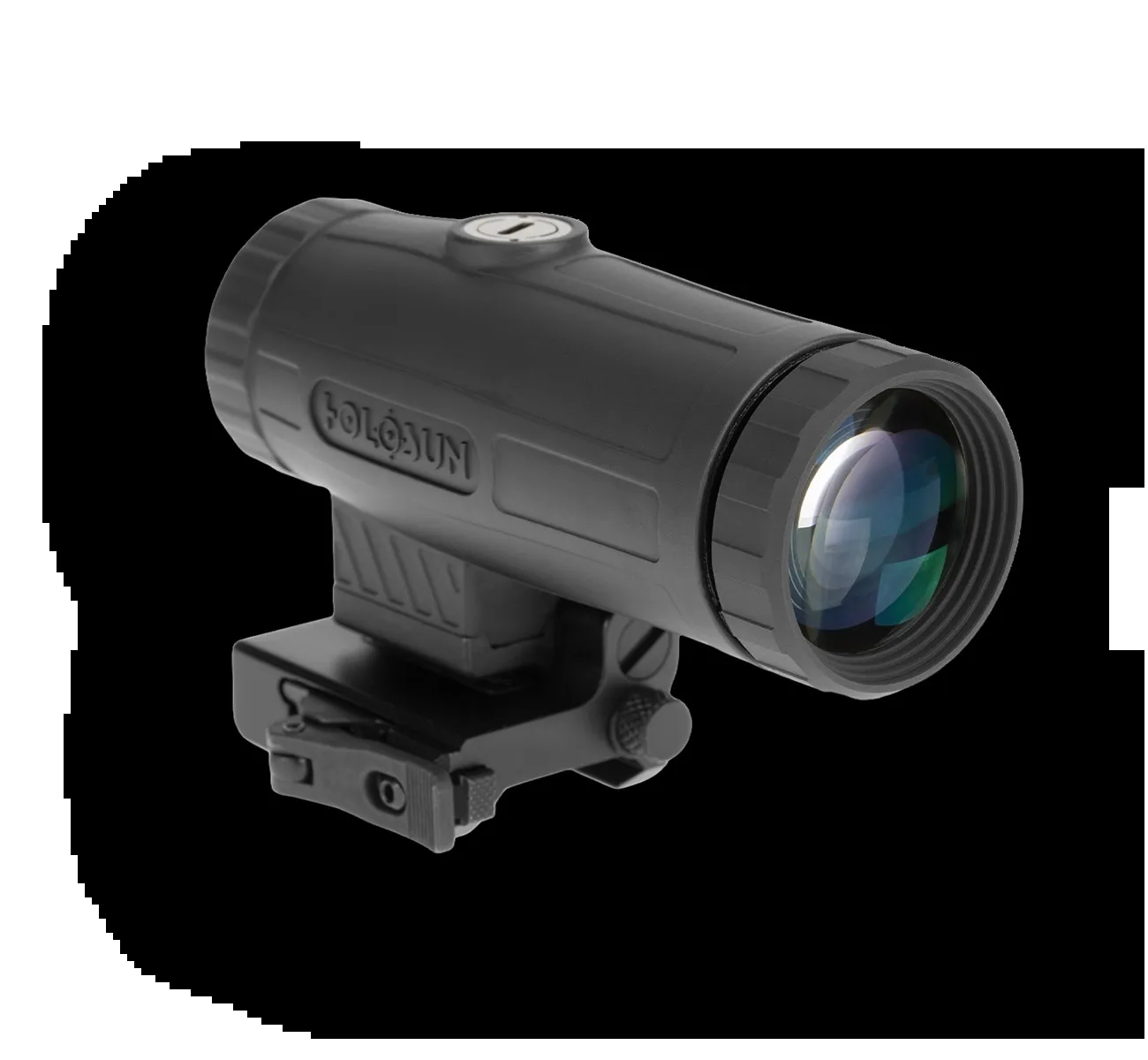
The Holosun HM3X is the value pick of the group and the lightest of the three, with the same flip-to-side idea in a shorter package. If the Juliet4’s length behind your dot is the problem, start there.
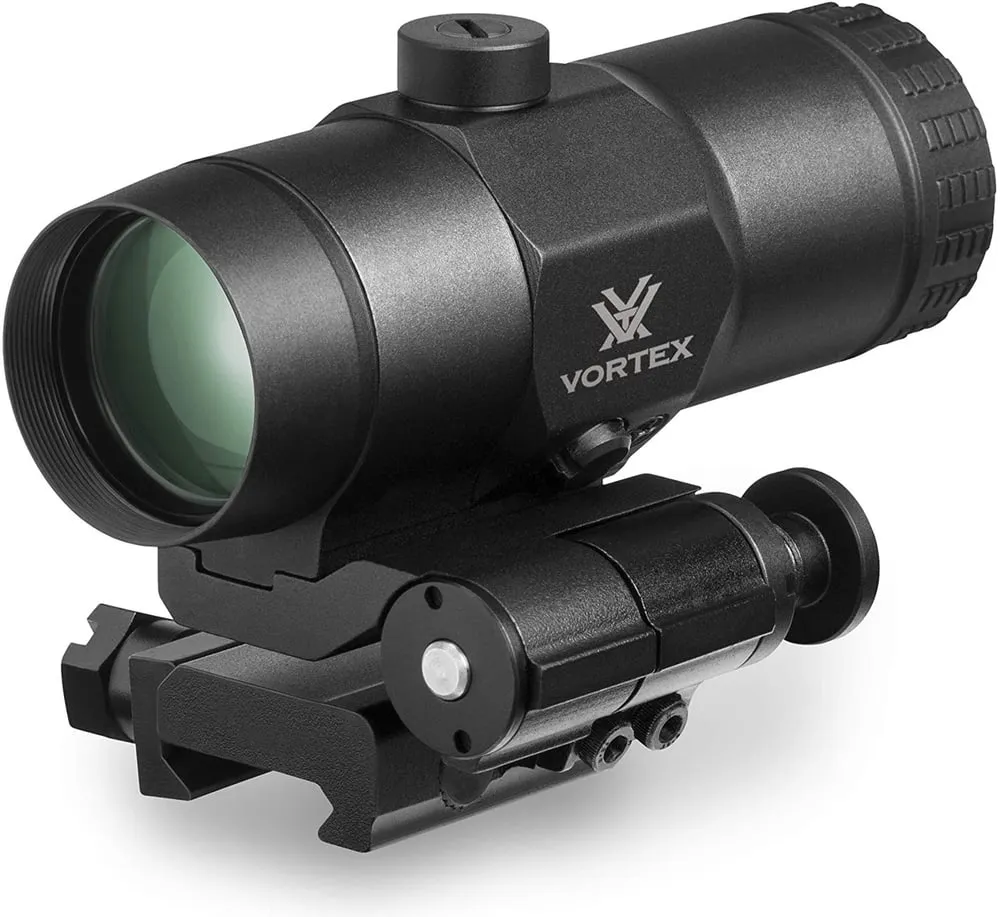
The Vortex VMX-3T sits in the same mid-tier price band as the Juliet4 and comes with Vortex’s warranty, which is the most generous in this comparison. It is the straightest 3x substitute if you want the flip mount and the lifetime coverage without paying for 4x.
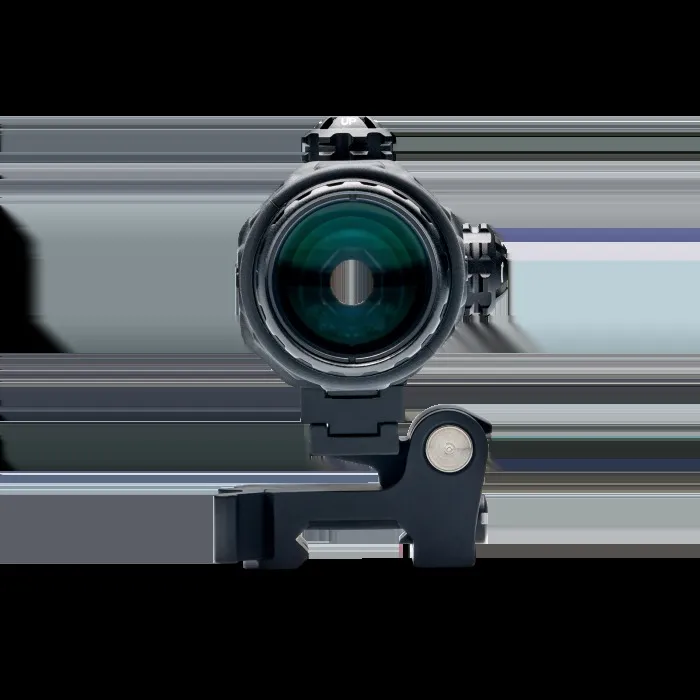
The EOTech G33 is the premium option and the obvious choice behind an EXPS or 500-series holographic sight, since its Switch-to-Side mount and glass are built around those optics.
One thing none of these replaces: the Juliet4 is an accessory, not a sight. Whatever you pick, it rides behind a red dot you already trust, so budget for the primary optic first.