Finding the best budget red dot sight under $200 used to mean accepting compromise: a dim dot, a battery that died in a weekend, and a housing that lost zero the first time you bumped it on a door frame. That is no longer the case.
Over the last several years, the major optics manufacturers have pushed serious technology down into the entry-level price bracket. You can now buy a red dot sight (RDS) for the cost of a couple range trips that offers a crisp reticle, 50,000 hours of battery life, motion-sensing wake-up, night-vision-compatible settings, and a transferable lifetime warranty. The trick is knowing which optics actually deliver and which ones are just cheap.
In this guide, I will walk you through my favorite budget red dot sights, ranked and broken down by who they are best for. Three of the seven list under $200. Four list above it: the Holosun HS403B, $205.87 at its last Holosun listing and now discontinued, here for its battery life; the Vortex Crossfire at $219.99, here for its 50,000-hour battery and lifetime warranty; the Vortex Strikefire II at $274.99, here for its 30mm tube and red/green dot; and the Burris FastFire 3 at $288, here because none of the others is built for a pistol slide. I have grouped them by strengths so you can match an optic to your platform and your wallet, whether you are setting up your first AR-15, topping a shotgun for home defense, or putting glass on a plinker.
Each pick links out to a full review if you want to dig deeper. So let’s get to it.
The best budget red dot sights
- Best overall: Sig Sauer Romeo5 (now replaced by the Romeo5 Gen II)
- Best battery life: Sig Sauer Romeo7
- Former battery-life pick: Holosun HS403B (discontinued by Holosun, leftover or used units only)
- Best for AR-15s (lists at $219.99, above the $200 line): Vortex Crossfire Red Dot Gen 2
- Best tube sight (lists at $274.99, above the $200 line): Vortex Strikefire II
- Best ultra-budget pick: Bushnell TRS-25
- Pistol pick (lists at $288, above the $200 line): Burris FastFire 3
Details, specs, and verdicts below.
Why a budget red dot is worth it
A red dot sight does one simple, powerful thing: it puts your aiming point on the same focal plane as your target. Instead of the visual gymnastics of aligning a rear sight, a front sight, and a target at different distances, you keep both eyes open, focus on the threat, and place the dot. The result for most shooters is faster target acquisition and better accuracy, especially under stress and in low light. That benefit used to be locked behind far pricier optics; today this list brings most of it to you for a fraction of that.
The honest trade-off is this: a budget red dot will not survive the same abuse as a duty-grade optic, and the warranties on the electronics are often shorter than the warranties on the housing. But for range work, plinking, hunting, 3-gun, and home defense, a well-chosen budget RDS is more than enough optic, and you will not feel bad about scuffing it.
What to expect under $200
In this price range you should still demand a few non-negotiables: a clear lens, a crisp dot, waterproof and shockproof construction, and a battery life measured in thousands of hours, not hundreds. Every optic below clears that bar. Where they differ is in battery technology, mounting, reticle options, and what platform they suit best.
Best overall budget red dot sight
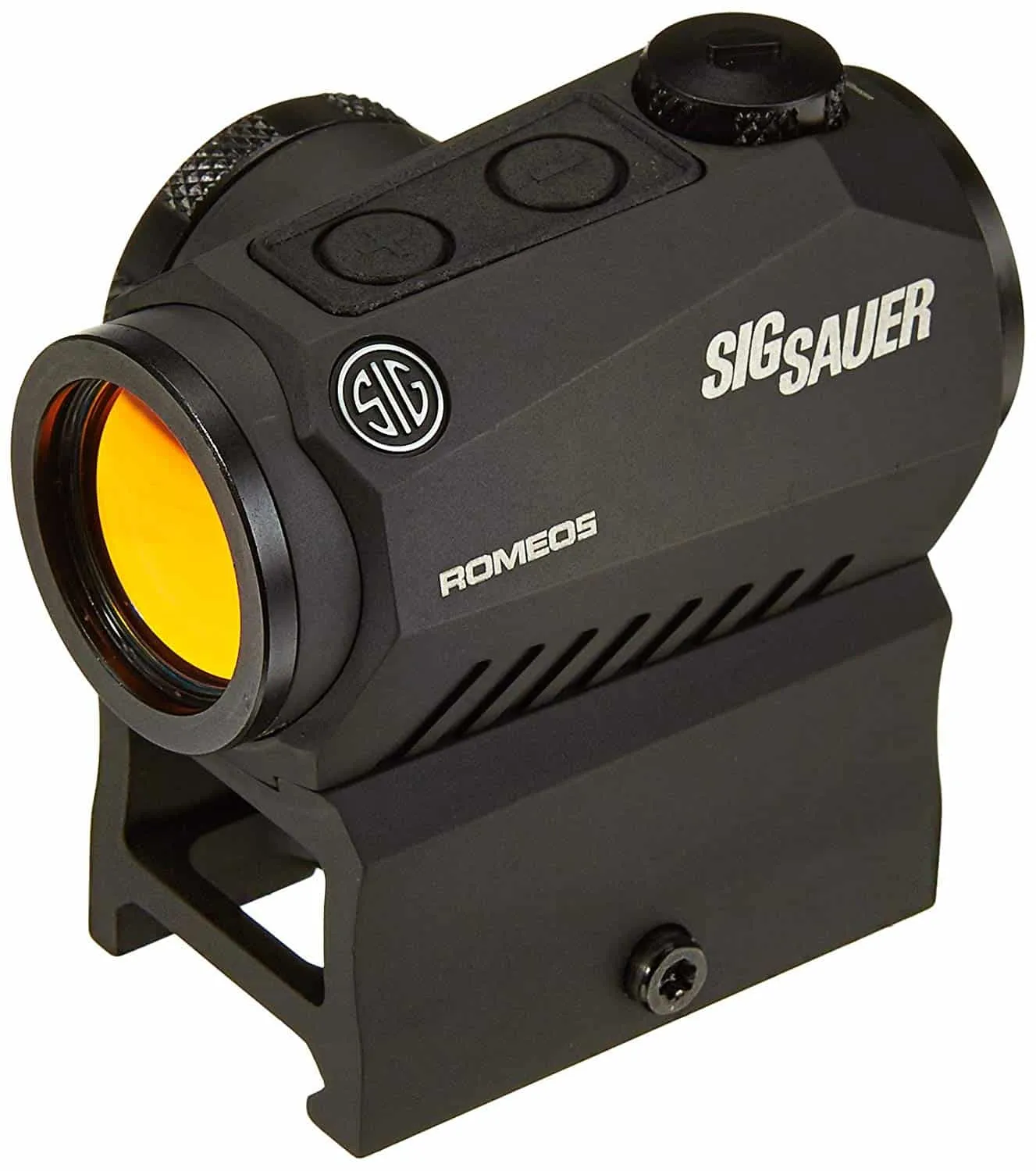
Sig Sauer Romeo5
The Sig Romeo5 is the optic I hand to anyone who asks for a no-regrets first red dot. Sig has since replaced it with the Romeo5 Gen II (from $149.99 in Sig’s June 2026 store capture, when the original showed out of stock at $139.99), so the original is now a leftover or used buy, and if you buy one used, check it against Sig’s SOR52001 recall (knurled battery cap, serial ending in K or M). At $139.99 it punched well above its price, and it was the easiest recommendation on this entire list. The compact 2 MOA reflex sight rides on rifles, carbines, and even some handgun setups, and it ships with everything you need to mount it at the right height.
What sets the Romeo5 apart is MOTAC, Sig’s motion-activated illumination. The optic wakes the instant it senses movement and powers down when it sits still, stretching a single CR2032 battery to 40,000-plus hours. Add half-MOA windage and elevation adjustments, a clear Spectracoat lens, an IPX7 waterproof rating, and Sig’s transferable Infinite Guarantee, and you have a remarkable amount of optic for the money.
- Compact 2 MOA reflex sight that suits rifles, carbines, and handguns
- MOTAC motion-activated illumination with 40,000+ hours of battery life
- Two mounts included: a low mount and a 1.41-inch co-witness riser
- IPX7 waterproof construction and Sig’s transferable Infinite Guarantee
Best budget red dot for battery life
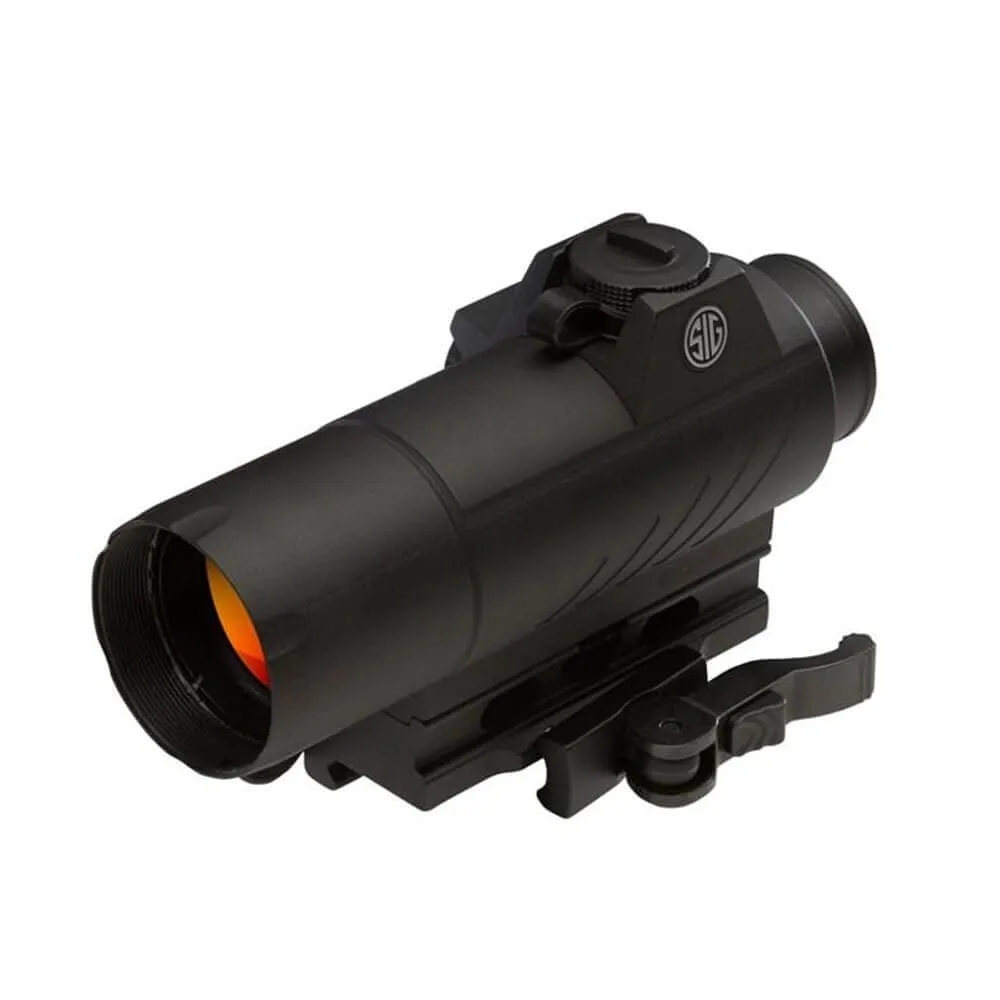
Sig Sauer Romeo7
If the battery is the thing you never want to think about, the Sig Romeo7 carries the longest maker rating of any current tube dot we review under $200: Sig rates its single AA cell at 62,500 hours on the medium setting, and it lists at $199.99, just inside the line. MOTAC motion-activated illumination powers the dot up when the rifle moves and down when it sits still, and when the cell finally does run out, an AA is the easiest battery on this list to find.
This is a full-size 1x30mm tube, not a micro dot: 12.5 ounces, a 2 MOA dot with 11 brightness settings (two night-vision compatible), and an IPX-7 waterproof rating. It ships with a quick-detach riser and a low-rise fixed mount, set up for a lower 1/3 co-witness with AR iron sights. The catches are the weight on a light carbine and a factory QD mount that some owners report arriving loose, so check and re-torque the mount screws before you trust a zero to it. Sig backs it with its Infinite Guarantee lifetime warranty plus a separate 5-year electronics warranty.
If the Romeo7’s 12.5 ounces is too much, the Primary Arms SLx MD-25 Gen II is the lighter runner-up at $159.99: a 6.5 oz 25mm tube rated at 50,000-plus hours on a CR2032, with AutoLive motion wake.
- 62,500-hour rated battery life (medium setting) on a single AA
- MOTAC motion-activated illumination
- Quick-detach riser and low-rise fixed mount in the box
- Infinite Guarantee lifetime warranty plus a 5-year electronics warranty
Former battery-life pick, now discontinued
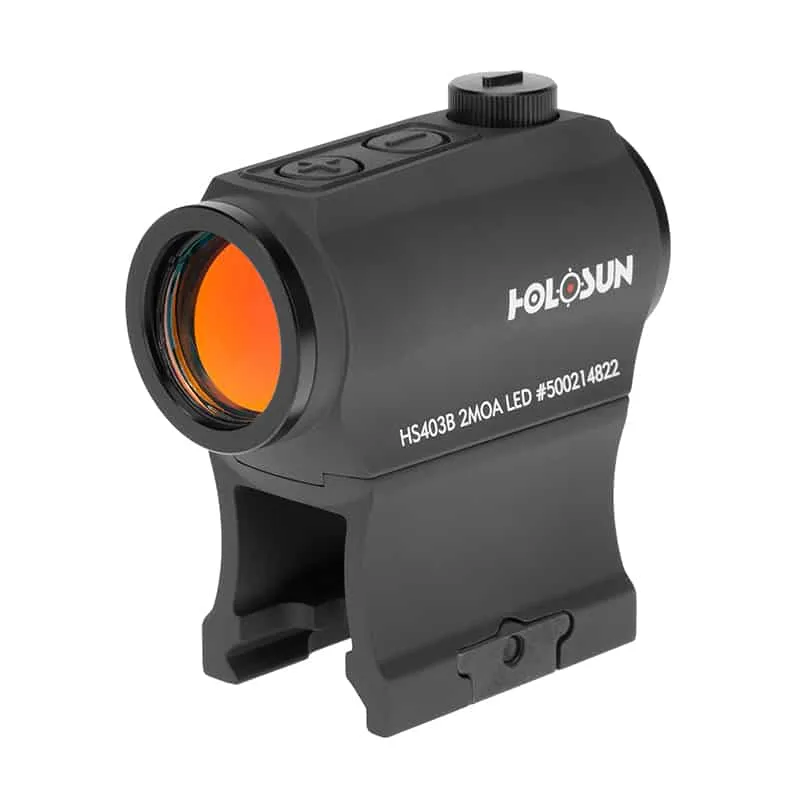
Holosun HS403B
Until Holosun discontinued it, the Holosun HS403B held this guide’s battery-life slot. This tube-style micro red dot pairs a single CR2032 with a 50,000-hour battery life and Holosun’s Shake Awake motion-sensing technology, so it is always ready when you shoulder the rifle and asleep when it is not.
Holosun has since discontinued it: the 403 series sits on Holosun’s Discontinued Model page and the HS403B no longer has a product page, so what you find now is leftover or used. Its last Holosun list price was $205.87, a few dollars over the $200 line, and it delivers Holosun’s signature toughness: a T6 aluminum housing with a hard Micro Arc Oxidation (MAO) finish and an IP67 waterproof and dust rating. It includes both a low mount and a lower 1/3 co-witness mount, and the side-loading battery tray means you swap cells without pulling the optic or losing your zero. The only things you give up at this price are Holosun’s solar failsafe and the multi-reticle system found on pricier models.
- 50,000-hour battery life on a single CR2032 with Shake Awake wake-up
- Tough T6 aluminum housing with IP67 waterproof and dust resistance
- Two mounts in the box: low profile and lower 1/3 co-witness
- Side-mounted battery tray for swaps without removing the sight
Best for AR-15s, above the $200 line
Vortex Crossfire Red Dot Gen 2
The Vortex Crossfire Red Dot Gen 2 has been an AR enthusiast favorite for years, and the Gen 2 update pushed battery life all the way to 50,000 hours at mid brightness. Vortex lists it at $219.99 today, which puts it above the $200 line this guide is built around; it stays here for the 50,000-hour battery, the two included mounts and the VIP warranty rather than for its price.
It is a 2 MOA reflex sight with a clear multi-coated lens and 11 brightness settings, including two that are night-vision compatible. Like the others here it includes two mounting options (a low mount and a lower 1/3 co-witness mount), so it drops onto an AR at the right height out of the box. The aluminum chassis is nitrogen purged and O-ring sealed against water and fog, and it is all backed by the Vortex VIP unlimited lifetime warranty, which is fully transferable. That warranty alone makes the Crossfire an easy choice for a working-class rifle.
- 50,000-hour battery life at mid brightness on a single CR2032
- 2 MOA dot with 11 brightness settings, two night-vision compatible
- Low mount and lower 1/3 co-witness mount included for AR platforms
- Vortex VIP unlimited, fully transferable lifetime warranty
Best tube-style red dot, above the $200 line
Vortex Strikefire II
If you prefer a traditional 30mm tube sight with a big, generous field of view (FOV), the Vortex Strikefire II is the tube to beat. Vortex still lists the red/green SF-RG-501 reviewed here at $274.99, above the $200 line this guide is built around; the StrikeFire II that Vortex files under Inactive products is a different red/green SKU, the SF-RG-505. For that price it brings a feature you will not find on most of the others here: a dual-color reticle that switches between a red and a green 4 MOA dot, letting you pick whichever stands out best against your background.
The Strikefire II is built from a single billet of aluminum and is argon purged and O-ring sealed for waterproof, fog-proof performance. The larger 4 MOA dot is fast to find for close-quarters and home-defense work, and the included cantilever mount sets it up for a lower 1/3 co-witness on AR-pattern rifles. It is heavier than the compact sights on this list at 7.2 ounces and runs a less common CR2 battery, but in return you get that wide tube view and, again, the Vortex VIP lifetime warranty.
- Dual-color reticle: switch between a red or green 4 MOA dot
- 30mm tube delivers a large, immersive field of view
- Cantilever mount included for lower 1/3 co-witness on AR platforms
- Argon-purged, O-ring-sealed billet aluminum body with VIP lifetime warranty
Best ultra-budget red dot
Bushnell TRS-25
When the budget is truly tight, the Bushnell TRS-25 proves you do not need to spend much to get a real, usable red dot. At $79.95 list it is the least expensive optic on this list, and it has earned a loyal following on .22 plinkers, shotguns, and entry-level ARs alike.
For the money it offers a genuinely solid feature set: a 3 MOA dot, 11 brightness settings, multi-coated lenses, and a metal housing that is shockproof, nitrogen purged, and fog proof, with an IPX5 water rating from Bushnell. It mounts to any Picatinny or Weaver rail, so it moves easily between guns. It is not built for professional or duty use, and I would swap the stock battery for a quality branded CR2032, but as a first optic or a budget addition to a fun gun, the TRS-25 is hard to argue with.
- The least expensive pick here at $79.95 list
- 3 MOA dot with 11 brightness settings and multi-coated lenses
- Shockproof, nitrogen-purged, fog-proof metal housing with IPX7 rating
- Mounts on rifles, shotguns, and muzzleloaders via Picatinny or Weaver rail
Pistol pick, above the $200 line
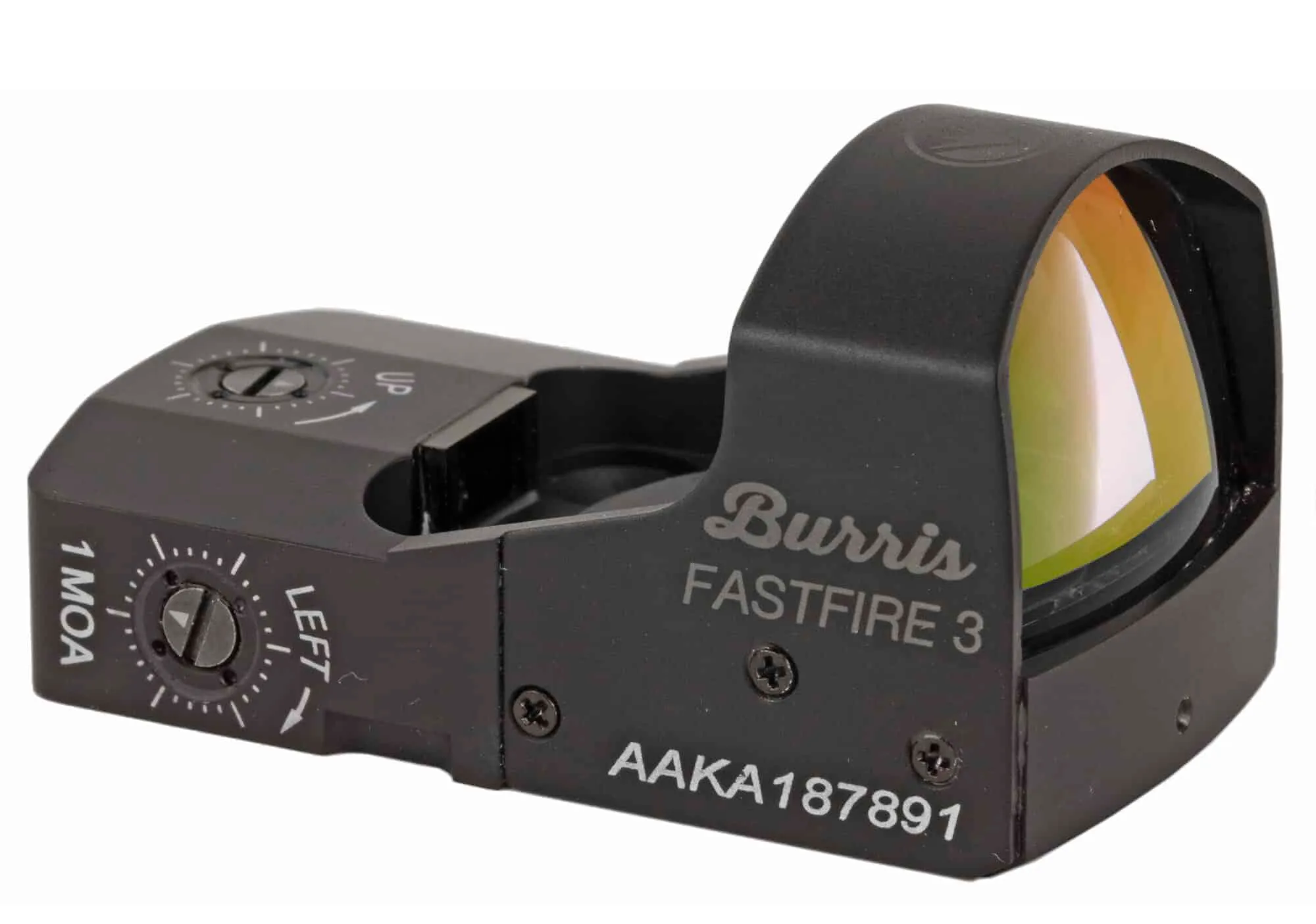
Burris FastFire 3
Every optic above is built for long guns, so if you are putting a dot on a pistol slide, the Burris FastFire 3 is the pick. It is a true micro red dot sight (MRDS) weighing just 1.5 ounces, small and light enough to ride a handgun without throwing off the balance. It lists at $288, more than anything else here; it is here because nothing cheaper on this list fits a pistol slide, and it is a long-proven design with a loyal following.
The FastFire 3 comes in 3 MOA or 8 MOA dot versions, runs an automatic brightness mode that reads ambient light, and uses a top-loading battery tray so you never have to dismount the sight to change the cell. It is shockproof to 1,000 Gs and carries Burris’s no-questions-asked, transferable lifetime warranty. The honest caveats: there is no Shake Awake, so you turn it on manually or rely on the auto mode, and it sleeps after eight hours. For a pistol or a small-gun build, though, it is a featherweight, dependable choice.
- True micro red dot at just 1.5 ounces, ideal for pistol slides
- 3 MOA or 8 MOA dot options with an automatic brightness mode
- Top-loading battery tray: no need to dismount to swap the cell
- Shockproof to 1,000 Gs with a transferable, no-questions-asked lifetime warranty
A budget buyer’s guide: how to choose
Picking the best budget red dot for you comes down to matching a handful of features to your platform and how you shoot. Here is what I weigh when spending under $200.
Battery life and motion sensing
This is where budget optics have improved the most. The difference between a sight rated for a few thousand hours and one rated for 50,000 is the difference between babysitting the power switch and forgetting it exists. If you want a “set it and leave it on” optic, prioritize the long-battery picks: the Sig Romeo7 leads at a rated 62,500 hours on one AA (medium setting), the Holosun HS403B (now discontinued) and Vortex Crossfire both hit 50,000 hours, and the Sig Romeo5 (now replaced by the Romeo5 Gen II, which we have not reviewed) reaches 40,000-plus.
Motion-sensing tech takes it further. Sig’s MOTAC and Holosun’s Shake Awake wake the optic the instant you pick up the gun and power it down when it sits idle. For a home-defense or duty-style setup where you need an always-ready dot, that feature is worth paying up for within the budget tier.
Reticle size and color
Dot size is measured in Minute of Angle (MOA), where one MOA is roughly one inch at 100 yards. A smaller 2 MOA dot (the Romeo7, the Crossfire, the Romeo5 now replaced by its Gen II, and the discontinued HS403B) is more precise at distance and is the most versatile all-around choice for a rifle or carbine. A larger 3 to 8 MOA dot (TRS-25, Strikefire II, FastFire 3) is faster for the eye to pick up, which favors close-quarters and home-defense work.
Color matters too. Most of the optics here are red, but the Vortex Strikefire II offers a switchable red or green reticle. Green can be easier to see in bright daylight, and for some color-blind shooters one color is visible when the other is not.
Durability and waterproofing
Even on a budget, demand a metal housing sealed against water and dust. Look for an Ingress Protection (IP) rating (IP67 or IPX7 means the optic survives submersion to one meter for 30 minutes) and nitrogen or argon purging to stop internal fogging. Every sight here meets that bar. Just remember that “budget durable” is not “duty durable”: these take range and field abuse, but a hard-use duty optic is a different category.
Mounting and co-witness
Check what mount comes in the box and whether it fits your gun. The reflex sights here (the Romeo5, HS403B, and Crossfire) include both a low mount and a co-witness riser, and the Romeo7 ships with a low-rise fixed mount and a quick-detach riser, which is ideal for an AR where you want the dot to line up with backup iron sights. The Strikefire II includes a cantilever mount for the same purpose. The TRS-25 mounts low on any Picatinny or Weaver rail. For a pistol, the FastFire 3 uses its own footprint, so confirm your slide is cut for it or that an adapter plate exists.
Warranty
A strong warranty is one of the best reasons to buy from an established brand even at the budget end. The Vortex VIP warranty is unlimited, lifetime, and transferable on both the housing and the electronics, no matter what happened or who owns it. Sig’s Infinite Guarantee is also lifetime and transferable, but it covers the housing and optical components only; Sig’s electronic components (the LED and circuitry) carry a separate 5-year warranty from the date of manufacture. Burris offers a similar no-questions-asked lifetime warranty. Holosun and Bushnell warranties are solid but read the fine print, since coverage on the electronics is sometimes shorter than coverage on the housing. See our warranty comparison tool for the full breakdown by brand.
Final thoughts
You do not need to spend a fortune to get a reliable, accurate red dot sight. Three of the seven optics in this guide list under $200, and the four that list above it (the HS403B, now discontinued, the Crossfire, the Strikefire II and the FastFire 3) earn their places on battery life, AR-ready mounts and warranty, a big tube with a red/green dot, and pistol fit. Every one comes from a brand that stands behind its product and will make you a faster, more confident shooter. Check the live price on each pick’s review page, since MSRP and street price can diverge.
Recommendations
If you want the single best all-around value, the Sig Romeo5 is the optic I recommend most often; Sig has replaced it with the Romeo5 Gen II, which we have not reviewed, so buy the original leftover or used, or look at the Gen II as its successor. If a battery you never think about is the priority, the Sig Romeo7 and its 62,500-hour AA rating are the way to go at $199.99 list; the Holosun HS403B that held the slot before is discontinued, so it is a leftover or used buy. AR-15 owners who want a bulletproof warranty should look hard at the Vortex Crossfire Red Dot, while the Vortex Strikefire II, at $274.99 list, is the pick for a traditional tube with a switchable red/green dot.
On the tightest budget, the Bushnell TRS-25 at $79.95 is a remarkable amount of optic for the price, and if you are dotting a pistol the featherweight Burris FastFire 3 is the pick, at $288 list. Whichever you pick, mount it, zero it, and put in the reps. The optic only pays off once the dot is part of your muscle memory.