Choosing the best holographic sight comes down to a surprisingly short list, and a fair bit of marketing confusion to cut through first. So let’s do both.
Holographic sights occupy a special place in the optics world. They deliver the fastest both-eyes-open target acquisition you can get, they keep a true 1 Minute of Angle (MOA) dot crisp even behind a magnifier, and they shine with night vision. But true holographic weapon sights are rare: only two companies make them for the consumer market, and a lot of optics sold as “holographic” are nothing of the sort.
In this guide we will explain exactly what a holographic sight is and how it differs from the LED red dot sights that dominate the market, clear up the single most common question we get (“is the Aimpoint holographic?”), and then compare the two true holographic sights worth your money: the EOTech EXPS3 and the Vortex AMG UH-1 Gen II. Let’s get to it.
The Best Holographic Sights
- Best overall: EOTech EXPS3
- Best for battery life and warranty: Vortex AMG UH-1 Gen II
- The cheaper way in: EOTech 512.A65
Details and specifications below.
What Is a Holographic Sight, Really?
A holographic sight does not work like the red dot sight on most people’s rifles. Understanding the difference is the whole point of this guide, so let’s be precise.
A typical “red dot” is an LED reflex sight. A light-emitting diode (LED) projects a dot of light onto a coated lens, and that lens reflects the dot back to your eye. The dot is, in effect, sitting on the glass. It is simple, sips power, and works extremely well, which is why the vast majority of optics, from the Vortex Venom to Aimpoint’s entire lineup, are built this way.
A holographic weapon sight (HWS) is a different animal. Instead of an LED, it uses a laser to illuminate a recorded hologram of the reticle built into the optical window. The result is that the reticle is reconstructed on the target plane: it is perceived as floating out on your target rather than resting on the lens. That seemingly small distinction drives every practical advantage holographic sights have.
Why the Difference Matters
Faster target acquisition. Because the reticle is perceived out on the target instead of on the glass, your eye does not have to shift focus between the dot and the threat. You stay target-focused, both eyes open, and the reticle is simply there. For close-quarters speed, nothing is quicker.
A true 1 MOA dot, even under magnification. The smallest dot an LED reflex sight can practically produce is 2 MOA, and when you put a magnifier behind it, the dot grows along with everything else in the picture. A holographic sight can deliver a genuine 1 MOA dot, and because of how the hologram is reconstructed, that dot stays 1 MOA when magnified. This makes holographic sights superb hosts for a flip-to-side magnifier.
Larger, smarter reticles. Holographic sights commonly pair a small precision dot with a large outer ring (the EOTech’s 68 MOA ring, the Vortex’s 65 MOA circle), giving you instant close-range capture and precise distance aiming in one reticle.
Clean performance with night vision. A holographic reticle stays sharp through a night vision intensifier tube without the bloom or washout an LED dot can produce. Both sights here include dedicated NV brightness modes.
The Trade-Offs
Holographic sights are not free wins. The laser draws far more power than an LED, so battery life is measured in hundreds of hours, not the tens of thousands an LED red dot delivers. Holographic designs also need more glass and electronics, so they weigh more and cost more. These are properties of the technology, not flaws in any one product. If minimal weight and multi-year battery life top your list, an LED red dot is the wiser buy.
”Is the Aimpoint Holographic?” Clearing Up the Confusion
This is the question we field more than any other, so here is the straight answer: no, Aimpoint sights are not holographic. Every Aimpoint (the Micro T-2, the PRO, the CompM series) is an LED reflex red dot sight. Excellent optics, but not holographic.
The confusion is understandable. “Holographic” has become a loose marketing buzzword, and plenty of inexpensive optics are sold as holographic when they are ordinary LED reflex sights. The reality is narrow: the only true holographic weapon sights sold to consumers come from EOTech and Vortex Optics (the AMG UH-1 line). EOTech essentially invented the consumer category; Vortex is the lone serious competitor. If a sight is not made by one of those two, it is almost certainly an LED reflex sight wearing a holographic label.
That is also why this is a short guide. The whole category comes down to two premium sights and one cheaper EOTech, and we would rather tell you that plainly than pad the list with LED optics pretending to be something they are not.
Best Overall Holographic Sight
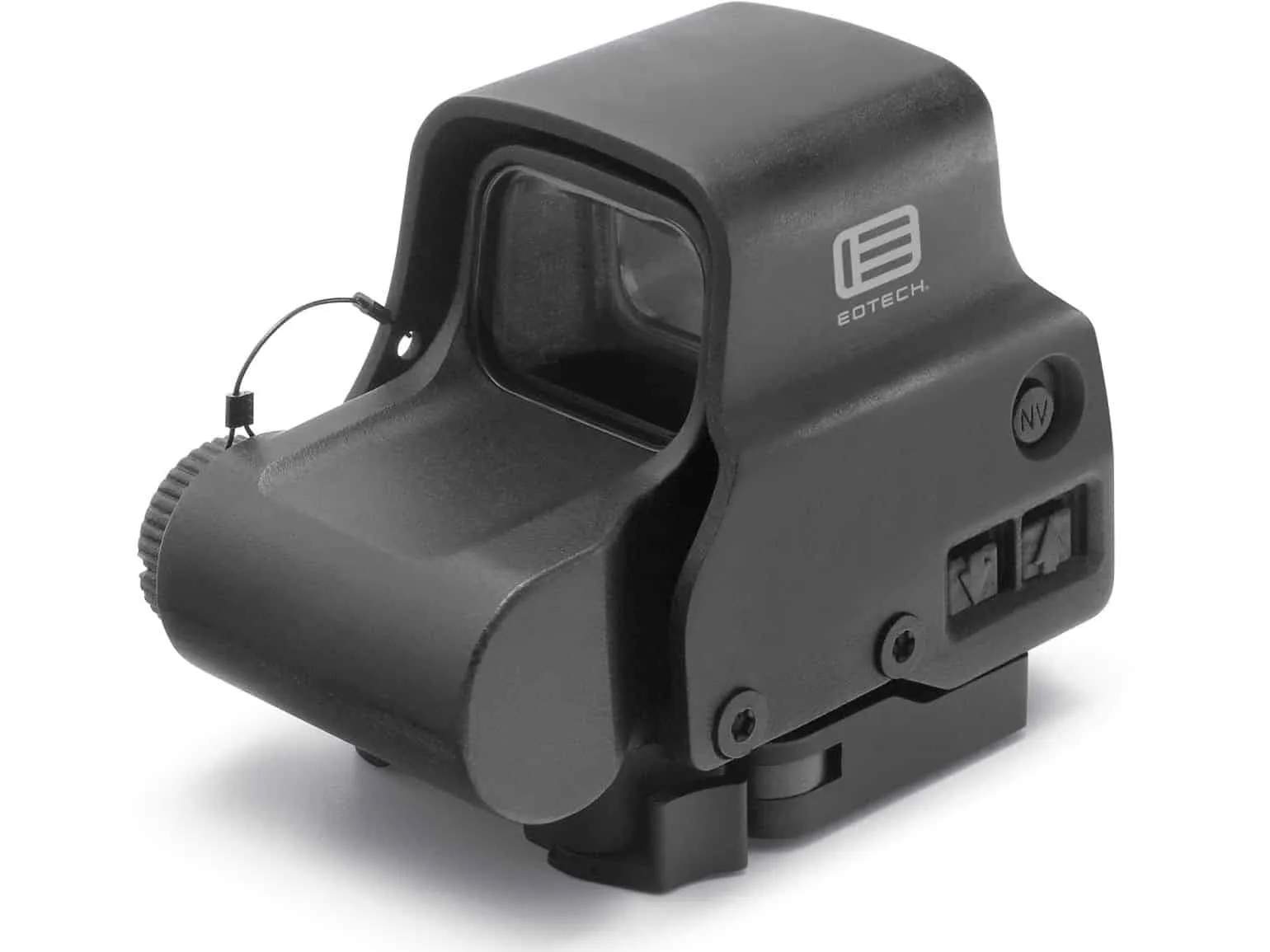
EOTech EXPS3
The EOTech EXPS3 is the holographic sight by which all others are judged. EOTech (a subsidiary of defense contractor L3Harris) created the consumer holographic category, and the EXPS3 carries that pedigree: the United States Special Operations Command (USSOCOM) awarded EOTech a close-quarters combat contract for this class of sight, which is about as strong an endorsement as an optic can earn.
The EXPS3-0 reticle is a 68 MOA ring with a single 1 MOA center dot, illuminated by a class 2 laser. The 68 MOA ring is built for fast close-quarters capture; the 1 MOA dot gives you precision out to intermediate range and stays a true 1 MOA behind a magnifier. It is the smallest and lightest holographic sight in its class at just 11.2 oz, with an aircraft-grade aluminum housing, an impact-absorbing protective hood, resin-encased electronics, and an IPX8-equivalent rating submersible to 33 feet. The ambidextrous quick-release lever mounts it to a 1 inch Weaver or MIL-STD-1913 rail at a lower 1/3 co-witness.
- Fastest target acquisition of any sight type via true holographic reticle
- 1 MOA dot stays 1 MOA even under magnification, ideal with a magnifier
- Lightest and smallest holographic sight in its class at 11.2 oz
- 30 brightness settings with 10 night-vision-compatible levels
- USSOCOM-selected, IPX8 submersible to 33 feet, quick-release mount
The honest trade-offs are the ones inherent to the technology: a 600-hour battery life on a single CR123A and a premium $699 price. For most professional and serious-use buyers, the proven track record justifies both, and at $699 it is actually the more affordable of the two holographic sights here. Read the full EOTech EXPS3 review for the complete breakdown.
Best for Battery Life and Warranty: Vortex AMG UH-1 Gen II
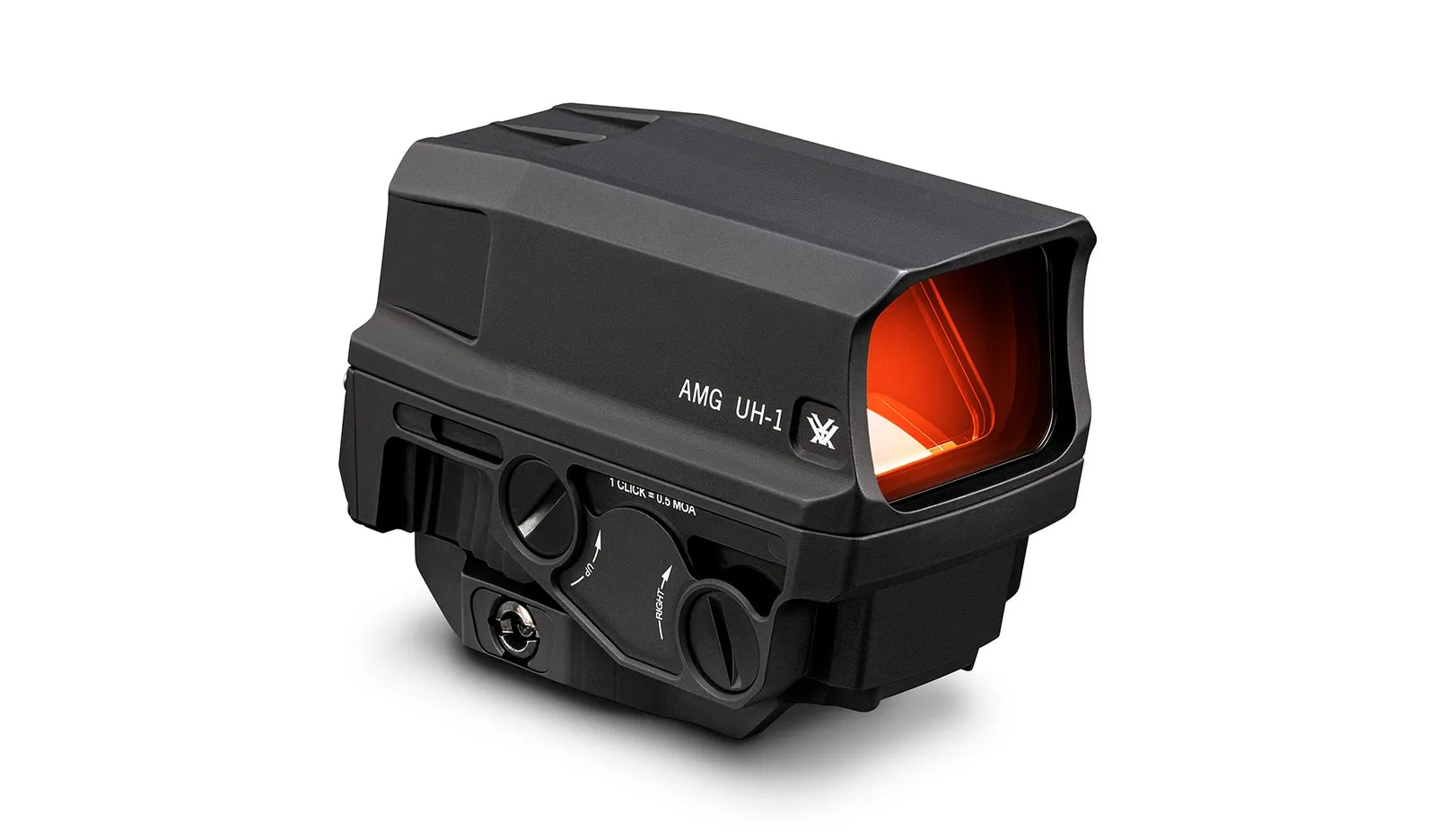
Vortex AMG UH-1 Gen II
If you want a genuine holographic sight from a brand famous for its warranty (and the longest runtime in the category), the Vortex AMG UH-1 Gen II is the one to take seriously. AMG stands for American Made Glass, Vortex’s premium US-built tier, and the UH-1 (“Huey”) is the brand’s only holographic offering.
The Gen II exists to fix the single biggest complaint about the original UH-1: its sealed internal rechargeable battery. The Gen II swaps that for a tool-less, field-replaceable CR123A under a quick cap, and bumps runtime to as much as 1,500 hours, more than double the EXPS3. It projects the Vortex EBR-CQB reticle, which pairs a 1 MOA dot with a 65 MOA circle and a close-quarters holdover triangle for very close targets. Larger lenses than Gen I widen the field of view, and a dedicated night-vision mode even remembers your last daytime brightness setting. It mounts directly to an M1913 Picatinny rail at lower 1/3 co-witness.
- Field-replaceable CR123A battery: the headline fix over the original UH-1
- Up to 1,500 hours of runtime, well ahead of the EXPS3
- EBR-CQB reticle adds a CQB holdover triangle for inside-ten-yard aiming
- Backed by the Vortex VIP unlimited, unconditional, lifetime warranty
- 15 daylight brightness levels plus 4 dedicated night-vision settings
The catches: at 11.6 oz it is a touch heavier than the EOTech, even at 1,500 hours its runtime still trails any LED red dot, and at an MSRP of $959.99 it is the pricier of the two. But the VIP warranty (repair or replace, no questions asked, no receipt needed) and the class-leading runtime are genuine reasons to pay it. See our full Vortex AMG UH-1 Gen II review for everything.
EOTech EXPS3 vs Vortex AMG UH-1 Gen II
These are the two premium holographic sights people cross-shop against each other, so here is how they stack up side by side.
| Spec | EOTech EXPS3 | Vortex AMG UH-1 Gen II |
|---|---|---|
| Reticle | 1 MOA dot / 68 MOA ring | 1 MOA dot / 65 MOA circle (EBR-CQB) |
| Weight | 11.2 oz | 11.6 oz |
| Battery | CR123A, ~600 hrs | CR123A, up to 1,500 hrs |
| Brightness | 30 (20 day + 10 NV) | 15 day + 4 NV |
| Mount | 1 in Weaver / M1913, quick-release | M1913 Picatinny, integrated |
| Waterproofing | IPX8, submersible to 33 ft | Argon-purged, waterproof / fogproof |
| Warranty | Limited (electronics covered) | VIP unlimited lifetime |
| MSRP | $699 | $959.99 |
The EOTech EXPS3 wins on weight, on price, on combat pedigree, and on the simple weight of its track record: it is the proven benchmark with a USSOCOM contract behind it, it is the lighter optic, and at $699 it is also the cheaper one. If you want the safest, most established choice, this is it.
The Vortex AMG UH-1 Gen II wins on battery life and on warranty. More than double the runtime and the no-questions VIP lifetime guarantee make it the pick for anyone who prioritizes long uptime and bulletproof support, though you pay a premium over the EOTech for it.
The Cheaper Way Into a Holographic Reticle
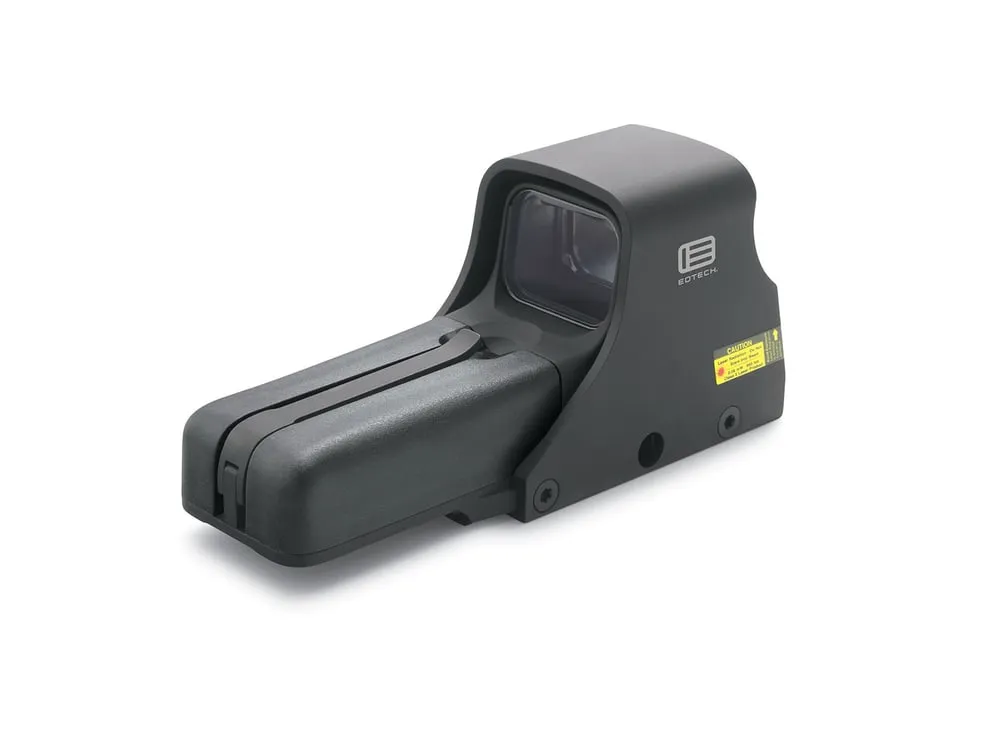
EOTech 512.A65
Not everyone shopping for a holographic sight needs a night-vision-capable, quick-detach optic. If that is you, the EOTech 512.A65 is the entry point, and it runs the same holographic engine as the EXPS3: an identical 68 MOA ring with a 1 MOA center dot, at true 1x, in a wide window. The difference is what surrounds that engine. It runs on two AA batteries (2,500 hours on lithium, 2,200 on alkaline at setting 12) instead of a CR123A, clamps to a 1 inch Weaver or MIL-STD-1913 rail with a thumbscrew instead of a lever, is submersible to 10 feet rather than 33, and weighs 11.5 oz.
- The same 68 MOA ring and 1 MOA dot as the EXPS3, at a $569 MSRP
- Two AA batteries: the cells are in your remote control right now
- 1 inch Weaver / M1913 thumbscrew mount, 20 brightness settings
- Submersible to 10 feet, with EOTech’s long service record behind the design
What you give up is the part of the EXPS3 people pay up for: night-vision brightness settings, the tool-less quick-detach lever, the deeper waterproof rating, and the compact profile. If your rifle lives at the range, in a truck, or beside the bed and no night-vision device is ever going in front of it, none of those absences will cost you anything. One caveat applies mainly to the used market: EOTech’s parent company settled a federal False Claims Act case in 2015 over a cold-weather zero-shift defect affecting 512, 552, and EXPS production of that era. That is settled history rather than a live problem with sights sold today, but on a secondhand buy, check the date code and confirm zero in the cold first. Read the full EOTech 512.A65 review.
How to Choose a Holographic Sight
A few questions will point you to the right one.
Do you actually want holographic, or would an LED red dot serve you better? Be honest here. Holographic sights are at their best for close-to-intermediate range, both-eyes-open speed shooting, and for hosting a magnifier or running night vision. If you want years of battery life and the lightest possible optic for a general-purpose build, an LED red dot like the Holosun HS510C or a magnified-prism option like the Vortex Spitfire 3x may serve you better and cost far less.
Where does it sit in your budget? The EXPS3 and the UH-1 Gen II are both premium optics, but they are not priced the same: the EOTech comes in about $260 below the Vortex while also being the lighter, more combat-proven option. The Vortex commands its higher price on battery life and the VIP warranty, so it is the spend for buyers who value long uptime and no-questions support over the lowest sticker. If neither number works, the 512.A65 gets you the same holographic reticle for less, as long as you can live without night vision and the quick-detach mount. Price both before you assume it is half the money: the 512 lists at $569 against the EXPS3’s $699, and discounting narrows that gap further than the “budget EOTech” reputation implies.
How much does battery life matter to your use? If your sight lives on a home-defense or duty gun that stays on for long stretches, the Vortex’s 1,500-hour runtime is a real advantage. If you run with the optic off between sessions, the EOTech’s 600 hours is plenty.
Are you running a magnifier or night vision? Both excel here (this is holographic’s home turf), so let weight, battery, and price decide.
Final Thoughts
The holographic sight market is small but excellent. The EOTech EXPS3 is our best overall pick: the lightest, most proven holographic sight there is, with a combat record nothing else in the category can match, and the lower price of the two. The Vortex AMG UH-1 Gen II is the pick when battery life and warranty lead your list: it fixes the original’s battery problem, runs more than twice as long, and carries the unbeatable VIP warranty, though it costs more than the EOTech. If both prices are more than the job calls for, the EOTech 512.A65 puts the same ring-and-dot holographic reticle on your rifle for less, running on AA cells, minus night vision and the quick-detach lever.
Whichever you choose, remember the one thing that started this guide: if a sight is not made by EOTech or Vortex, it is almost certainly an LED reflex sight, not a holographic one, no matter what the box says.