If you have astigmatism, you already know the problem: you mount an expensive red dot sight, look through it, and the dot is not a dot. It is a comet, a smear, a tiny firework, or a cluster of little dots dancing around where your aiming point should be. It is frustrating, and it makes you wonder if red dots are just not for you.
Here is the good news: the problem is not the optic, it is the kind of optic. Once you understand why an LED dot starbursts, the fix is straightforward, and there are excellent sights built specifically to get around it. This guide explains the why, then ranks the optics we would actually put in front of an astigmatic shooter. Let’s get to it.
Best Red Dot Sights for Astigmatism
- Best overall: Primary Arms SLx 1X MicroPrism
- Best magnified option: Vortex Spitfire 3x
- Best LED (green dot) option: Holosun HE508T-GR X2
- Etched prism at 2X: Primary Arms GLx 2X
- Etched prism at 5X: Primary Arms SLx 5X MicroPrism
Details and the science below.
Why a Red Dot Starbursts With Astigmatism
Astigmatism is one of the most common vision quirks there is, and it has nothing to do with how good your eyes are otherwise. A healthy eye focuses light through a cornea and lens that are shaped like a section of a sphere, evenly curved in every direction. An astigmatic eye is shaped more like a football: curved more steeply on one axis than the other.
That uneven curve means light from a single point does not all land on one spot on your retina. It focuses at slightly different places depending on which axis it came through. Your brain stitches those mismatched focal points together, and the result is a stretched, doubled, or radiating image of that point.
Now think about what a Light Emitting Diode (LED) red dot sight actually is. A reflex sight, also called a red dot sight (RDS), works by projecting a tiny glowing dot of light off the back of its lens and into your eye. That dot is, optically, a single point of light, exactly the thing astigmatism mangles. So you get the smear, the comet tail, the starburst. The brighter you run it, the more light there is to distort, and the worse it gets.
Crucially, the dot itself is perfectly round. A shooter standing next to you with no astigmatism sees a clean dot through the same optic. The distortion lives in your eye, which is why you cannot fix it by buying a more expensive reflex sight. You fix it by changing what your eye is asked to focus on, or by reducing the amount of light it has to work with.
Three Ways to Beat the Starburst
There are three proven approaches, and they are the basis for our rankings.
1. Etched-prism reticles (the real fix)
A prism sight does not project a glowing dot. Instead it uses a reticle that is physically etched into the glass, a solid, engraved pattern that is always there. Because that pattern is a real object inside the optic rather than a point of projected light, your astigmatism has nothing to smear. You see a crisp reticle no matter how your eye is shaped. As a bonus, an etched reticle is still visible with the illumination off, so the sight keeps working if the battery dies. This is the most reliable solution and the reason our top two picks are both prism optics.
2. Green illumination
The human eye is more sensitive to green light than to red, peaking right around the green-yellow part of the spectrum. A green LED dot therefore looks brighter to your eye at a lower actual output, so you can run it dimmer, and a dimmer dot starbursts less. Green will not cure a strong astigmatism, but for mild cases the combination of a sharper-perceived color and a lower brightness setting is often enough to get a usable dot.
3. Lower brightness (do this no matter what)
This one is free. The single biggest mistake astigmatic shooters make is cranking the dot to maximum brightness, which floods the eye with the very light it cannot focus and balloons the starburst. Turn the dot down to the lowest setting you can still see against your background and it tightens up dramatically. Whatever optic you run, dial it back.
A note on enclosed-emitter optics: an enclosed (closed-emitter) sight seals the LED behind glass so debris cannot block or scatter the dot, which keeps the dot edge clean and reliable. That is a durability and consistency win, but it does not change the fact that the dot is still projected light; it will not, by itself, cure astigmatism. We mention it because shooters often assume “enclosed = astigmatism-friendly,” and that is not quite right.
Best Overall for Astigmatism
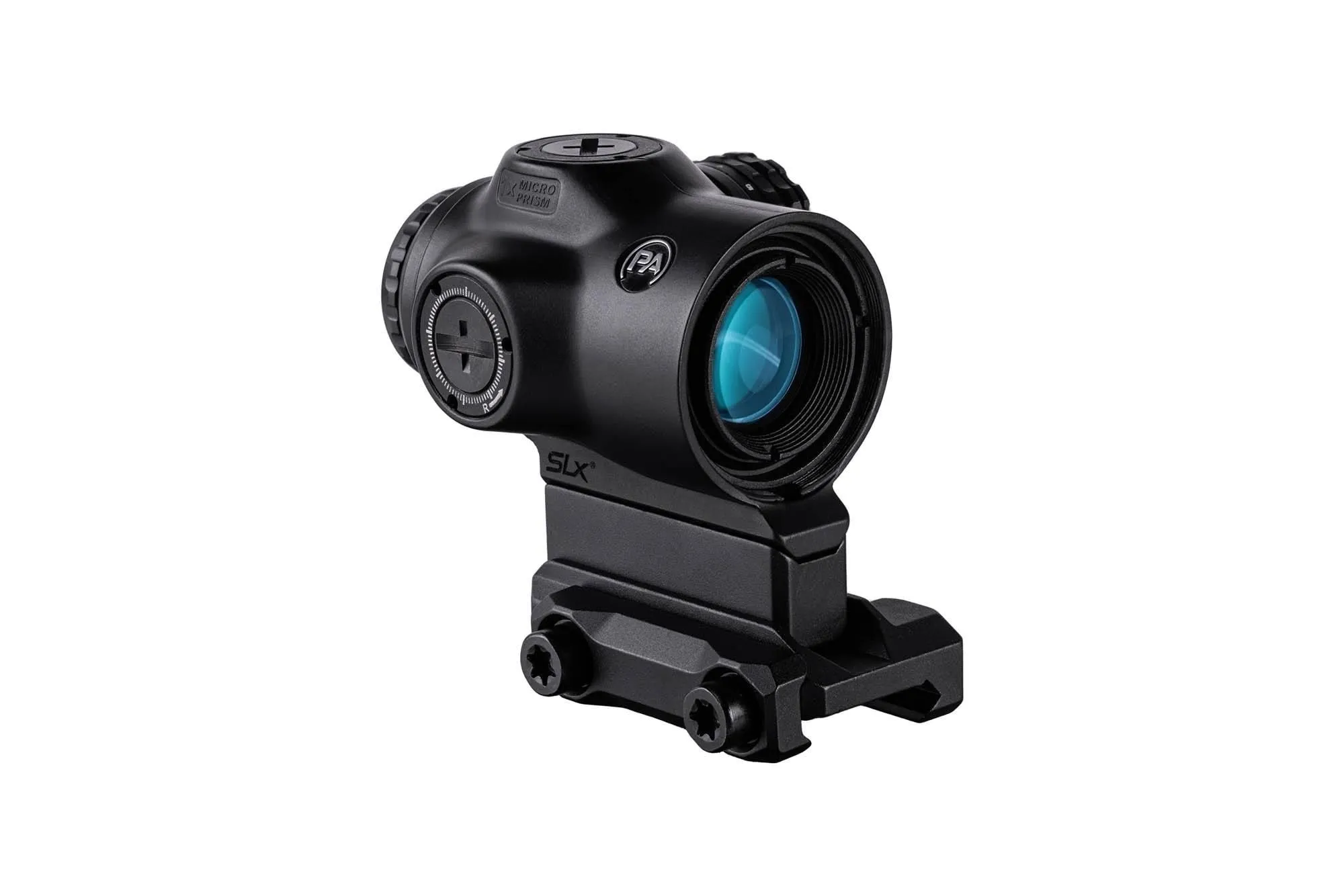
Primary Arms SLx 1X MicroPrism
This is the one we hand to anyone whose red dot looks like a firework. The SLx 1X MicroPrism is a true 1x prism optic with the ACSS Cyclops Gen II reticle etched directly into the glass, so the starburst problem simply does not exist: you see a sharp horseshoe-and-chevron pattern regardless of your eyes. It runs a red illumination across 13 brightness settings (including 3 night-vision modes), uses AutoLive motion sensing to stretch a single CR2032 battery to roughly 29,000 hours, and ships with a multi-height mount for absolute or lower 1/3 co-witness right out of the box. At $264.99 it is a genuine bargain for what it solves. Read the full Primary Arms SLx 1X MicroPrism review.
- Etched ACSS Cyclops Gen II reticle: no smeared or starbursted dot, period
- Reticle stays visible with the battery dead, plus 13 illumination settings when it is on
- AutoLive motion-sensing power management and a rugged IP67, nitrogen-purged housing
- Included mount with multiple heights for co-witness with iron sights
Best Magnified Option
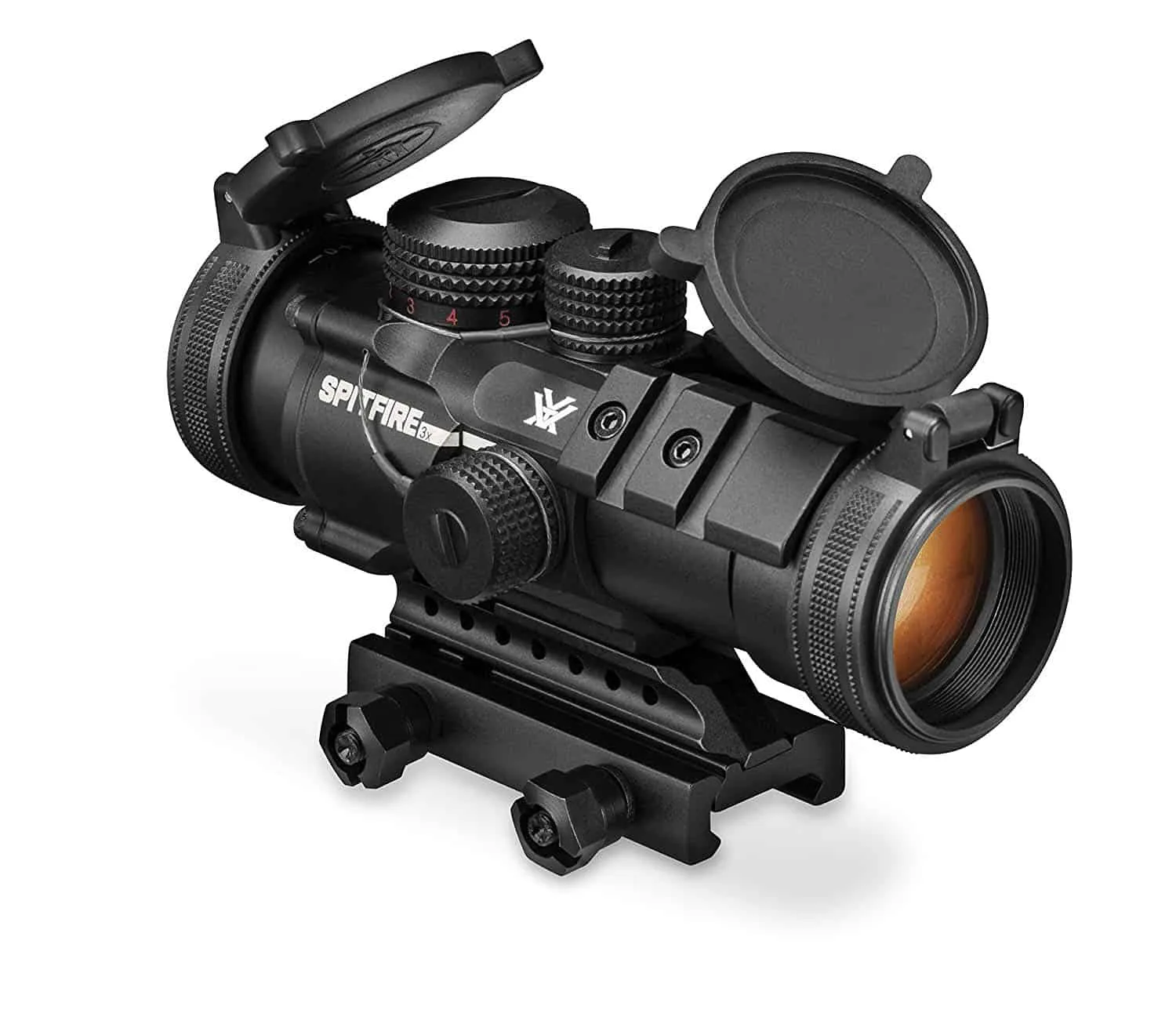
Vortex Spitfire 3x
If you want magnification along with the astigmatism fix, the Vortex Spitfire 3x uses the same etched-glass approach at a fixed 3x. Its EBR-556B reticle is engraved into the prism (so, like the MicroPrism, there is no projected dot to distort) and it is tuned with bullet drop compensation (BDC) holds from 0 to 500 yards for the 5.56x45 platform. It is heavier and longer than a 1x at 15.4 oz and 5.5”, and the fixed 3x is slower up close than a true 1x, but for a magnified rifle optic that an astigmatic shooter can actually use, it is the pick. It also offers red, green, and non-illuminated reticle modes, and it is backed by Vortex’s unconditional VIP lifetime warranty. See the full Vortex Spitfire 3x review.
- Etched EBR-556B reticle: astigmatism cannot smear an engraved pattern
- 3x magnification with BDC holds from 0 to 500 yards for 5.56
- Red, green, or non-illuminated reticle modes plus a non-illuminated fallback
- Vortex VIP unconditional lifetime warranty
Best LED (Green Dot) Option
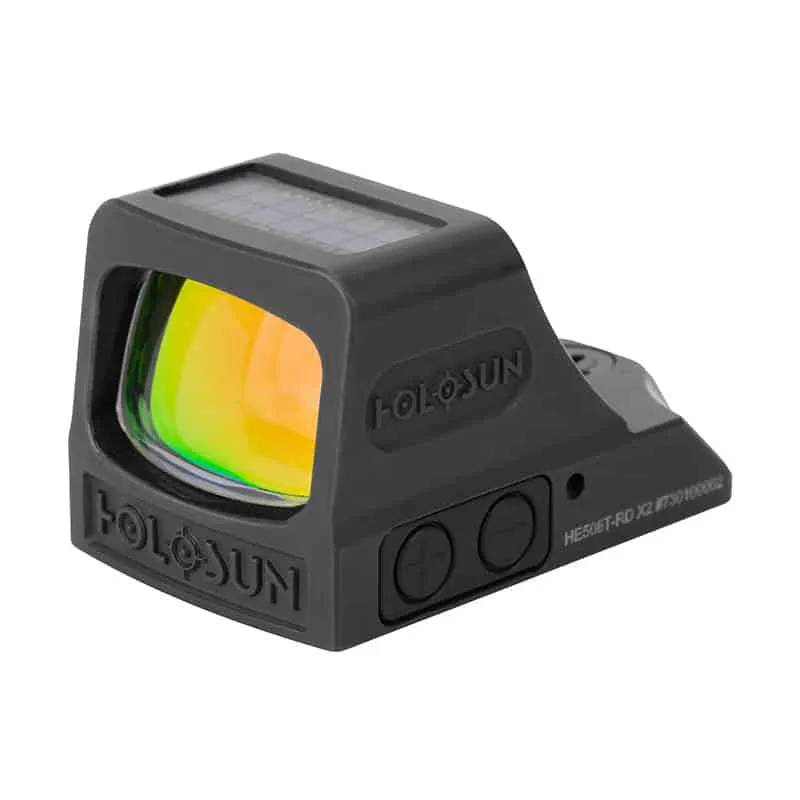
Holosun HE508T-GR X2
Sometimes you do not want to give up the unlimited eye box and feather weight of a reflex sight, and if your astigmatism is on the milder side, you may not have to. The Holosun HE508T comes in a green-dot variant (model HE508T-GR X2) and, as we explained above, a green dot perceived at lower brightness is the best an LED reflex sight can do for astigmatism. Pair that green dot with a low brightness setting and many shooters with mild astigmatism get a clean enough picture. You also get everything that makes the 508T great: a single-piece titanium housing, 50,000-hour battery life with a solar failsafe, the 2 Minute of Angle (MOA) dot / 32 MOA circle multi-reticle system, Shake Awake, and a side-loading battery tray. Be honest with yourself, though: if your astigmatism is strong, even a green dot will starburst, and you should go prism. Read the full Holosun HE508T review.
- Green-dot variant (HE508T-GR X2): the most astigmatism-friendly LED color
- Multi-reticle 2 MOA dot / 32 MOA circle: run just the circle if the dot smears
- Titanium housing, 50,000-hour battery, Solar Failsafe, and Shake Awake
- Keeps the unlimited eye box and light weight of a reflex sight
Two More Etched Prisms, If You Want Magnification
The etched-reticle fix is not limited to the two prisms above. Two more Primary Arms prisms have come through our review queue since we first ranked this list, and both solve astigmatism the same way: an engraved reticle your eye has nothing to smear.
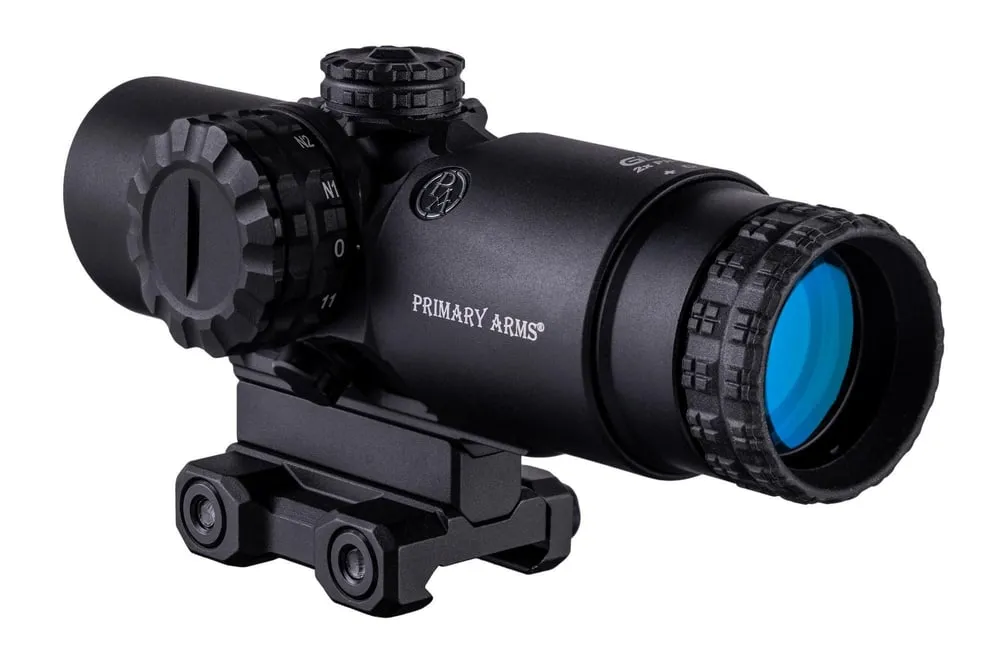
Primary Arms GLx 2X Prism Scope. A fixed 2X with the ACSS CQB-M5 5.56 reticle etched into the glass, so the aiming point is there whether the illumination is on, washed out, or the battery is flat. That etched-glass fallback is the reliability argument for the whole category, and it is the reason this optic belongs on an astigmatic shooter’s list. It weighs 11.0 oz, runs AUTOLIVE motion-activated illumination from a CR2032, and ships with a mini-ACOG-pattern mount plus three riser heights. Two honest notes from the published testing: reviewers at American Rifleman and AmmoLand praised the turret feel and the forgiving eye relief but both found the illumination can wash out against a bright, light-colored backdrop at maximum brightness, and neither ran a drop or immersion test, so the durability claims are still unbacked by a published figure. The etched reticle is the part that does not depend on any of that. Read the full Primary Arms GLx 2X review.
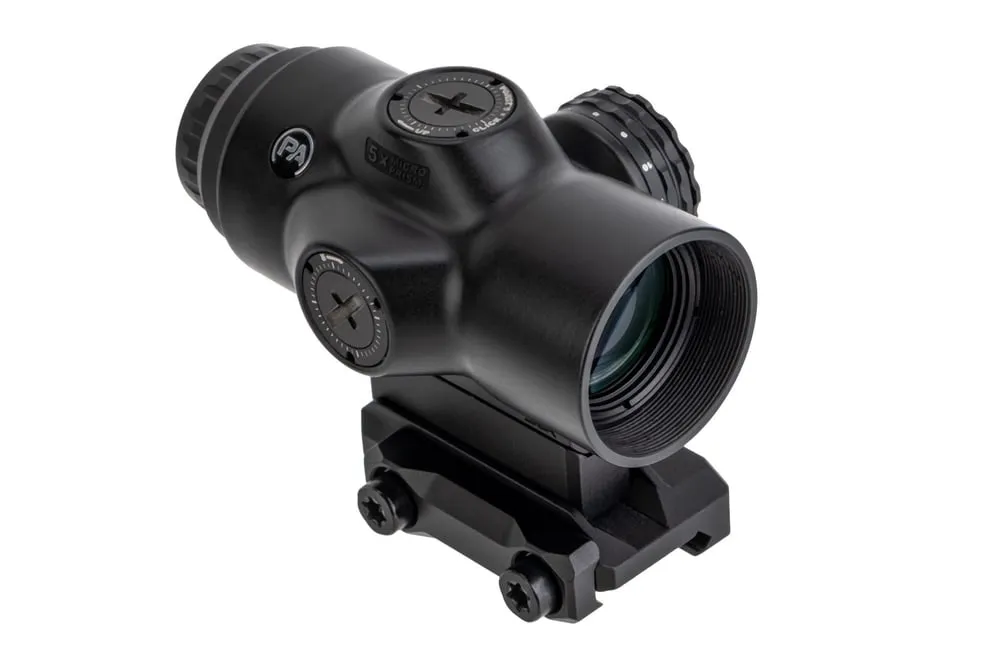
Primary Arms SLx 5X MicroPrism. This is the reach model of the MicroPrism line, an 8.5 oz body with the ACSS Aurora 5.56/.308 reticle etched in and AutoLive illumination from a CR2032. At 5X it is a precision optic for identifying and hitting things past 200 yards, and it is close to useless at conversational distance, which is why you usually see one paired with a red dot piggybacked on top. It also carries the strongest durability file of any prism in our corpus: a filmed torture test dropped it roughly 15 feet onto a deck, submerged it in 105 degree water for twenty-plus minutes and froze it, and a hunter on Rokslide ran a separate 52-inch multi-orientation drop onto gravel and snow. Neither produced a failure or a lost zero. Buy it only if your rifle’s job actually involves distance. See the full Primary Arms SLx 5X MicroPrism review.
Prism vs. LED Quick Reference
| Sight | Type | Reticle | Astigmatism fix | Eye box | Weight |
|---|---|---|---|---|---|
| SLx 1X MicroPrism | 1x prism | Etched ACSS Cyclops Gen II | Etched glass (complete fix) | Fixed, ~3.6” relief | 7.6 oz |
| Spitfire 3x | 3x prism | Etched EBR-556B | Etched glass (complete fix) | Fixed | 15.4 oz |
| HE508T-GR X2 | LED reflex | Projected green dot / circle | Green + low brightness only | Unlimited | 2.0 oz |
| GLx 2X Prism | 2x prism | Etched ACSS CQB-M5 5.56 | Etched glass (complete fix) | Fixed | 11.0 oz |
| SLx 5X MicroPrism | 5x prism | Etched ACSS Aurora 5.56/.308 | Etched glass (complete fix) | Fixed | 8.5 oz |
How to Choose
Start with the severity of your astigmatism, because it decides everything.
If your astigmatism is moderate to strong (if the dot is a real comet or a cluster you cannot shoot precisely with), go prism and do not look back. The etched reticle is the only thing that genuinely removes the distortion. Pick the Primary Arms SLx 1X MicroPrism for a fast 1x close-quarters and general-purpose optic, or step up to the Vortex Spitfire 3x if you want magnification for reaching out. The trade is a fixed eye box and more weight than a micro red dot, which is a small price for a crisp aiming reference. If 3x is not the magnification you want, the ladder runs on either side of it: the Primary Arms GLx 2X keeps things fast for close and mid range, and the Primary Arms SLx 5X MicroPrism reaches well past 200 yards for a rifle that lives at distance.
If your astigmatism is mild (the dot is a little fuzzy or has a faint flare but is still basically round), you have the option of keeping a reflex sight’s look-anywhere eye box and tiny weight. Get a green dot, such as the Holosun HE508T-GR X2, and run it at the lowest usable brightness. The multi-reticle ring is a nice bonus here: if the center dot still smears, you can shoot the 32 MOA circle instead, which is large enough that astigmatism does not ruin it.
Whatever you choose, turn the brightness down. It is the free fix that helps every astigmatic shooter, and the single most common thing people get wrong.
Final Thoughts
Astigmatism does not mean you are stuck with iron sights. The starburst is your eye distorting a point of projected light, so the answer is either to stop projecting a point (an etched prism reticle) or to give your eye less and friendlier light to distort (a low-brightness green dot). For most astigmatic shooters the prism route is the clean, permanent fix, which is why the Primary Arms SLx 1X MicroPrism is our top recommendation. If your case is mild and you love the reflex-sight form factor, a green-dot Holosun run low will likely get you there.
Recommendations
- Strong astigmatism, 1x: Primary Arms SLx 1X MicroPrism
- Strong astigmatism, want magnification: Vortex Spitfire 3x
- Strong astigmatism, want a little magnification for close work: Primary Arms GLx 2X
- Strong astigmatism, shooting past 200 yards: Primary Arms SLx 5X MicroPrism
- Mild astigmatism, want a reflex sight: Holosun HE508T-GR X2, green dot at low brightness