If you have spent any time shopping for an AR-15 red dot, you have run into the terms “absolute co-witness” and “lower 1/3 co-witness,” usually attached to a mount or riser, and usually with zero explanation of what they actually do. The short version: they describe how high your optic sits, and therefore where your backup iron sights line up when you look through the glass.
It sounds like a small detail, but it shapes your sight picture, your head position on the gun, and how cleanly you can run the rifle. In this guide we will cover what co-witnessing is, the difference between absolute and lower 1/3, the real height numbers behind each, how to measure your own setup, and which one makes sense for the way you shoot.
What Co-Witness Means
Co-witnessing means your red dot sight and your backup iron sights share the same line of sight. When you bring the rifle up and look through the optic, you see the dot floating on the target, and behind it, your front and rear iron sights, lined up on that same point of aim. The two aiming systems “witness” the same target through one window.
Why does that matter? A red dot sight (RDS) is an electronic device. It runs on a battery, and batteries die, electronics fail, and lenses can get fogged, smeared, or cracked. Iron sights do none of those things. If you co-witness, a dead dot does not take your rifle out of the fight: you simply ignore the dark optic and aim with the irons you can already see through it. No tools, no removing the optic, no re-zeroing. That redundancy is the whole point.
Two things have to be true for a clean co-witness. First, your optic has to be mounted at roughly the same height as your iron sights so the dot and the front sight post can occupy the same window. Second, your iron sights and your dot both have to be zeroed (ideally to the same distance) so they actually agree on where the rounds land. Co-witnessing is about the line of sight; it does not zero anything for you.
It is worth saying up front: you do not have to co-witness at all. Plenty of shooters skip backup irons entirely and run a taller mount for a more comfortable, heads-up shooting position (more on that under “Which to Choose”). Co-witness only matters if you intend to run iron sights as a backup. If you do, the next question is how the irons sit in the window, and that is where absolute and lower 1/3 split.
Absolute Co-Witness
Absolute co-witness (sometimes called 100% co-witness) mounts the red dot at the same height as your iron sights. The result: the dot sits directly on top of the front sight post, and the irons are centered in the middle of the optic window. Look through the glass and the iron sight picture fills most of what you see, with the dot resting right on the front post.
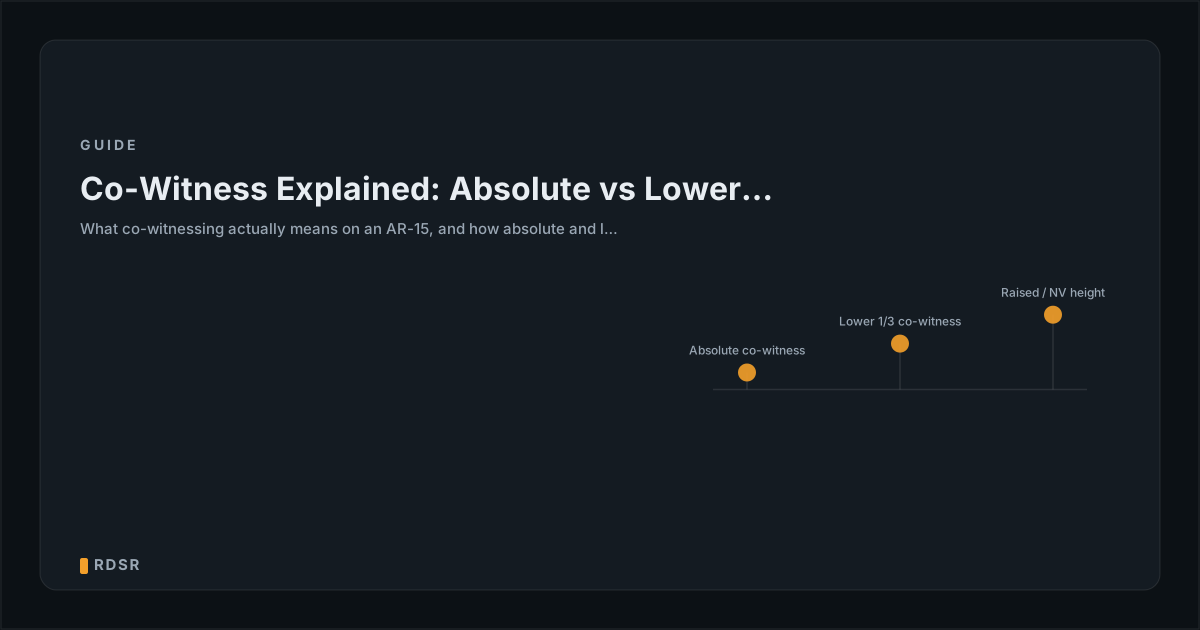
On a flat-top AR-15 with standard mil-spec sights, the iron sight line of sight is about 1.41” above the top of the Picatinny rail. So an absolute co-witness optic needs its optical centerline at roughly that same 1.4” height. In riser terms, the classic combination is a 0.83” riser under a micro red dot (a Trijicon MRO, Aimpoint Micro, Holosun 403/503, or similar) which lands the dot right at iron-sight height.
The big advantage is consistency. Your cheek weld, your head position, and your sight picture are identical whether you are using the dot or the irons. There is nothing to relearn when the dot dies: the irons are already exactly where your eye expects them. Many shooters also find absolute the most instinctive transition, and it tends to be the cheaper option since “standard height” mounts and short risers are common and inexpensive.
The downside is clutter. Because the irons sit dead center, they take up the majority of your sight picture through the optic. The front sight post is parked right in the middle of your window, and on a magnified-free red dot that is a lot of hardware in the way of your target. It works, and millions of shooters run it happily, but it is a busier picture than some people want.
Lower 1/3 Co-Witness
Lower 1/3 co-witness mounts the optic a little higher than your iron sights. Instead of sitting in the center, the irons now appear down in the bottom third of the window, and the upper two-thirds of the glass stays clear. The dot floats in that open space, and your irons are still there if you need them, just tucked out of the way at the bottom.
That extra height is modest but meaningful. Where absolute puts the optical centerline around 1.4” above the rail, a lower 1/3 setup raises it to roughly 1.5” to 1.7” of optical centerline (often cited around 1.57”). The common riser shorthand is a 1.0” riser under a micro dot, or a dedicated lower 1/3 mount built to that height. (You will also see taller 1.93” “heads-up” mounts marketed nearby, and those generally sit too high to co-witness with standard irons at all, so do not confuse them with lower 1/3.)
The payoff is a cleaner, faster sight picture. With the irons pushed to the bottom third, your eye lands on a mostly empty window with just the dot and your target. That makes target identification easier and the dot quicker to find, especially in dynamic shooting. The slightly higher optic also tends to give a more natural, upright head position (less of a chin-to-the-stock crunch) which many shooters find more comfortable over a long range day and a touch easier on the neck.
The trade-offs are small but real. Because the irons are not centered, the transition to backup irons is slightly less instinctive than absolute, since you have to drop your head a hair to pick them up. Lower 1/3 mounts cost a little more than a bare standard mount, and the higher optic increases your “height over bore” marginally, which matters mostly for very close-range precision. For most carbine work, none of this is a dealbreaker, which is why lower 1/3 has become the default choice for general-purpose AR-15s.
Which to Choose
Start with whether you even want backup irons. If you do not plan to run them, you do not need to co-witness, and a taller heads-up mount (around 1.93”) may be the most comfortable option of all. If you do want the redundancy, the decision comes down to how you balance a clean window against a consistent sight picture, and, importantly, what kind of iron sights you pair with it.
Fixed iron sights pair best with lower 1/3. Because fixed irons are always up, you want them out of your main sight picture, and the bottom third of the window is exactly where they belong. A lower 1/3 height keeps the irons present but unobtrusive, so a permanently-mounted front sight or fixed BUIS does not clutter your view.
Flip-up (folding) iron sights pair well with absolute. Flip-ups (also called BUIS, backup iron sights) stay folded down and out of the way until you need them, so window clutter is not an everyday concern. Running them at absolute height means that when you do deploy them, they snap up to a familiar, centered position with the same cheek weld you already use: maximum consistency for an emergency.
Beyond sights, match the choice to your use:
- Duty, defensive, or “this rifle has to work” builds: co-witness is worth it. Lower 1/3 with fixed irons is a popular, fast-handling combination; absolute with flip-ups is the consistency-first alternative.
- General-purpose range and competition carbines: lower 1/3 is the common pick for its clean window and comfortable head position.
- Budget builds: absolute often wins by default, since standard-height mounts and short risers are the cheapest path to a co-witness.
- Pairing a magnifier later: mind your optic height now, because the magnifier has to match the dot’s centerline, and lower 1/3 and 1.93” heights are common for magnifier-friendly setups.
To check what you have, measure from the top of the Picatinny rail straight up to the optical centerline of your dot (the middle of the lens, where the dot lives), not from the bore. Around 1.4” is absolute territory; roughly 1.5” to 1.7” (about 1.57”) is lower 1/3; about 1.93” is a non-co-witness heads-up height. Most micro red dots sit roughly 0.6”-0.7” above their own base, so a 0.83” riser gets you to absolute and a 1.0” riser to lower 1/3. When in doubt, mount it, look through it, and see where the irons fall: the window tells the truth faster than any spec sheet.
If you are still picking the optic itself, our reviews cover several co-witness-friendly carbine dots, including the budget-friendly Sig Romeo5, the feature-loaded Holosun HS510C and Holosun HS403B, and premium options like the Aimpoint T-2 and the EOTech EXPS3. If you think a magnifier is in your future, the Vortex Spitfire 3x is worth a look while you plan your heights.
There is no universally “correct” answer here. Both absolute and lower 1/3 put working irons in the same window as your dot, which is the part that actually matters. Pick the height that matches your iron sights and your shooting style, get both systems zeroed, and you will have a rifle that keeps aiming even when the battery does not.