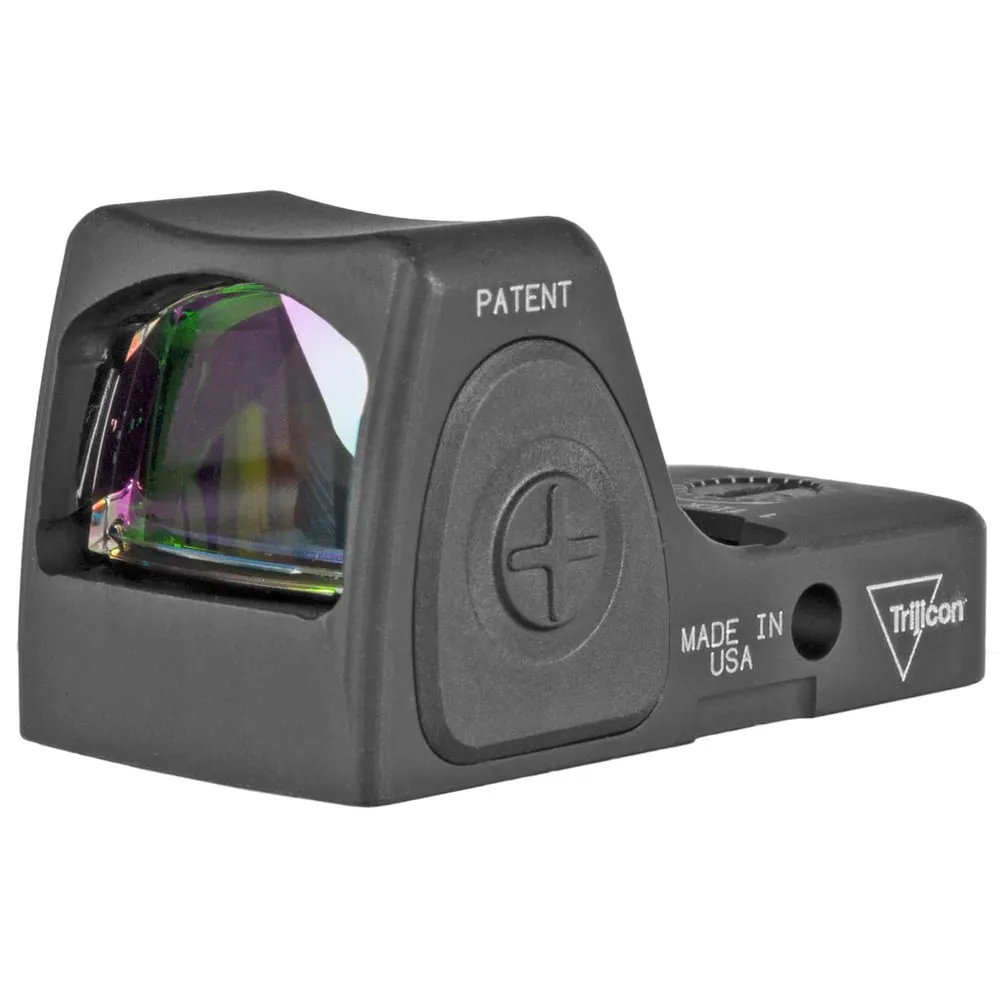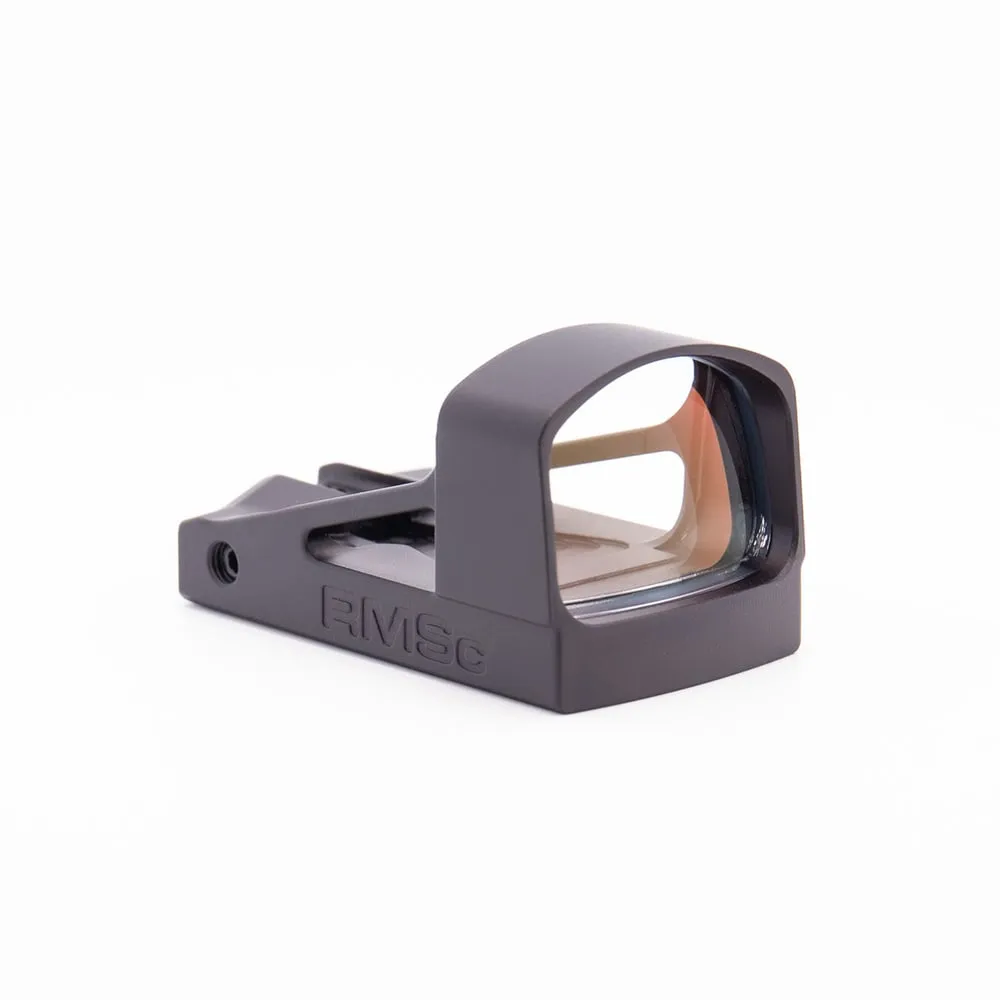
Shield Sights describes the RMSc as “the ORIGINAL compact mini sight for slimline pistols”, a slimmed-down RMS built for single-stack carry guns. This review covers what Shield publishes about the current glass-lens model, what two outside reviewers reported after shooting it, and how it compares with the compact open-emitter dots we have reviewed. We have not tested the RMSc ourselves; every observation below is credited to the person who made it.
Shield RMSc Review
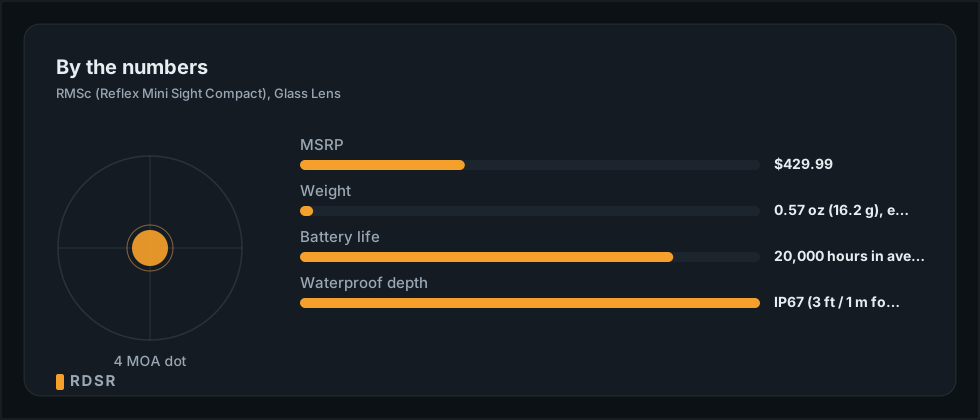
The RMSc is an open-emitter micro red dot sight (MRDS). Shield’s technical specification lists it at 40.8 x 23 x 22.8 mm (1.6 x 0.9 x 0.89 inches) and 16.2 grams (0.57 oz) excluding the battery, in an aluminum housing. It runs on one A 3-volt lithium coin cell, 20mm across, and the most common red dot battery (about 210 to 240 mAh). Stocked almost everywhere, so a field swap is easy.Full comparison →, which Shield’s product page rates at 20,000 hours “in average daylight”. Shield’s FAQ gives a different, plainer figure: “approximately 2 years” on its 2, 4 and 8 MOA mini sights for an average day and night cycle. The housing is rated for immersion to 3 feet for 30 minutes (A full IP code meaning dust-tight (first digit 6) plus temporary immersion to 1 meter for 30 minutes (second digit 7).Full comparison →). Shield’s own store lists every RMSc variant at $429.99, quoted ex VAT; Pike’s 2022 review put the street price at about $370.
Shield Sights is a British company (its store gives a registered address in Crewkerne, Somerset), and Pike notes that Shield builds its sights in the United Kingdom. Shield says gun makers “have built guns around” the RMSc and names the Glock 43X and G48 as the latest; its product page also lists the Glock 43, the Smith & Wesson Shield and the 1911 as intended hosts, and sells an optional screw set for the Smith & Wesson Shield Plus Optics Ready. Giddings adds that Taurus mills its TX22 Compact and GX4 TORO for the RMSc footprint.
Top Features of the Shield RMSc
Design
The current RMSc carries a D-shaped glass lens. Shield describes it as “scratch-resistant, ultra-clear” with a hard, anti-reflective, color-free coating, and says the glass model also brought “upgraded electronics with improved battery contacts”. The Firearm Blog reported in September 2020 that the original RMSc “came with a clear plastic window as standard and only offered glass as a custom option” until this glass edition made glass standard. Pike wrote in 2022 that the A lightweight, low-cost composite housing that resists corrosion but is generally less impact and heat resistant than aluminum or titanium.Full comparison → version was still sold for a little less, but Shield’s store today lists only glass-lens SKUs (4 MOA and 8 MOA, each in black, Flat Dark Earth and Olive Green).
Pike called the glass “crystal clear and easily one of the clearest pistol red dots I’ve ever handled”, with no noticeable tint. A small notch at the back of the housing acts as a rear sight, and Pike found the sight sat low enough to co-witness with standard-height irons on his P322.
Reticle
Shield offers a 4 MOA or an 8 MOA red dot. Its 4 MOA listing adds “3.25MOA” in brackets and the 8 MOA listing adds “6.5MOA”, without explaining the bracketed figures. Pike ran the 4 MOA dot, called it “clear and precise”, and shot it out to 50 yards.
The sources disagree on how the adjustments work. Shield’s product description says its patented mechanism “uses no click adjustment, making it infinitely more accurate when zeroing”, and zeroing uses a supplied Mini dial threaded on the hex wrench to gauge the movement. Pike, using that dial, wrote that “each click is a ¼ MOA at twenty yards” and that the adjustments were tactile: “You can feel each click, but can’t hear it and they’re dead on.” Shield’s FAQ warns against forcing either screw past the point of resistance, which it says damages the sight and voids the warranty.
Operation
Brightness is automatic only. Shield’s spec runs from a lowest setting that is night-vision compatible to a highest one “visible against the sky in bright daylight”. Pike reported the dot adjusting “quickly and intuitively” from room to room, staying visible at Florida noon through sunglasses, and showing no washout with a 1,000-lumen light held in front of, beside or behind the optic.
There are no buttons, and the sight cannot be turned off. Pike notes that the included rubber cover drops it to its lowest, battery-saving level when fitted. Shield’s listing describes no motion-activation feature; the design is “always on and ready”.
The CR2032 fits underneath the sight, between the optic and the slide. Shield’s mounting-interface drawing says its four locating posts maintain “repeatability following a battery change”, which tells you the sight comes off the gun for every battery swap. Shield includes two battery stickers in the box; its FAQ says they ensure contact across batteries of different heights and keep the battery from shorting against the slide.
Reliability standing
Shield Sights RMSc (Reflex Mini Sight compact)
Low confidence based on 4 sources, 3 first-hand.
- Rounds tested
- About 400 rounds on the first unit (250 on a TX22 Compact, 150 on an 856 TORO) and about 500 on the second, both before failure (Giddings)
- Battery
- CR2032: 20,000 hours in average daylight with a CR2032 (Shield); Pike gives the rated life as two to three years
What those tests were
- recoil: fail . Giddings (2026) had the same recoil dropout on both units he was sent, across three guns, under what he calls "extremely light recoil," from a .22 and from .32 Long. Pike (2022) reports no malfunction in his range use on a SIG P322 at 10 to 50 yards, with no round count given.
- zero retention (single owner report): pass with caveat . One forum owner zeroed his RMSc at 15 yards, carried it daily for a month and found the point of impact had moved six inches up and two inches right. After re-zeroing, 50 more rounds stayed on the same point of impact.
Aggregated from others' first-hand testing, not our own: this standing deliberately reaches past any one shooter's round count. We surface a sourced reputation tier rather than inventing a score the evidence cannot support.
Full reliability data →Mounting
The RMSc uses Shield’s own footprint, which Shield says has “100+ mounting solutions”. It is not the Trijicon RMR footprint, so RMR-cut slides and plates do not take it directly. Shield’s interface drawing specifies four locating posts and calls them “critical for reliable & accurate use”, noting that some suppliers have cut them down to two posts or removed them, which Shield calls “not an acceptable condition”.
Holosun’s K footprint (used by the 507K X2 and 407K X2) shares the RMSc screw pattern but is not the same cut: the locating-post geometry differs. If you are moving between a Shield sight and a K-footprint dot, check your slide or plate against the specific optic rather than assuming one fits wherever the other does.
Shield’s box includes two M4x8 mm and two M4x10 mm screws plus a 1° shim for extra elevation range on guns such as the 1911. Optional screw sets for the Smith & Wesson Shield Plus Optics Ready, the SIG P365XL and the SIG P320 are sold separately.
Details
What Shield lists in the box:
- Shield RMSc sight
- Mini dial
- CR2032 battery
- 1° shim
- Two M4x8 mm and two M4x10 mm button-head screws
- 1.5 mm and 2.5 mm hex wrenches
- Four 0.5 mm nylon washers
- Reese’s Law battery cover
- Two battery stickers and two Shield target stickers
- RMSc cover
Warranty
Shield’s terms and conditions state that products it designs and manufactures “carry a limited lifetime warranty on materials and workmanship” and that “electronics carry a 7-year warranty”. Claims go through an account on Shield’s site, and repairs are done in the UK: Shield’s FAQ says it aims to finish warranty repairs “within 4-6 weeks” from the sight leaving you to its return.
Warranty standing
Shield Sights warranty
Lifetime housing, 7-yr electronics, transferability unstated
- Housing
- Lifetime
- Electronics
- 7 yrs
- Transferable
- Unstated
- Receipt required
- Unstated
- Registration
- Unstated
- Support
- active
Customer Feedback
We found two detailed first-hand accounts and one older owner report, and they do not agree.
Travis Pike, The Truth About Guns (July 18, 2022). Pike shot a glass-lens 4 MOA RMSc on a SIG P322 (a .22 LR pistol) at 10 to 50 yards. He praised the clarity (“This is the clearest micro pistol optic, and hell, the clearest pistol optic I’ve ever used”), the auto brightness and the co-witness notch. His review describes no malfunctions and gives no total round count.
Caleb Giddings, Substack (March 12, 2026). Giddings, who works at Taurus, says Shield sent him “a pair of the classic Shield RMSc sights”; he does not say whether they had glass or polymer lenses. The first stopped working after about 250 rounds on a TX22 Compact; after he changed to a battery without a bitterant coating and moved it to an 856 TORO revolver, it stopped working again after 150 rounds of .38 Special wadcutters. The second ran about 500 rounds on a 327 Defender TORO before the dot began flickering off with .32 Magnum, and kept doing it with .32 Long, even after a battery change. His summary: “Under extremely light recoil the dot will shut off on both optics and then immediately re-appear.”
Walther Forums owner (July 10, 2018). On a Walther PPS fitted with an RMSc (2018, two years before Shield made glass standard), the owner reported that after a month of daily carry “the point of impact moved up six inches and two inches to the right”. After re-zeroing he fired 50 more rounds and the point of impact stayed the same. Later in the thread he wrote that he believed some of the issue came from Walther “not machining a true flat surface for the Shield”, and concluded that “Walther and Shield provide good warranty service.”
Clarity: Praised by Pike, who had the glass-lens model.
Recoil reliability: The weak point on the record. Giddings’ two units failed the same way, which points past a single bad sample, though both were older-generation units supplied by Shield and both accounts come from one person.
Zero retention: One 2018 owner report of a shift after a month of carry, which the owner partly blamed on the slide’s optic cut.
Pros & Cons
Pros
- Glass lens with a hard, anti-reflective, color-free coating per Shield's spec sheet
- 0.57 oz (16.2 g) without battery, sized for single-stack carry pistols
- Auto brightness that Travis Pike (TTAG, 2022) found fast, even facing a 1,000-lumen light
- Shield cites more than 100 mounting solutions for its footprint
- Limited lifetime warranty on materials and workmanship, with electronics covered for 7 years
Cons
- Caleb Giddings (2026) had two units shut off under recoil, down to .22 LR and .32 Long
- No manual brightness control and no off switch: the dot is always on
- The CR2032 fits underneath, so a battery change means taking the sight off the slide
- Shield's $429.99 list sits above Holosun's K-footprint 507K X2 and 407K X2
Conclusion
On paper, the RMSc is what Shield says it is: a 0.57 oz glass-lens open dot that fits small carry slides, with no buttons and nothing to switch on. The best outside account of the glass model (Pike, 2022) is enthusiastic. The most recent account (Giddings, 2026) describes two older units failing under recoil light enough that most dots would never notice it. Neither is a controlled test, so weigh both: if your gun is cut for the RMSc and you like the simple, always-on design, it does the job it was designed for. If that dropout report is a deal-breaker for a carry gun, compare the alternatives below first.
Alternative Sight Options
These are open-emitter pistol dots for small carry guns, the same category as the RMSc. The Holosun 507K X2 and Holosun 407K X2 sit on Holosun’s K footprint, which shares the RMSc screw pattern but differs in its locating posts, so confirm your slide’s cut first. Both add Shake Awake motion sensing and a side-loading battery tray, and the 507K X2 adds a 32 MOA circle reticle. The Trijicon RMRcc is Trijicon’s compact open dot on its own RMRcc footprint, which is not interchangeable with the full-size RMR cut or the RMSc. Each of these has a reliability record in our database to compare against the RMSc’s.