If you have shopped for a new optic, you have run straight into the same fork in the road every shooter hits: red dot or holographic? The two get lumped together because both throw a glowing aiming point onto a piece of glass and both let you shoot with both eyes open. Under the hood, though, they work in completely different ways, and those differences decide which one belongs on your gun.
This is a plain-English explainer, not a product roundup. We will walk through how each type actually works, how their reticles, batteries, size, and price stack up, what happens when the glass takes a hit, how astigmatism and parallax factor in, and finally a use-case verdict so you can match the right optic to the right firearm. By the end you will know exactly which camp your next build belongs in.
How a red dot works
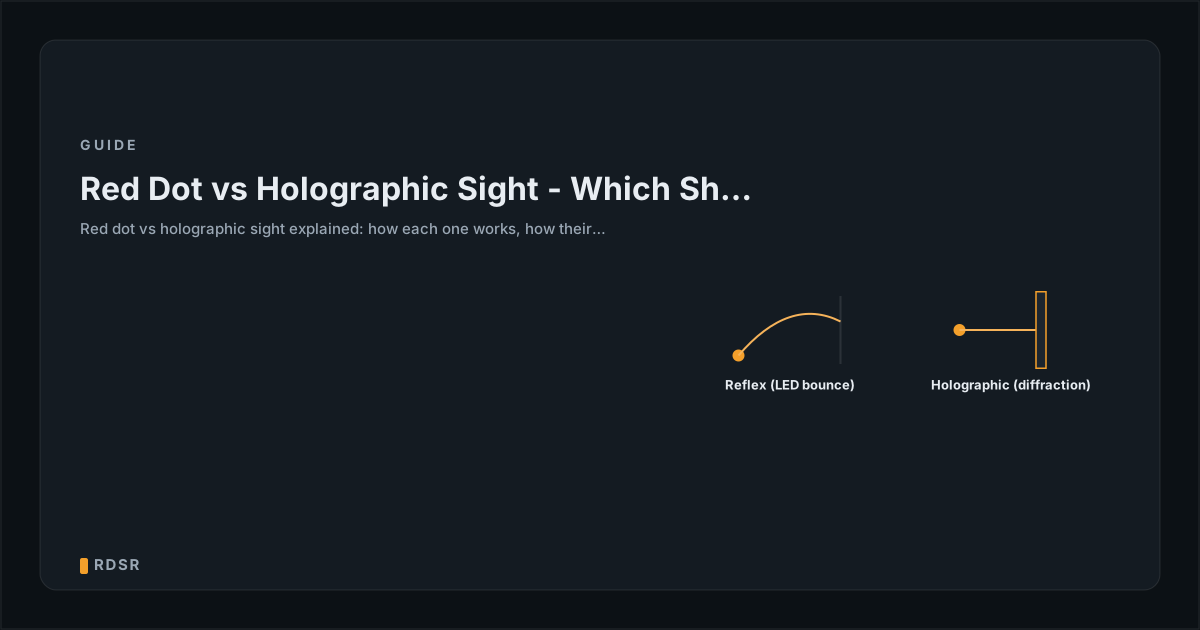
A red dot sight, also called a reflex sight, is the simpler of the two. Inside the housing sits a small light-emitting diode (LED) tucked down near the base. That LED projects a beam forward onto the back of the objective lens, the front piece of glass you look through.
The trick is in that lens. It carries a special coating tuned to reflect one narrow band of light (the red or green wavelength the LED produces) straight back toward your eye, while letting every other wavelength pass through. So you see the target normally through clear glass, with a glowing dot floating on top of it. The lens is also slightly spherical, which bends the reflected light into parallel rays so the dot appears to sit out on the target rather than on the glass itself.
Because an LED sipping current is all it takes to make that dot, red dots are remarkably efficient. That single design choice ripples into nearly every advantage on the red dot side of the ledger: tiny size, light weight, and battery life measured in years.
How a holographic sight works
A holographic weapon sight (HWS) gets to the same end (a reticle floating on the target) by a far more elaborate route. Instead of an LED, it uses a laser diode. That laser illuminates a hologram: a three-dimensional recording of the reticle that has been captured into a holographic film sandwiched inside the optic’s window.
When the laser lights up that recording, it reconstructs the reticle as a holographic image that appears downrange, on the same focal plane as your target. This is why many shooters describe a holographic picture as feeling like the reticle is “out there” with the target rather than painted on the glass, and it is part of why acquisition can feel so fast.
Recording and lighting a hologram with a laser takes considerably more power and more precision hardware than bouncing an LED off a mirror coating. That is the root of the holographic sight’s trade-offs: a sharper, more sophisticated reticle and some genuinely useful durability quirks, paid for with more size, more cost, and a much thirstier battery.
Key differences
Here is where the two technologies separate in ways you will feel at the range.
Reticle. A typical red dot gives you a single dot, most often 2 to 6 Minute of Angle (MOA) across, and a 3 MOA dot is the popular do-everything middle ground. Holographic sights tend to run a more complex reticle, classically a fine 1 MOA center dot inside a large ring (EOTech’s well-known pattern is a 1 MOA dot in a 65 to 68 MOA ring). The big ring grabs your eye fast up close, while the tiny center dot lets you reach out with precision.
Behavior under magnification. This is the holographic sight’s signature party trick. Pair an optic with a flip-to-side magnifier and the holographic 1 MOA dot stays 1 MOA: it does not grow. With a red dot, the smallest dot you can usually get is 2 MOA, and a magnifier enlarges the entire sight picture, so the dot balloons right along with the target. For shooters who magnify, that crisp holographic dot is a real edge. (Our EOTech EXPS3 review digs into exactly this behavior behind a magnifier.)
Battery life. The gap here is enormous. A modern red dot running on a CR2032 commonly advertises 50,000 hours or more, enough to leave it on for years and not think about it. A holographic sight runs a laser and pays for it: an EOTech, depending on the model, delivers anywhere from around 600 hours (the compact CR123A-powered EXPS3, at a moderate mid-range brightness setting under normal conditions, not a worst-case maximum-brightness figure) to roughly 2,500 hours (the larger AA-powered 512/552), still an order of magnitude less than a red dot, so it is usually switched off when not in use rather than left always-on. The micro red dots we cover, like the Aimpoint Micro T-2, are built around that set-it-and-forget-it longevity.
Size, weight, and price. Red dots span a huge range, from compact micros to pistol-sized optics, and a huge price range with them, from roughly $150 for solid budget reflex sights up to $950 for premium pieces like the Aimpoint T-2. Holographic sights are bigger and heavier by nature of the laser-and-hologram hardware, and they cluster at the upper end on price, often $400 to $700-plus, with an EOTech EXPS3 commonly landing around $600 to $700.
Damaged or obstructed glass. This one surprises people. Because a holographic sight’s reticle is recorded across the whole window, the image still reconstructs through whatever glass remains: crack or partially obstruct the window and you can usually still see and use the reticle. A red dot leans on that reflective lens coating to deliver the dot, so if the objective lens cracks or is badly fouled, the dot can be distorted or lost. It is not magic (enough damage will defeat any optic), but the holographic design is genuinely more forgiving of a busted window.
Astigmatism. If your eyes have astigmatism, a projected dot can look like a smear, comet tail, or starburst rather than a clean point. Both technologies project light, so both can show this. Some shooters with mild astigmatism find a holographic ring-and-dot easier to resolve than a fat round dot, and dialing brightness down often cleans up either type, but it is not a guaranteed fix for everyone. The most reliable cure is an etched-reticle optic such as a prism sight, where the reticle is physically etched into glass rather than projected. Bottom line: if astigmatism affects you, test an optic with your own eyes before buying.
Parallax. Both types are marketed as “parallax-free,” and for practical purposes both are. Quality red dots show only a hair of parallax up close that effectively vanishes at distance, and holographic sights are engineered to be parallax-free as well. For the vast majority of shooting, you can put the dot on the target and trust it regardless of where your eye sits behind the glass.
Which should you choose
Match the optic to the gun and the mission and the choice usually makes itself.
Pistols: go red dot. Holographic sights are too large and heavy for a slide, and they are not built around the compact pistol footprints handgun optics use. A micro red dot is the only real answer here; its small size, light weight, and long battery life are exactly what a carry or competition pistol wants.
Close-quarters carbine, home defense, 3-gun: either, with the edge to holographic for speed. Both excel up close with both eyes open. The holographic ring-and-dot is hard to beat for grab-it-fast target acquisition, which is why holographic sights are so popular on defensive carbines and shotguns. A quality red dot is right there too, lighter and far easier on batteries.
Reaching out with a magnifier: holographic. If you plan to run a 3x magnifier and stretch your effective range, the holographic sight’s 1 MOA dot that stays 1 MOA under glass is the standout advantage.
Budget-minded or battery-conscious: red dot. If you want years of always-on runtime, a lighter package, or simply more optic for your money, the red dot wins on cost and on the kind of forget-about-it reliability that comes from a battery you change every few years instead of every few range trips.
There is no wrong answer here, only a right answer for your setup. If you want to go deeper on the holographic side, see our best holographic sight guide for specific models worth your money, and if you are leaning toward a dot, our individual reflex sight reviews break down the standouts at every price point. Pick the technology that fits the gun in your hands, and the rest is just zeroing it.