Picking the best red dot for an AR-15 comes down to matching the optic to how you actually run the rifle, and this guide and buyer’s checklist will get you there fast.
The AR-15 is the most popular rifle platform in America, and the red dot sight has become its default optic for good reason. A quality reflex or holographic sight lets you shoot with both eyes open, acquire targets faster than irons, and stay accurate under stress. Every modern AR’s flat-top Picatinny rail makes mounting straightforward, so the real decision is which optic and which mount height fit your build.
In this guide I will walk you through my ranked picks, then break down the features that actually matter on a carbine: durability, reticle, co-witness mounting, battery life, and price. Every optic below has a full hands-on review you can follow for the complete specifications, and all come from manufacturers with a real track record on fighting rifles. So let’s get to it.
The Best Red Dots for an AR-15
- Best overall: Aimpoint Micro T-2
- Best feature set: Holosun HS510C
- Best for magnifier use: EOTech EXPS3
- Best value: Holosun HS403B
- Best magnified option: Vortex Spitfire 3x
- Best budget pick: Sig Sauer Romeo5
- Best budget circle-dot: Sightmark Ultra Shot M-Spec
- Best entry-level: Bushnell TRS-25
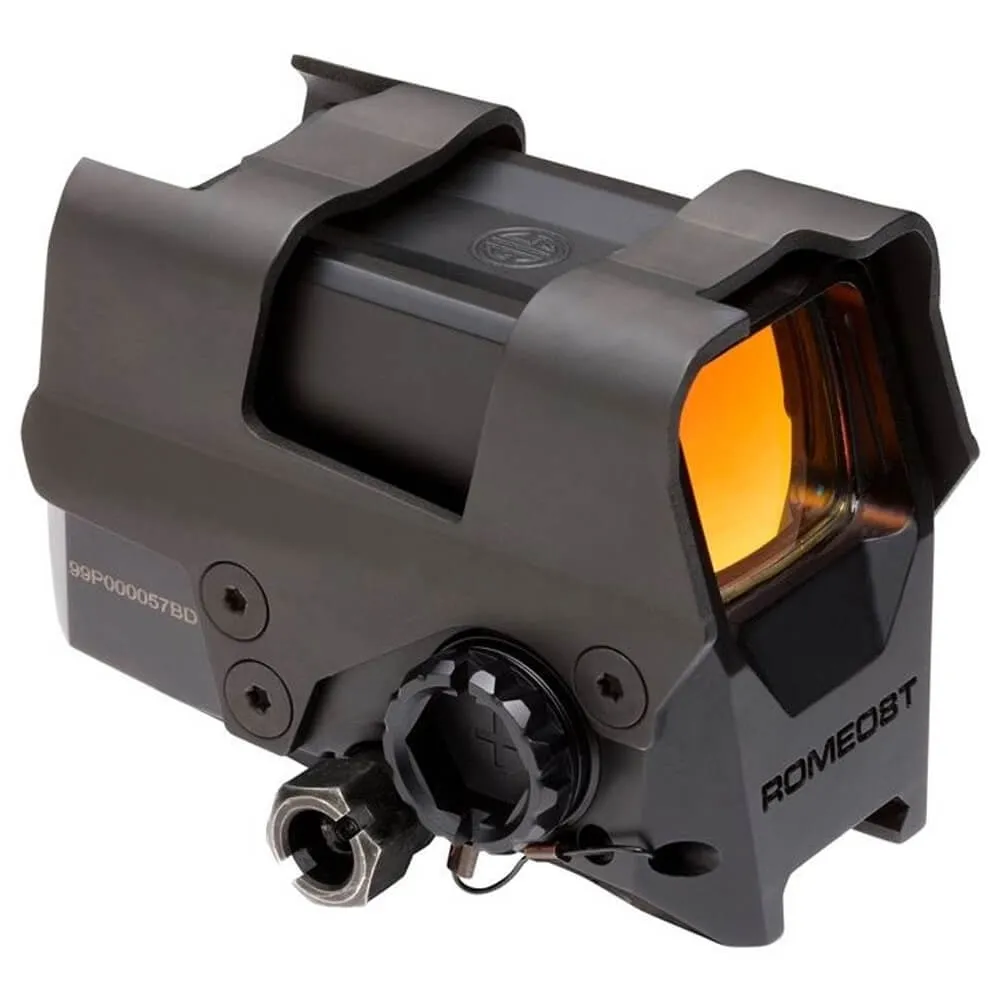
- Best sealed, closed-channel option: Sig Sauer Romeo8T
Details and specifications below.
Why a Red Dot Belongs on Your AR-15
The AR-15 lives in the space where a red dot sight shines: most engagement distances fall inside 100-200 yards, where a 1x optic is fastest. There is no front-and-rear sight alignment to manage: you put the dot on the target and press, both eyes open, field of view wide, situational awareness intact. Compared to a magnified scope, a red dot is lighter, more forgiving of head position, and far quicker for close to intermediate work; compared to irons, it removes the visual gymnastics of focusing on three planes at once. For home defense, range work, and most practical shooting on the platform, a parallax-free red dot gets the most shooters to a hit the fastest.
The trade-off is that a red dot is a 1x optic. If you regularly shoot past a few hundred yards you will want either a magnifier behind your dot or a magnified optic, which is why a couple of the picks below go beyond the classic 1x reflex sight.
Best Overall AR-15 Red Dot
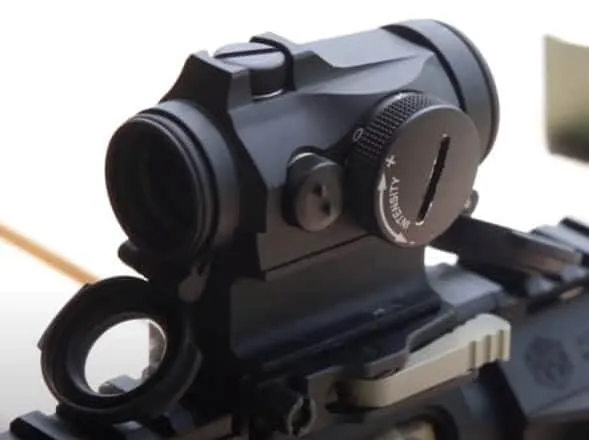
Aimpoint Micro T-2
The Aimpoint Micro T-2 is the benchmark. Aimpoint pioneered the red dot sight, and the T-2 carries that legacy with a housing that takes a licking and keeps on ticking, one of the most shockproof, weatherproof optics you can bolt to a rifle. The 2 Minute of Angle (MOA) dot is crisp and clean with no blue or green hue, the IP68 housing is submersible to 25 meters, and the CR2032 runs roughly 50,000 hours, so you simply leave it on. This is the dot I trust when failure is not an option.
- Battle-proven by USSOCOM, the U.S. Army, and law enforcement worldwide
- IP68 waterproof and shockproof for genuine duty-grade durability
- 50,000-hour battery life on a single CR2032, effectively always on
- Exceptionally clear lenses and a true 2 MOA dot for both speed and precision
The one catch: at an MSRP near $950, and with the mount sold separately (I run a Scalarworks LEAP), it is a serious investment. You pay for reliability, not features. See the full Aimpoint T2 review for the complete breakdown.
Best Feature Set
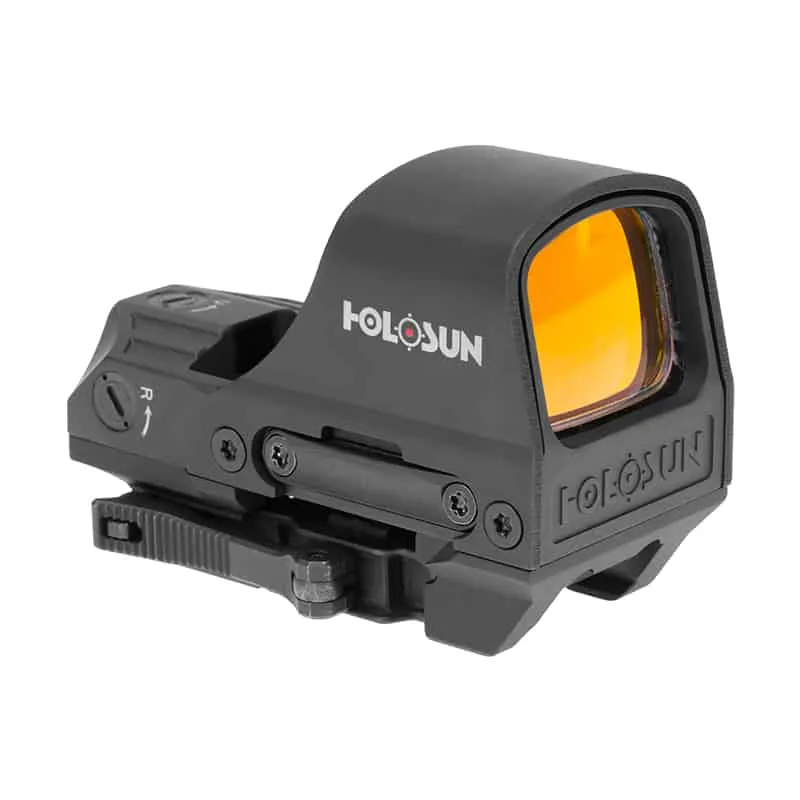
Holosun HS510C
If you want the most optic for your money, the Holosun HS510C is hard to beat. This open-emitter reflex sight gives you a switchable reticle (a 2 MOA dot, a 65 MOA circle, or both), the most versatile setup on this list. The big square window throws a wide field of view, the solar panel acts as a failsafe that can run the sight indefinitely in good light, and Shake Awake motion sensing keeps the battery alive between range trips. The quick-release Picatinny mount is included, so it is ready for your flat-top out of the box.
- Switchable circle-dot reticle (2 MOA dot, 65 MOA ring, or both) for any distance
- Solar failsafe plus a CR2032 that runs 20,000-50,000 hours depending on setting
- Shake Awake motion-sensing technology extends battery life and keeps it ready
- Large viewing window and an included quick-release mount
At an MSRP around $310 it is mid-tier money for premium-tier capability. Read the full Holosun HS510C review for the details.
Best for Magnifier Use
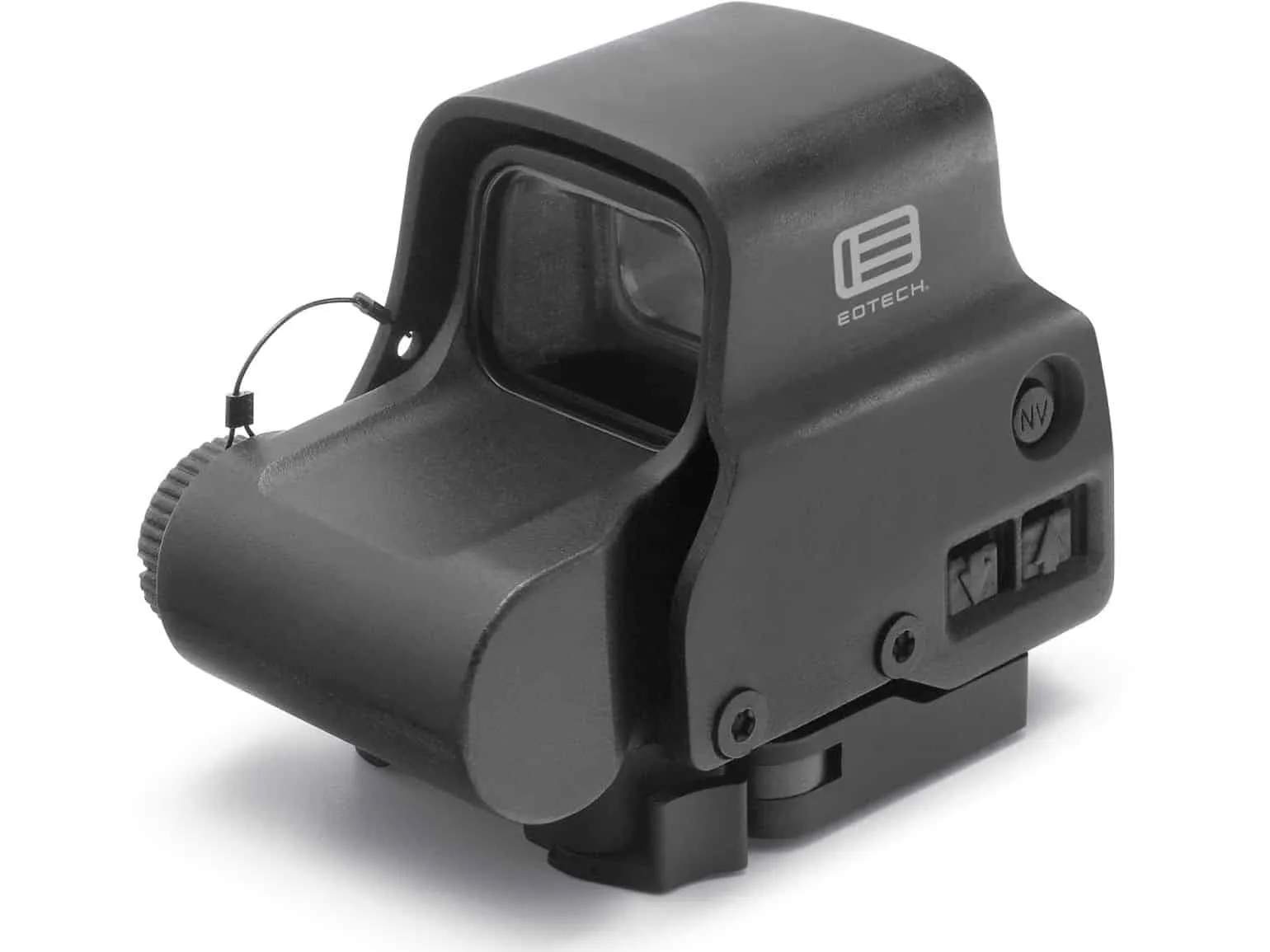
EOTech EXPS3
When you plan to run a flip-to-side magnifier, the EOTech EXPS3 is the optic I reach for. It is a holographic weapon sight, not an LED red dot, and that matters: the 1 MOA dot inside a 68 MOA ring stays a true 1 MOA even under magnification, where a projected LED dot would appear to grow. Holographic reticles also offer the fastest pickup of anything here, the hooded housing is rugged, the quick-detach lever is ambidextrous, and the optic is night-vision compatible.
- 1 MOA dot stays 1 MOA under a magnifier: the holographic advantage
- 68 MOA ring drives the fastest reticle acquisition in this lineup
- Rugged hooded housing with an ambidextrous quick-release mount
- 30 brightness settings including 10 night-vision-compatible levels
The trade-offs are real: the laser-driven holographic system only runs about 600 hours per CR123A, and the MSRP near $699 is premium territory. For shooters building a do-it-all carbine with a magnifier, it earns its keep. The full EOTech EXPS3 review has more.
Best Value
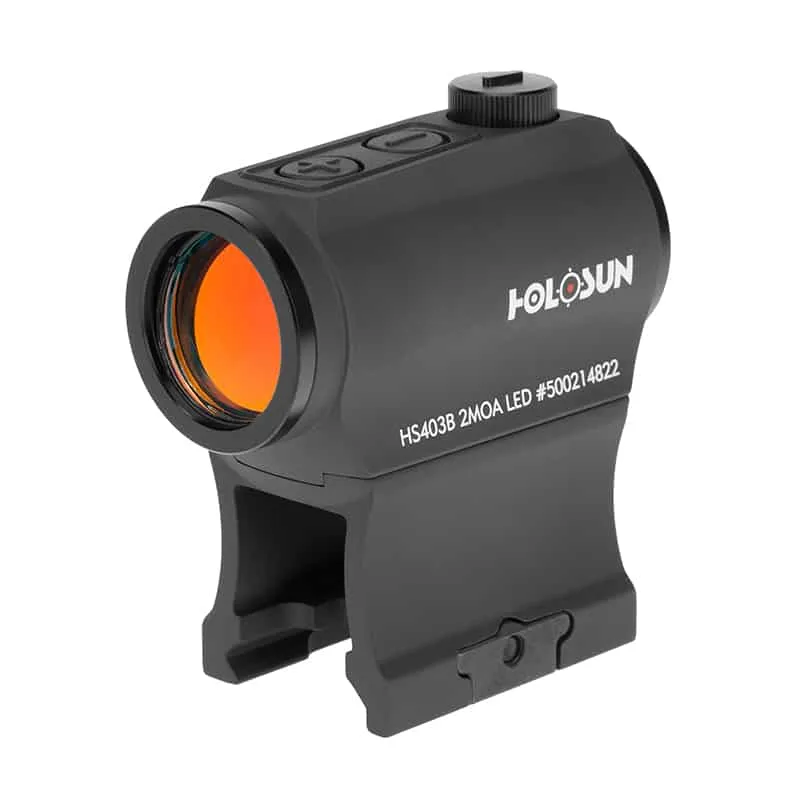
Holosun HS403B
The Holosun HS403B is the value champion. It packs Holosun toughness into a tube-style micro red dot under $200, and it ships with both a low mount and a lower 1/3 co-witness mount, so you do not spend extra to get the right height for an AR. The 2 MOA dot is clean, the T6 aluminum housing carries an IP67 rating, and the 50,000-hour battery life with Shake Awake means it is always ready.
- Holosun toughness and a clean 2 MOA dot for under $200
- Includes low and lower 1/3 co-witness mounts in the box
- 50,000-hour battery life with Shake Awake motion sensing
- Side-loading battery tray and an IP67 waterproof, dust-resistant housing
It skips the solar failsafe and the multi-reticle system to hit its price, but for a no-nonsense AR dot that just works, it is the smartest dollar on this list. See the Holosun HS403B review for the rundown.
Best Magnified Option
Vortex Spitfire 3x
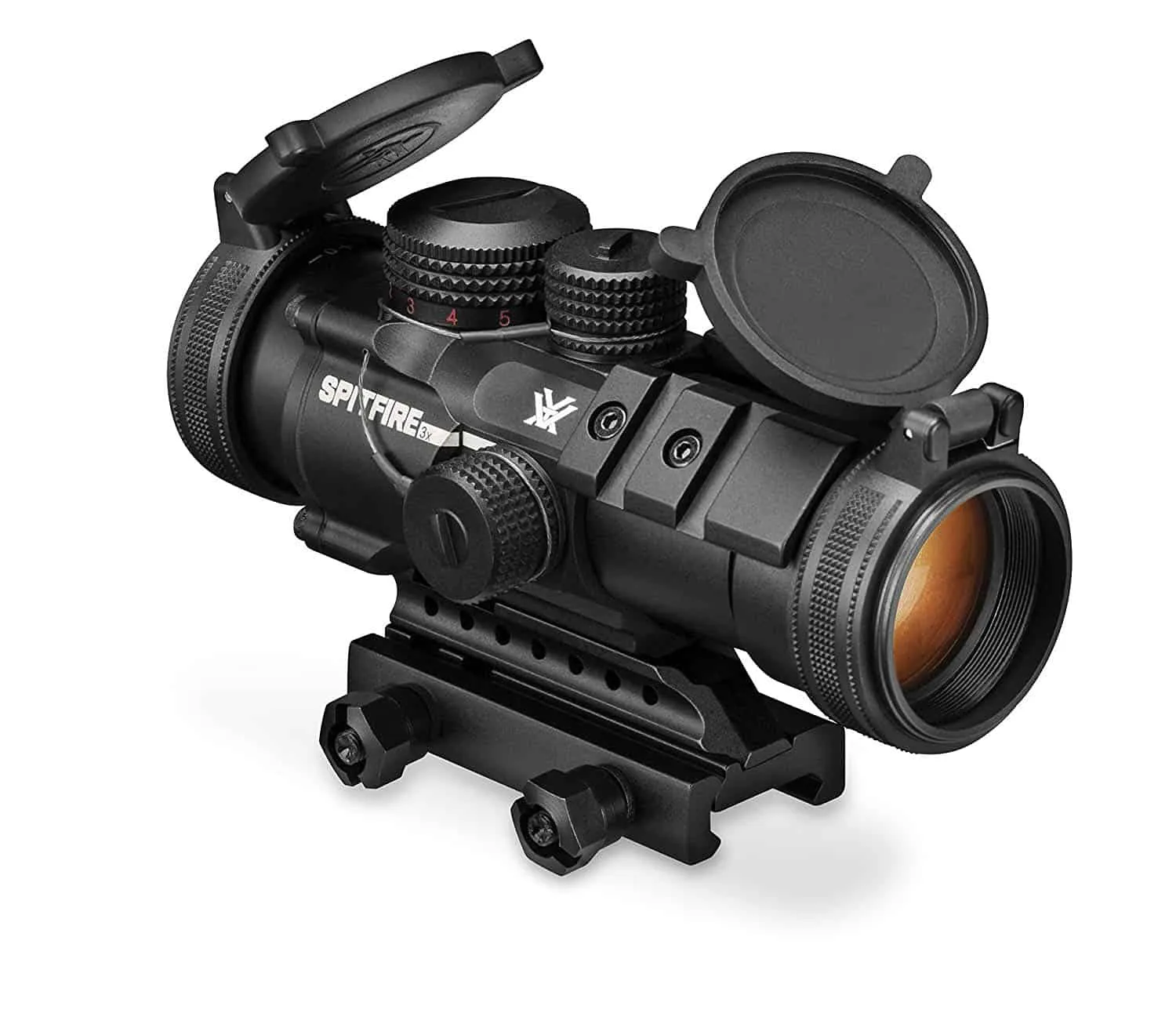
Not every AR job is a close-range job. The Vortex Spitfire 3x is a fixed three-power prism scope built specifically for the 5.56x45 platform, with an etched, illuminated EBR-556B reticle holding bullet-drop references out to 500 yards. Because the reticle is etched into the glass, it still works with the illumination off if your battery dies. Two mount heights come in the box, and the Vortex VIP unconditional lifetime warranty backs it for life.
- Fixed 3x magnification with a 5.56-specific BDC reticle out to 500 yards
- Etched reticle works even with the illumination switched off
- Two mounting heights included, no extra mount to buy
- Vortex VIP unlimited lifetime warranty
It is the heaviest optic here at 15.4 oz, and the fixed 3x gives up close-quarters speed to a true 1x dot, so pick it only if your distances justify the magnification. The full Vortex Spitfire 3x review covers it in depth.
Best Budget Pick
Sig Sauer Romeo5
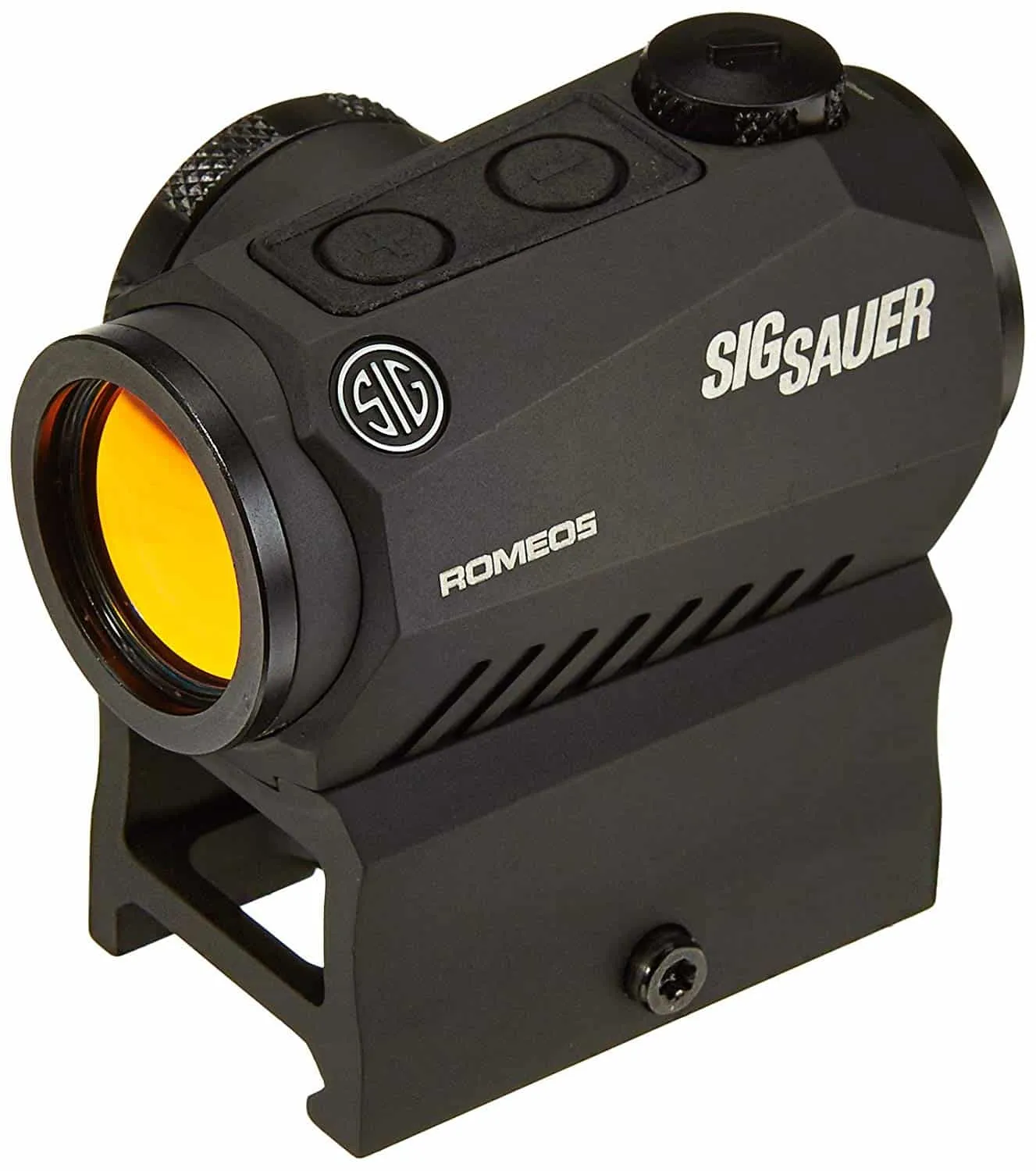
For a proven, reliable dot without spending much, the Sig Sauer Romeo5 is the obvious answer. One of the bestselling compact red dots on the market, it includes both a low mount and a 1.41-inch co-witness riser at an MSRP around $119, runs MOTAC motion-activated illumination, and is backed by Sig’s transferable Infinite Guarantee. The 2 MOA dot and half-MOA adjustments make zeroing painless.
- Includes low and 1.41-inch co-witness mounts for the AR right out of the box
- MOTAC motion-activated illumination and a 40,000-hour-plus battery life
- Half-MOA adjustments for precise zeroing at close and intermediate range
- Sig Sauer Infinite Guarantee: transferable lifetime warranty
For a first AR optic or a backup-rifle dot, it is tremendous value. Read the full Sig Romeo5 review for more.
Best Budget Circle-Dot
Sightmark Ultra Shot M-Spec
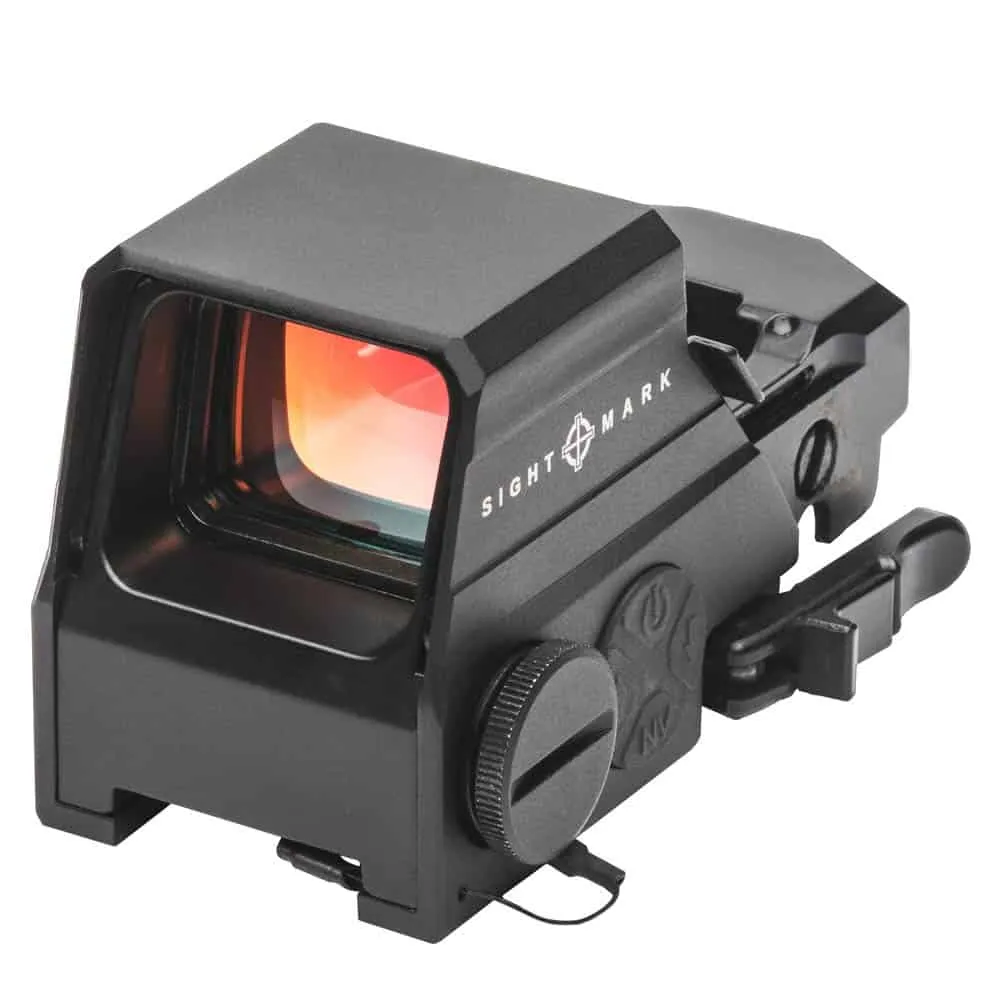
If you like the circle-dot concept but not the premium price, the Sightmark Ultra Shot M-Spec delivers it for under $200. It pairs a 2 MOA center dot with a 65 MOA ring in a rugged magnesium-alloy chassis that is IP68 waterproof to 40 feet and night-vision compatible across Gen 1-3 systems. The Interlok system holds zero through recoil without locking screws, and a Locking Quick Detach mount is included.
- 2 MOA dot inside a 65 MOA ring for fast, versatile acquisition
- IP68 waterproof to 40 feet with a shockproof magnesium-alloy frame
- Night-vision compatible with 6 daylight and 6 NV brightness settings
- Interlok system holds zero through recoil; quick-detach mount included
At 10.2 oz it is heavier than a micro dot, and tensioning the mount means pulling the optic, but the feature-to-price ratio is excellent. See the Sightmark Ultra Shot review for details.
Best Entry-Level
Bushnell TRS-25
When the budget is tight or you are putting a dot on a first AR, the Bushnell TRS-25 is the proven entry point. At an MSRP around $55 it offers a 3 MOA dot, 11 brightness settings, and a nitrogen-purged, fog-proof, waterproof metal housing. It mounts on rifles, shotguns, and pistols via Picatinny, so it is endlessly useful around the safe.
- Capable, durable red dot at an entry-level price near $55
- 3 MOA dot with 11 brightness settings for any lighting
- Nitrogen-purged, fog-proof, waterproof metal housing
- Versatile Picatinny mounting across multiple platforms
It is not built for hard duty use, and you will want to swap the stock battery for a quality brand, but for learning the platform or building a budget plinker it punches above its weight. The full Bushnell TRS-25 review has more.
Best Sealed, Closed-Channel Option
Sig Sauer Romeo8T
Every reflex sight above leaves its emitter in an open channel, which is fine until the rifle spends a wet, dusty day outdoors. The Sig Sauer Romeo8T takes the closed-channel idea that pistol optics like the Aimpoint ACRO made popular and scales it up for rifles, carbines, and shotguns. It is a 1x38mm sight in a 7075-T6 body wrapped in a removable titanium shroud, with flip-back lens covers, an IPX-8 waterproof rating, and four selectable ballistic reticles (a 2 MOA dot inside a 65 MOA circle among them) so you can hold for distance without touching a turret. A single CR123A with MOTAC motion activation is rated past 100,000 hours across 13 brightness settings, 3 of them night-vision compatible.
- Closed optical channel plus a removable titanium shroud over the housing
- Four selectable ballistic reticles for holdovers without dialing
- IPX-8 waterproofing and 100,000-plus hours from one CR123A with MOTAC
- Mounts to any M1913 rail with a 1/2 inch hex nut cross bolt
The independent torture testing that exists on this exact model backs the design up: it survived a drop onto rock, a dunk in water, and multiple shotgun pellet impacts with no functional failure. Two honest caveats. At 13.7 oz it is one of the heaviest optics here, and the owner round counts we could find run in the hundreds to roughly 1,200 rounds, which is genuinely positive but a far smaller sample than a decade-proven optic like the T-2 carries. Street pricing has moved around a lot over this sight’s life, so check the current listing rather than any older quoted figure. Read the full Sig Sauer Romeo8T review.
Specification Quick Comparison
Now that we have covered the key points for each pick, here is the technical data that matters most when choosing a red dot for an AR-15. The links above lead to a comprehensive review of each optic.
| Sight | Type | Reticle | Battery | Battery Life | Weight | MSRP |
|---|---|---|---|---|---|---|
| Aimpoint T-2 | LED red dot | 2 MOA | CR2032 | 50,000 hrs | 3.3 oz | $950 |
| Holosun HS510C | LED reflex | 2 MOA / 65 MOA | CR2032 | 20k-50k hrs | 4.94 oz | $310 |
| EOTech EXPS3 | Holographic | 1 MOA / 68 MOA | CR123A | 600 hrs | 11.2 oz | $699 |
| Holosun HS403B | LED red dot | 2 MOA | CR2032 | 50,000 hrs | 2.82 oz | $170 |
| Vortex Spitfire 3x | Prism scope | EBR-556B (3x) | CR2032 | 250-3,000 hrs | 15.4 oz | $349 |
| Sig Romeo5 | LED red dot | 2 MOA | CR2032 | 40,000+ hrs | 5.1 oz | $119 |
| Sightmark Ultra Shot | LED reflex | 2 MOA / 65 MOA | CR123A | 2,000 hrs | 10.2 oz | $175 |
| Bushnell TRS-25 | LED red dot | 3 MOA | CR2032 | 3,000+ hrs | 3.7 oz | $55 |
| Sig Romeo8T | LED, closed channel | 2 MOA / 65 MOA (4 reticles) | CR123A | 100,000+ hrs | 13.7 oz | $799.99 |
A Shooter’s Guide to Choosing the Best Red Dot for an AR-15
Choosing the right optic for your carbine comes down to a handful of features. How much each one matters depends on how you run the rifle: a home-defense build, a competition gun, and a budget range toy each weight these differently. The factors I consider most important are durability, reticle, mounting and co-witness, battery life, magnifier compatibility, and price.
Durability
An AR-15 generates real recoil and real handling abuse, and your optic has to survive both. For a defensive or duty rifle, durability is the single most important factor; a dot that loses zero or quits is worse than no optic at all. Look for a sealed housing with an Ingress Protection (IP) rating: IPX7 means submersible to 1 meter for 30 minutes, while the Aimpoint T-2 and Sightmark Ultra Shot push that to IP68 with deeper submersion. A machined aluminum, magnesium-alloy, or titanium chassis resists impact, and quality optics encase their electronics against recoil and moisture. If your rifle’s job is protecting life, buy the most rugged optic you can afford.
Reticle
Reticle choice on an AR comes down to dot size and pattern. A 2 MOA dot is the sweet spot for most builds: it covers about 2 inches at 100 yards, small enough for precise hits out to 200-300 yards yet large enough to find fast up close. A larger 3 MOA dot, like the Bushnell’s, trades a little precision for quicker close-range pickup. Circle-dot reticles split the difference: the Holosun HS510C and Sightmark Ultra Shot pair a 2 MOA center dot with a 65 MOA ring, where the big ring drives the eye to the dot for speed while the dot delivers precision. Holographic sights like the EOTech EXPS3 use a 1 MOA dot in a 68 MOA ring and hold that fine dot even under a magnifier. Match the reticle to your distances: simple dot for general use, circle-dot for speed-plus-precision, holographic if a magnifier is in your future.
Mounting and Co-Witness
Every modern AR-15 has a flat-top Picatinny rail, so mounting is straightforward; the real question is height. For a rifle you want the optic high enough for a comfortable, heads-up cheek weld, so mount height matters more here than on a pistol. Co-witnessing keeps your backup iron sights visible through the optic so you can keep fighting if the electronics fail. The most popular AR setup is a lower 1/3 co-witness mount (around 1.6 inches): the irons sit in the bottom third of the window, out of the way until you need them, while the dot rides at a natural height. An absolute co-witness instead puts the dot directly over the front sight post. Several picks here (the Holosun HS403B and the Sig Romeo5) include both a low mount and a co-witness riser in the box, which saves you buying a mount separately.
Battery Life
A red dot is only useful when it is on, so battery life matters, especially on a rifle you may grab in a hurry. Modern LED red dots win here: the Aimpoint T-2 and Holosun HS403B run roughly 50,000 hours on a single coin cell, long enough to leave on for years. Motion-sensing technology (Shake Awake on Holosun, MOTAC on Sig) powers the optic down when it sits still and wakes it the instant you move the rifle, stretching life further while keeping the dot ready. Holographic sights pay for their performance: the EOTech EXPS3 runs about 600 hours per battery. For a true set-it-and-forget-it optic, prioritize a long-life LED dot with motion sensing.
Magnifier Compatibility
A red dot is a 1x optic, perfect inside 100 yards but limiting beyond it. You have two ways to reach farther. The first is a flip-to-side magnifier behind your dot: choose an optic whose reticle behaves under magnification, which is exactly where the EOTech EXPS3’s 1 MOA holographic dot excels (a projected LED dot appears to grow under glass). The second is a dedicated magnified optic like the Vortex Spitfire 3x, a fixed 3x prism scope with a 5.56-specific bullet-drop reticle built for AR distances out to 500 yards. Decide honestly how far you shoot: if it is mostly close, a plain 1x dot is faster and lighter; if you stretch the legs of your carbine, plan for magnification from the start.
Two more options sit either side of that decision. On the magnifier route, the Vortex VMX-3T is a 3x flip-to-side unit with a push-button mount, absolute and lower 1/3 co-witness heights, and Vortex’s VIP warranty, built to ride behind a tube-style dot. On the dedicated-optic route, Primary Arms’ prisms give you an etched reticle that keeps working with the illumination off: the GLx 2X stays fast for close and mid range with an ACSS CQB-M5 reticle, and the SLx 5X MicroPrism reaches well past 200 yards, though at 5X it needs a piggybacked red dot to stay usable up close. If a holographic reticle is what you are after but the EXPS3’s price is not, the AA-powered EOTech 512.A65 runs the same 68 MOA ring and 1 MOA dot without the night-vision settings or the quick-detach lever.
How Much Should You Spend?
AR-15 red dots span a wide range, from about $55 for a Bushnell TRS-25 up to $950 for an Aimpoint T-2, and the platform’s popularity has driven serious quality into the middle of the market. For a beginner or budget build, $50-$120 gets you a capable dot like the Bushnell or Sig Romeo5. The $150-$350 band is the value sweet spot: the Holosun HS403B, Sightmark Ultra Shot, and Holosun HS510C all deliver near-duty-grade reliability there. Premium duty and holographic optics like the EOTech EXPS3 and Aimpoint T-2 run $700-$950, where you pay for proven, no-compromise durability. Buy the most reliable optic your intended use justifies, and no more.
Conclusion
There is no single best red dot for every AR-15, only the best dot for how you run yours. For a do-anything, bet-your-life carbine the Aimpoint Micro T-2 is the benchmark; for the most features per dollar the Holosun HS510C is tough to beat; and for a first AR optic the Sig Romeo5 and Bushnell TRS-25 prove you do not need to spend a fortune to get on target fast. If the rifle works outdoors in bad weather, the sealed Sig Romeo8T is the one on this list that keeps debris off the emitter entirely. Whichever you choose, mount it at a co-witness height, leave it on, and put in the reps. The optic gives you the advantage, but practice turns it into a hit.