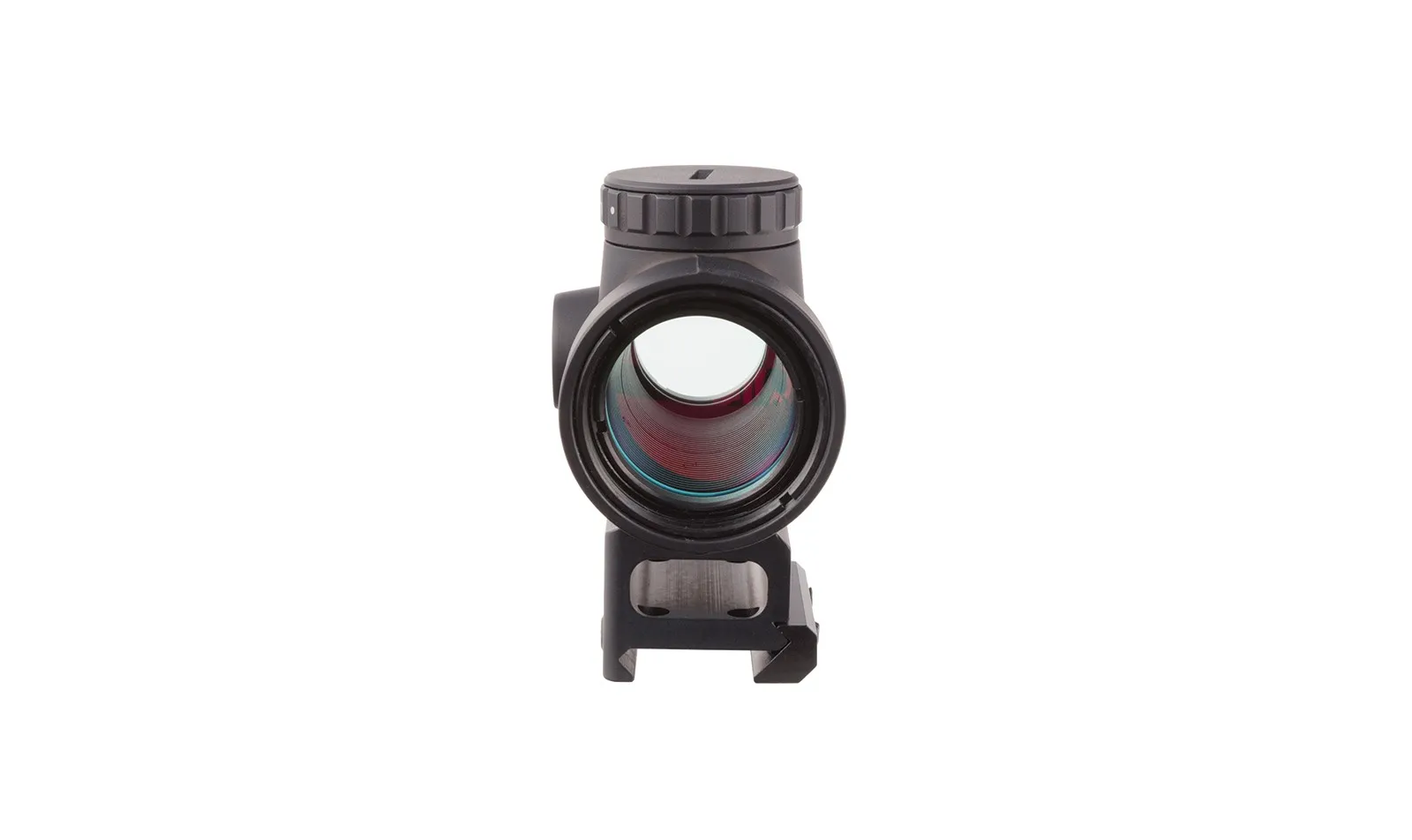
Are you searching for a tube-style red dot with a genuinely big window? The Trijicon MRO, short for Miniature Rifle Optic, is Trijicon’s answer. Where most compact red dots squeeze you behind an 18mm aperture, the MRO opens things up with a 25mm objective and a tapered housing that keeps the view wide and the obstruction low. It is a sight built to be looked through, not around.
In this review of the Trijicon MRO, we will take a complete look at the top features, the full specifications, and the pros vs. the cons of this optic. We will cover the design, reticle, operation, and mounting, walk through what comes in the box, and finish with what other shooters have to say about it. We will also touch on how the standard MRO differs from the newer MRO HD so you know exactly which one you are buying.
Trijicon MRO Review
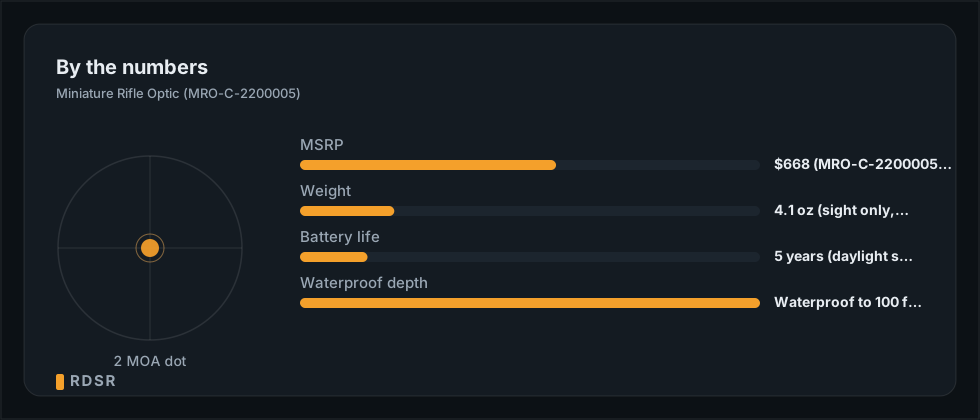
The Trijicon MRO is a 1x sealed tube red dot sight with a 25mm objective lens and a single 2 Minute of Angle (MOA) LED-projected red dot reticle. The housing is forged from A high-strength aerospace aluminum alloy (yield about 503 MPa / 73 ksi, roughly 1.8x that of 6061-T6) for only a few percent more weight. The go-to for duty and hard-use pistol optics, often forged.Full comparison → aluminum, the same alloy class used in aircraft and rifle receivers, and the whole unit weighs just 4.1 oz on its own with the battery, or around 5.8 oz once you add Trijicon’s full co-witness mount. It measures a stout 2.6” long by 1.7” wide by 2.0” tall. Power comes from a single A 3-volt lithium coin cell, 20mm across, and the most common red dot battery (about 210 to 240 mAh). Stocked almost everywhere, so a field swap is easy.Full comparison → lithium coin cell rated for up to five years of continuous use at daylight brightness setting 3. The version reviewed here, the MRO-C-2200005, which ships with the full co-witness mount, carried a Trijicon MSRP around $668. Note that Trijicon has since discontinued the original MRO in favor of the newer MRO SD and MRO HD lines, so new pricing now tracks those models.
Trijicon is a Wixom, Michigan optics maker best known for the battle-tested ACOG and its tritium-and-fiber-optic illumination technology, and for the Trijicon RMR, the pistol-slide sight that USSOCOM put its name behind. The company has supplied optics to the U.S. military and law enforcement for decades, and that institutional reputation carries straight into the MRO. This is a red dot sight from a maker that builds for duty first and the range second.
Top Features of the Trijicon MRO
Design
The MRO’s signature feature is its housing geometry. Trijicon used a tapered, ambidextrous tube and a large 25mm objective to deliver a field of view that feels far wider than the small rear aperture would suggest. The result is a sight you can run with both eyes open without the tunnel-vision sensation that plagues smaller red dots.
The body is forged from 7075-T6 aluminum and finished in a hard-anodized matte black that resists scratches, solvents, and corrosion. The optic is fully sealed and nitrogen-purged to prevent internal fogging. It is An optic's Ingress Protection (IP) code from IEC 60529: the first digit rates dust (0 to 6), the second rates water (0 to 8). A digit shown as X was simply not tested.Full comparison → to 100 feet (30 m), deep enough that water or dust intrusion is simply not a concern for any realistic use.
At 2.6” x 1.7” x 2.0” and 4.1 oz on its own, the MRO is compact but a touch taller and heavier than an 18mm micro once a mount is attached. That extra glass is the trade-off for the wider window, and most shooters find it well worth it.
Lenses
The MRO uses multi-coated lenses tuned to pass light cleanly and present a crisp dot. The standard MRO shows a hint of distortion at the very edge of the glass and a slightly less-than-perfect dot shape compared with the newer MRO HD. For general red dot duty, though, the view is clear and the dot is easy to pick up fast.
Reticle
The MRO carries a single 2 MOA red dot reticle generated by an LED emitter. I find 2 MOA the easiest size to justify on a carbine dot: fine enough for precise shot placement out to mid range yet large enough to grab quickly up close, a versatile, do-everything dot size that suits the carbine and patrol-rifle role this optic is built for.
There are 8 brightness settings in total: 5 daylight levels, 1 extra super-bright daylight setting for the brightest conditions, and 2 settings compatible with Night Vision Devices (NVD). That spread covers everything from a dim indoor hallway to harsh desert sun.
Operation
Brightness is controlled by a knurled dial that doubles as the battery cap, positioned at the top of the optic. You rotate the dial to the desired level and to the off position. Simple and tactile, and there’s nothing to relearn if you’ve used a rotary-dial red dot before. Note that the MRO is fully manual: there is no motion-sensing auto-off, so you will want to dial it off when you store the firearm to preserve battery life.
Speaking of which, that single CR2032 lithium battery delivers up to five years of continuous use at daylight setting 3. Because the battery lives under the top-mounted brightness dial, you can swap it without removing the optic or losing your zero, an advantage the original Trijicon RMR never had.
Windage and elevation adjustments move the point of impact (POI) in 1/2 MOA increments, with a total adjustment range of 70 MOA. The capped turrets click positively, and the adjustment tool is integrated into the turret caps so you are never hunting for a separate tool at the range.
Reliability standing
Trijicon MRO (2 MOA red dot, MRO-C-2200005)
High confidence based on 4 sources, 4 first-hand.
- Rounds tested
- 1500+
- Battery
- CR2032: 5 years continuous-on at daylight setting 3 (red 2 MOA, CR2032), per Trijicon and cited consistently across reviewers; the green-dot MRO variant is far shorter at about 1 year due to the laser-diode emitter.
What those tests were
- drop: pass with caveat . First-hand: dropped ~5 feet onto a large rock with turret caps installed (Pew Pew Tactical torture test). The optic struck its illumination/brightness knob; on the next group at 50 yards the point of impact had shifted noticeably high-left. The companion MRO review summarizes the same event as a shift of 'a few MOA,' still good for torso-sized targets. Exact MOA was not measured. Survived structurally and kept functioning.
- drop: pass . First-hand real-world abuse (TTAG): carried loosely in bags and a truck bed for about a month and fired from unconventional positions (ground, upside down, off a truck, braced against a tree); never lost zero. Separately, a Scottsdale PD patrol sergeant (Police Magazine) banged it against barriers and dropped it on the deck several times, then confirmed it held zero.
- submersion: pass . First-hand: Jon Wayne Taylor (TTAG) dropped the MRO in a sink full of water and confirmed it kept working ('it is, in fact, waterproof'). This is an informal dunk, not a depth/duration-controlled submersion. Trijicon rates the standard MRO to 100ft (manufacturer claim, not measured by these testers).
- thermal drift: pass with caveat . First-hand but admittedly imprecise (Pew Pew Tactical torture test): frozen with inverted compressed-air cans to roughly -30 to -40F, then heated with a butane torch to roughly 130F. The testers report every optic survived the thermal test without issue (the fogging they saw was on the ACOG in the same test, not the MRO), and they cautioned that surface temperature may not reflect internal exposure. Treat as a rough pass, not a lab thermal-drift figure.
- recoil: pass . First-hand: ~1,500+ rounds across 5.56 NATO and heavy-recoiling .458 SOCOM uppers including 200 rounds of maximum-pressure hand loads in one session, with no failure and zero retained throughout (TTAG). Roughly 1,000 rounds in standard testing with zero issues (Pew Pew Tactical).
Aggregated from others' first-hand testing, not our own: this standing deliberately reaches past any one shooter's round count. We surface a sourced reputation tier rather than inventing a score the evidence cannot support.
Full reliability data →Mounting
The MRO sits on a Picatinny / MIL-STD-1913 rail. Trijicon sells the MRO in several configurations: as a bare optic, with a low mount for a lower-third sight picture, or with a full co-witness mount that lines the dot up with standard AR-15 iron sights. The SKU reviewed here, the MRO-C-2200005, ships with that full co-witness mount, so you can run it out of the box. Because the mounting options are modular, the MRO drops cleanly onto rifles, carbines, and shotguns alike.
If you instead buy a bare-optic configuration, budget for a quality mount on top of the sight price. The real-world cost of those configurations is the sight plus the mount you choose.
Details
Included with your purchase:
- Trijicon MRO 1x25 red dot sight
- CR2032 battery (installed)
- Trijicon full co-witness mount (included with the MRO-C-2200005 SKU reviewed here; bare-optic SKUs ship without a mount)
- Lens cloth
- Instruction manual
- Trijicon warranty documentation
What is the Difference Between the MRO and the MRO HD?
Trijicon released the MRO HD to address the standard MRO’s two main limitations. The HD adds a switchable, ambidextrous reticle (you can run a 2 MOA dot alone or a 2 MOA dot inside a 68 MOA segmented outer ring), and it uses a re-engineered objective for a crisper, rounder dot that holds up better behind a magnifier. The HD also expands the brightness range to 16 settings (4 of them night-vision compatible) versus the standard MRO’s 8, while its battery life is shorter: roughly 2.5 years on the dot-only reticle versus the standard MRO’s five years. Both share the same forged 7075-T6 housing and 100-foot waterproof rating. If you want the cleaner glass and the ringed reticle, step up to the HD. If you want the longest battery life at the lowest price, the standard MRO reviewed here is the pick.
Warranty
The MRO is covered by Trijicon’s limited lifetime warranty on the optical system and metal housing, plus a five-year warranty on the electronic LED illumination components. Trijicon’s customer service has a solid reputation in the shooting community, which is part of what justifies the premium over budget brands.
Warranty standing
Trijicon warranty
Lifetime housing, 5-yr electronics, non-transferable
- Housing
- Lifetime
- Electronics
- 5 yrs
- Transferable
- No
- Receipt required
- Unstated
- Registration
- Unstated
- Support
- active
What Reviewers Say
Independent reviewer testing backs up the MRO’s reputation. Reviewers at The Truth About Guns put roughly 1,500 rounds through the optic across a 5.56 upper, a heavy-recoiling .458 SOCOM upper, and a session of maximum-pressure hand loads without losing zero, and separately carried it loose in bags and a truck bed for a month, firing from unconventional positions with no issue. A Scottsdale PD patrol sergeant writing for Police Magazine banged the optic against barriers and dropped it on pavement several times and confirmed it held zero. Pew Pew Tactical’s torture test dropped the MRO onto a rock, which shifted point of impact a few MOA but left the optic functional, and it survived rat shot, birdshot, and a rough freeze-and-heat cycle before an extreme .22 LR impact finally destroyed the front lens, an outcome most peer optics in the same test also suffered. Reviewers consistently describe the glass as clear and the wide 25mm window as a real advantage for shooting with both eyes open. No source has published a measured battery-runtime figure or a large-scale round-count endurance test, so treat those specifics as manufacturer claims rather than independently verified data.
Pros & Cons
Pros
- Large 25mm objective with a wide, distortion-light field of view for easier both-eyes-open shooting than most micro red dots
- Forged 7075-T6 aluminum housing that is exceptionally rugged and built to take a beating
- Five-year battery life on a single CR2032 at daylight setting 3
- Clean 2 Minute of Angle (MOA) dot that snaps into focus fast for quick target acquisition
- 8 brightness settings including 2 night-vision and 1 super-bright daylight setting
- Waterproof to 100 feet (30 m) with a fully sealed, nitrogen-purged body
- Backed by Trijicon's limited lifetime warranty on the optic and housing, plus 5 years on the LED electronics
Cons
- Premium price for a single-reticle optic, with no shake-awake or solar backup at this cost
- Single 2 MOA dot only, with no ringed or switchable reticle like the newer MRO HD
- Manual brightness only, so no motion-activated power saving means you must remember to switch it off
Conclusion
The Trijicon MRO is a no-nonsense, combat-proven red dot sight that does the fundamentals exceptionally well: a wide, clear view, a clean 2 MOA dot, a rugged forged body, and a battery you can set and forget. It is not the most feature-loaded optic at its price, but it is one of the most dependable, and for a duty rifle or a serious home-defense carbine that reliability is exactly the point. We would rather recommend an optic that does fewer things without fail than one that does more and occasionally lets you down.
Alternative Sight Options
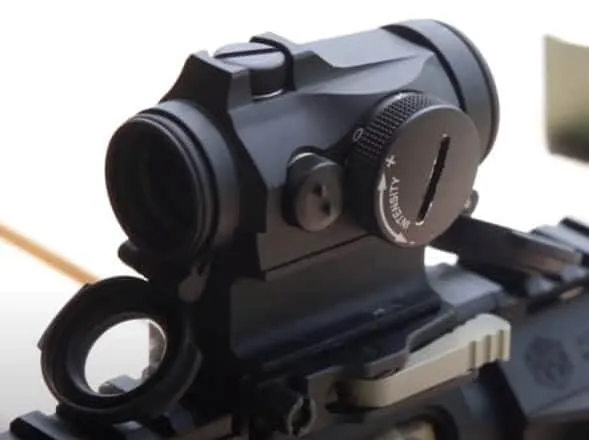
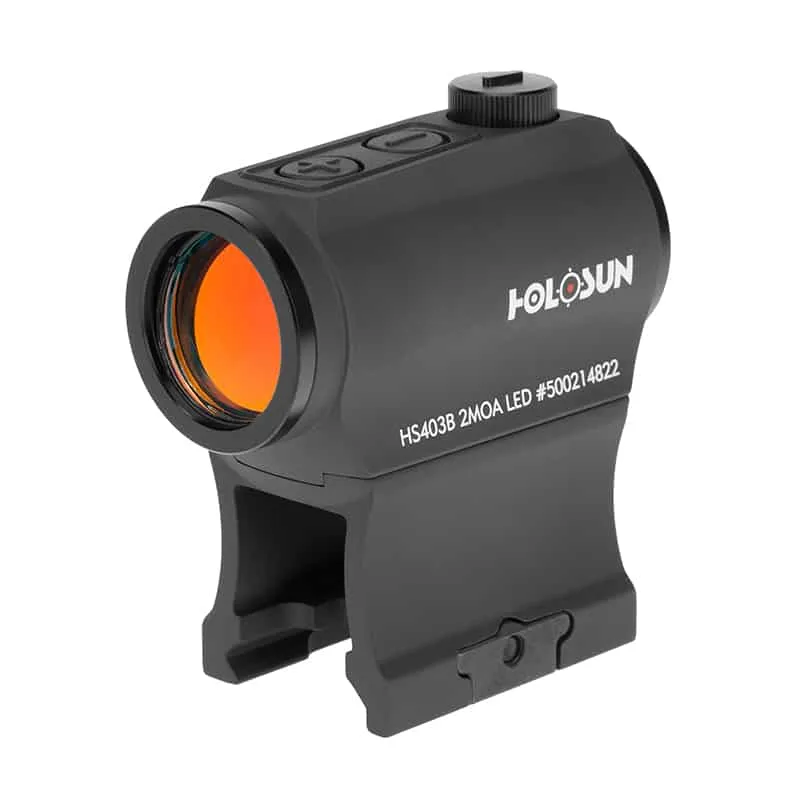
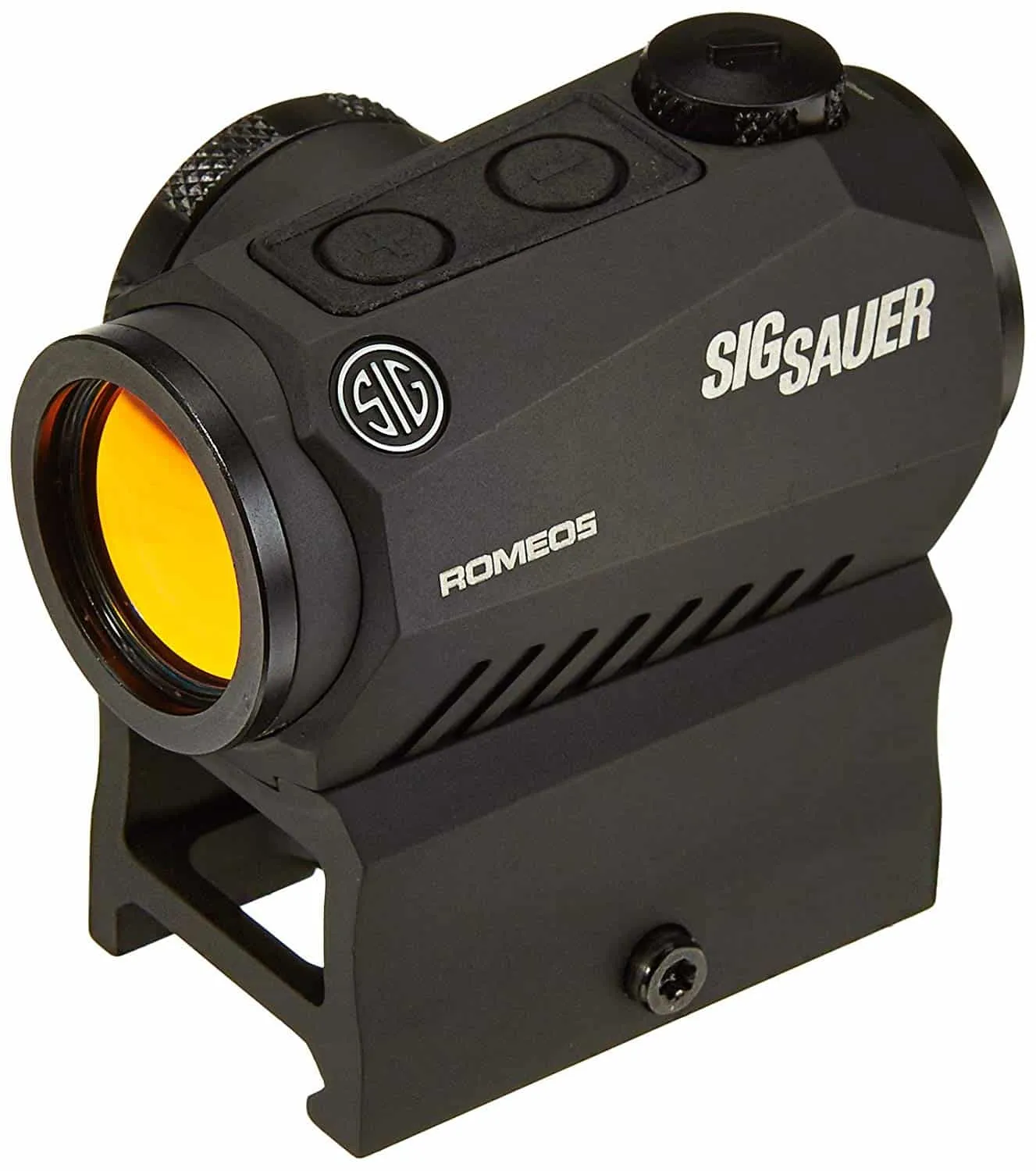
If you want comparable ruggedness in a smaller package and you are willing to spend more, look at the Aimpoint T2, which is the gold standard for compact duty red dots. If the MRO’s price is a stretch and you can live with a smaller window, the Holosun HS403B delivers reliable performance at a fraction of the cost. And if you want a carbine-ready optic that splits the difference on price, the Sig Romeo5 is an easy pick for the budget-conscious shooter who still wants a rifle-rated sight.