Start with fit, because it is the only question with a yes-or-no answer. A pistol dot bolts to one specific pattern of screw holes, so the optic you can buy is the one whose footprint matches your slide cut, or one an adapter plate can bridge to it. Even the top-ranked sight on this page is the wrong sight if it cannot sit on your gun.
Once the shortlist is the set that fits, two kinds of evidence separate what is left. The first is the warranty: published terms are a fact you can read before you spend anything, and they differ far more between brands than the marketing does. The second is the durability record, which for most of these optics has already been written by independent testers logging round counts, drops, submersion and freeze cycles. Price comes last. The cheapest optic that dies in a class was not cheap.
This page is built in that order. Our order comes from sourced data, the same as our open pistol ranking: reliability reputation first, then how much first-hand evidence backs it, then the lower list price. The optics below keep their place in that ranking of 18 current open-emitter pistol dots, and under the list a data table assembled from this site’s own records: each optic’s footprint, how many of the pistols we track it drops straight onto with no adapter, the brand’s warranty grade computed from published terms alone, the reliability standing and confidence level aggregated from other people’s first-hand testing, and the manufacturer’s MSRP. We do not shoot these optics ourselves, so nothing here is presented as our own test result. Every record behind the table carries its own verification date, and the most recent of those dates is printed with it.
Choosing for a pistol has requirements a rifle optic does not: slide reciprocation punishes an optic far harder than a receiver rail does, and the mounting space is a fraction of the size. In recent years reflex sight manufacturers have increased the quality of their Micro Red Dot sights (MRDs), making them more suitable for handgun applications. The picks below are reflex-style sights from the makers this site tracks in depth: Trijicon, Leupold, Holosun, Vortex Optics, and Burris.
The Best Pistol Red Dot Sights
- Best overall (first of the 18 open pistol dots we rank) - Trijicon RMR Type 2
- Runner-up (second of the 18) - Trijicon SRO
- Concealed carry - Holosun HS507K X2
- Duty-grade titanium housing - Holosun HE508T-RD X2
- Biggest window on the RMR footprint - Holosun HE507COMP
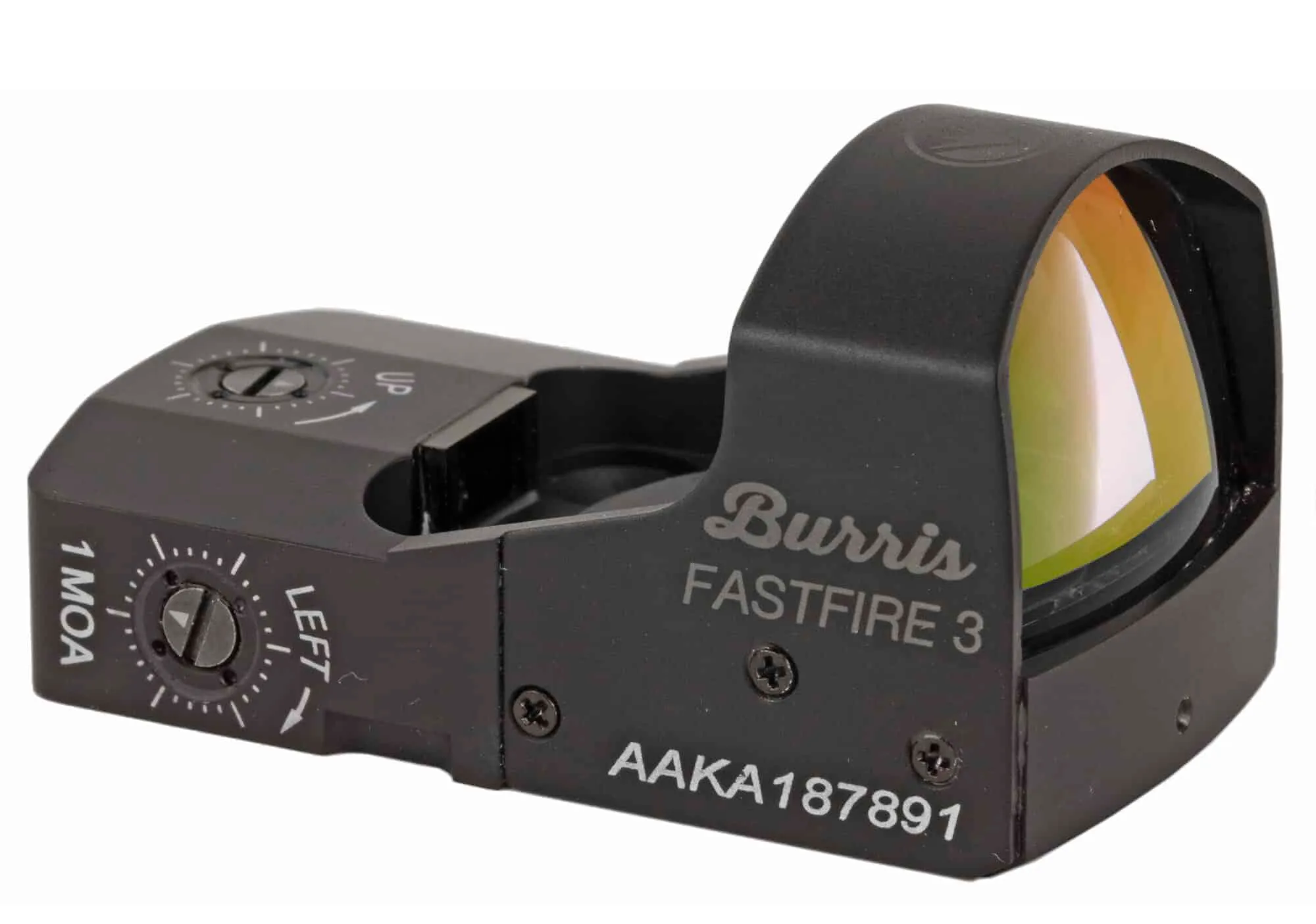
- Entry-level, under $300 list - Burris FastFire 3
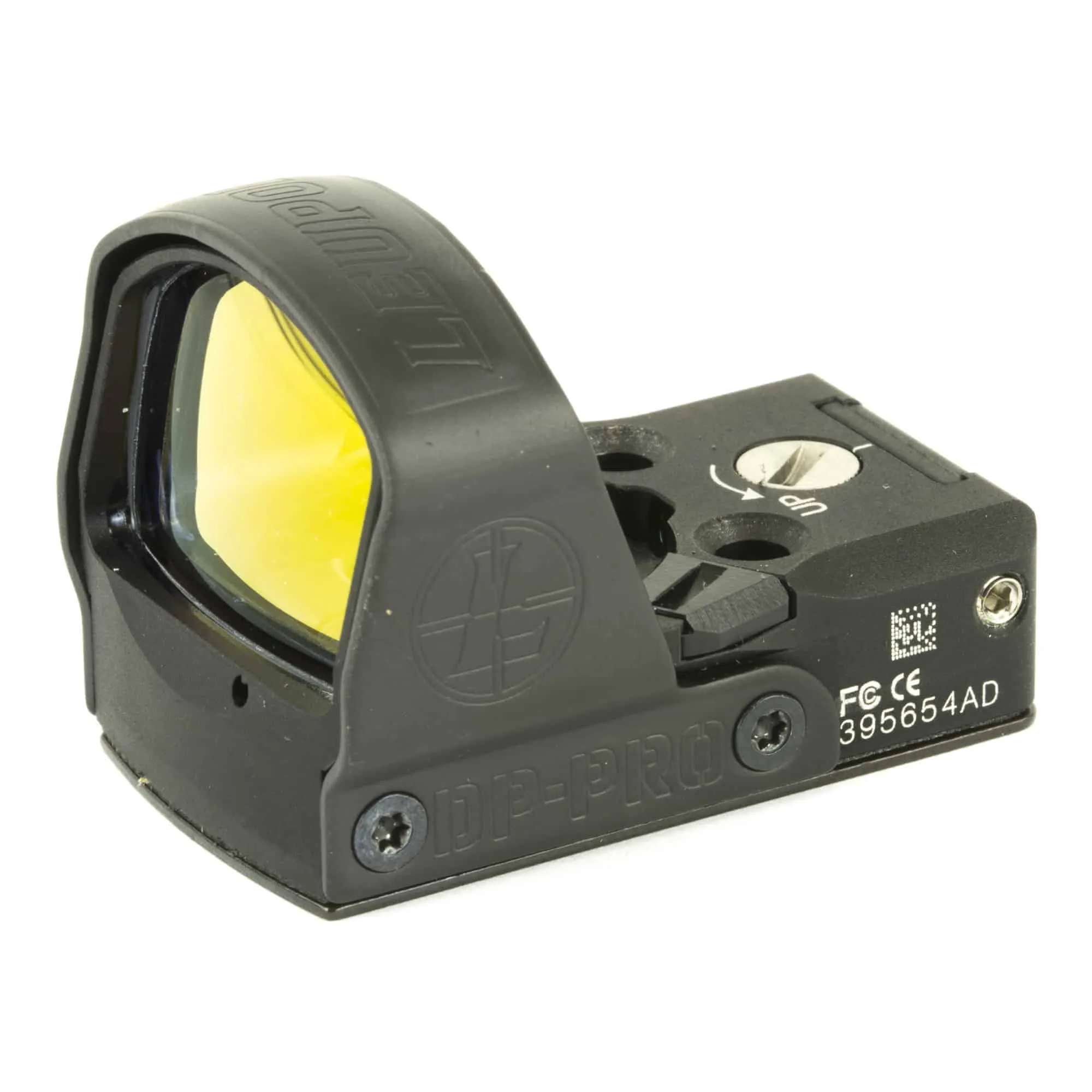
- Competition-oriented open reflex - Leupold DeltaPoint Pro
- Closed emitter - Holosun HE509T
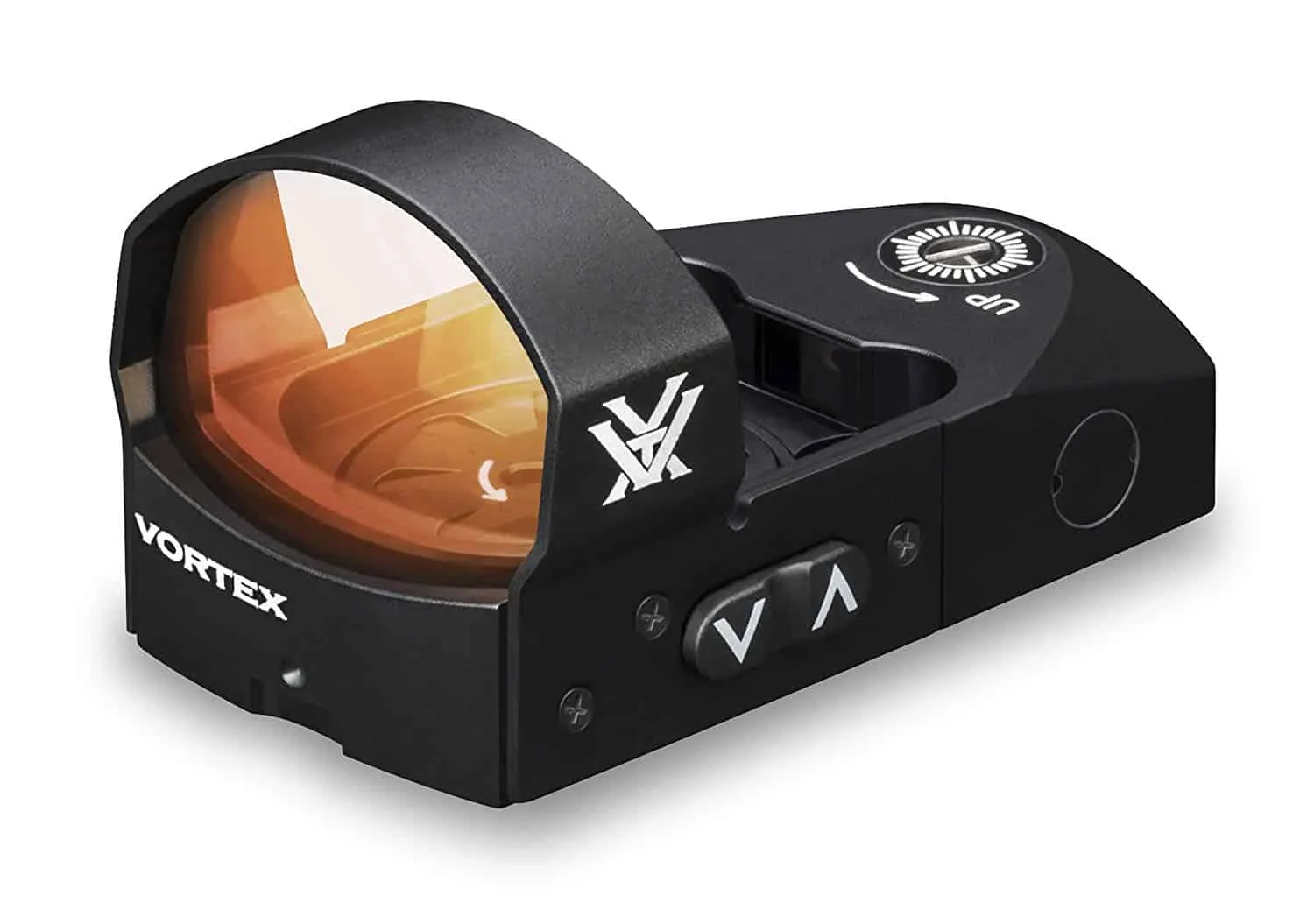
- Used-market note - Vortex Venom (discontinued, used and NOS only)
Details and specifications below.
Why Use a Red Dot Sight on a Pistol?
Maybe you were once like me, believing that you should be able to shoot with iron sights before you should even consider optics.
But one day, it dawned on me, the level of visual gymnastics necessary to focus on your target while simultaneously observing and aligning the front and rear iron sights in the foreground was counter to the way we usually observe the world with our eyes.
As a former military member, I can attest that iron sites served many a shooter well over the years; up until recently, they were the best technology available.
But today’s highly reliable red dot technologies allow you to use your eyes as they were intended. Both eyes open and focusing on the threat.
Benefits
When using a red dot sight, most handgun users will experience faster target acquisition and greater accuracy.
This is achieved mostly through the elimination of the sight alignment process.
With a red dot sight, you, the shooter, only need to focus your attention on a single plane, the target with a dot on it!
Two recent studies demonstrated an increase in overall accuracy for any level shooter using a red dot sight over iron sights.
Statistics from Miniaturized Red Dot Systems For Duty Handgun Use by Aaron Cowan
Similar to the results above in another study, the COMPARATIVE PISTOL PROJECT conducted by James E. Ryan of Norwich University; increased accuracy was observed with a red dot sight.
Selecting the best pistol red dot sight will have a lot to do with your intended application, but rest assured, there is an optic to fit any application.
Whether you are hunting, on-duty, competition shooting, or looking for a sight to mount on your daily carry handgun, there is a red dot sight suited for your needs.
Best Overall Pistol Red Dot Sight
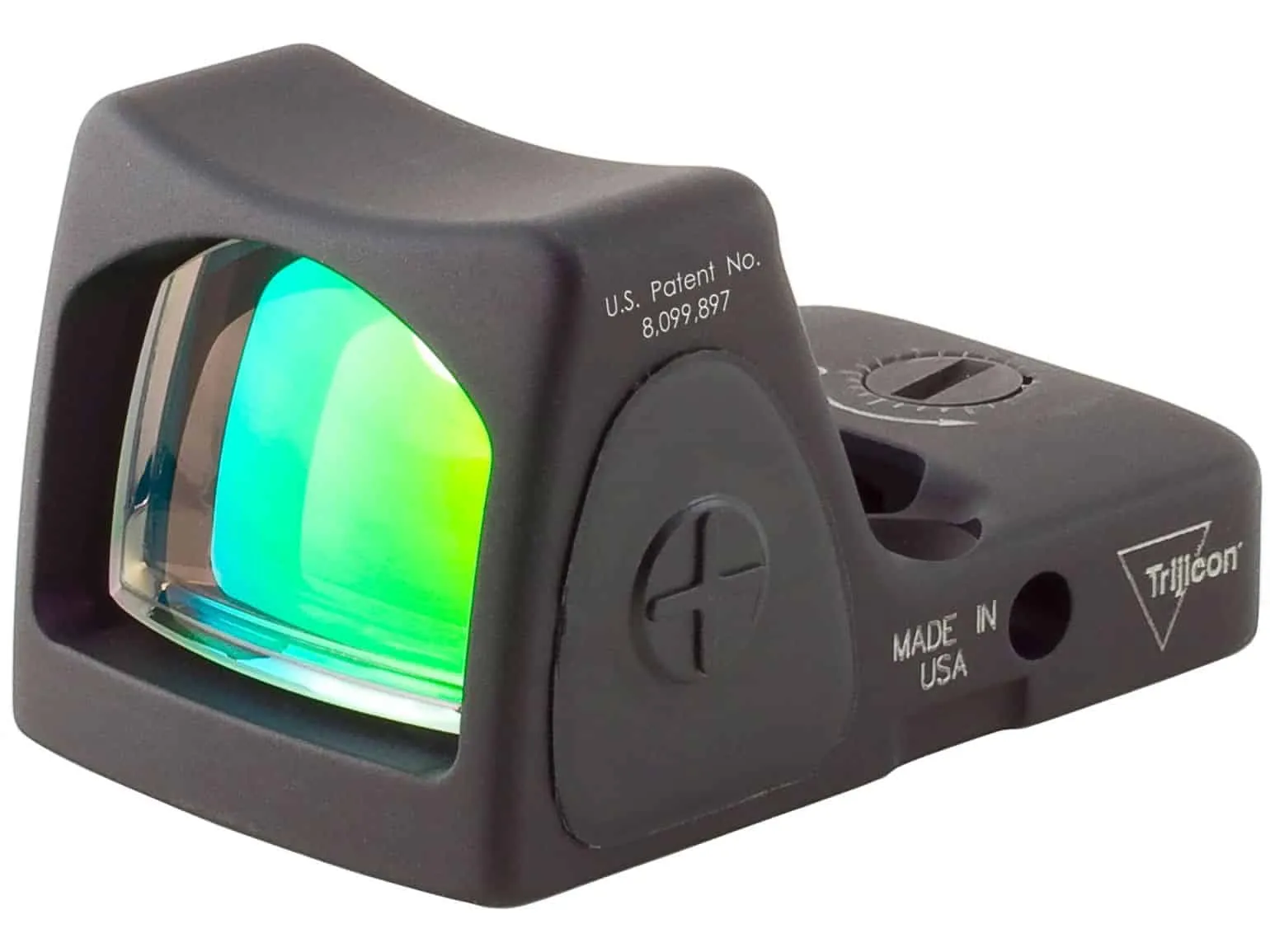
Trijicon RMR Type 2
The strongest durability record of any pistol dot in this lineup, on the published evidence. The RMR Type 2 has independently documented torture testing past 20,000 rounds and repeated drop, submersion, and freeze passes. With its owl ear shape, the RMR withstands a substantial amount of punishment from both impact and recoil related forces and keeps performing. Trijicon’s RMR is small and extremely lightweight. This is an essential factor when adding anything to your handgun to ensure uninhibited maneuverability and stabilization when engaging a target. It is first of the 18 current open-emitter pistol dots we rank. If your pistol optic absolutely has to work, this is our top pick.
Pros:
- Engineered to withstand the most extreme and austere conditions.
- Always on capability with over 4 years of continuous battery life at setting 4.
- Multiple models with various reticle size options and feature for a tailored application.
- Auto/Manual modes with an industry standard footprint.
Cons:
- The need to unmount the sight to replace the battery.
Runner Up: Trijicon SRO for Competition
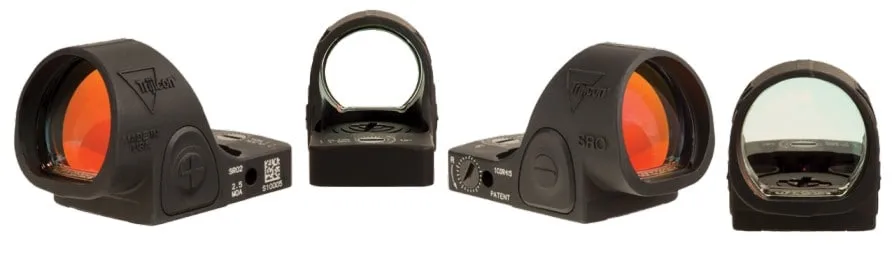
Trijicon SRO
The SRO is second of the 18 current open-emitter pistol dots we rank. Trijicon’s goal with the Specialized Reflex Optic (SRO) is speed. It suits those who enjoy knocking them down at the range, and competition shooters will find it a fit for match use. The optic sports a large Field of View (FOV) with a sight window measuring .98 x .89 inches.
Pros:
- Clear distortion free viewing through a large FOV objective lens.
- Top-loading battery along with long battery life.
- SRO is sealed on the bottom so it doesn’t require a sealing plate like the RMR.
- Very sharp viewing experience along with crisp reticle dot.
Cons:
- The SRO is at the top of the list when it comes to price.
- Not suitable with irons forward rear sight aperture pistols.
Holosun HS507K X2 for Concealed Carry
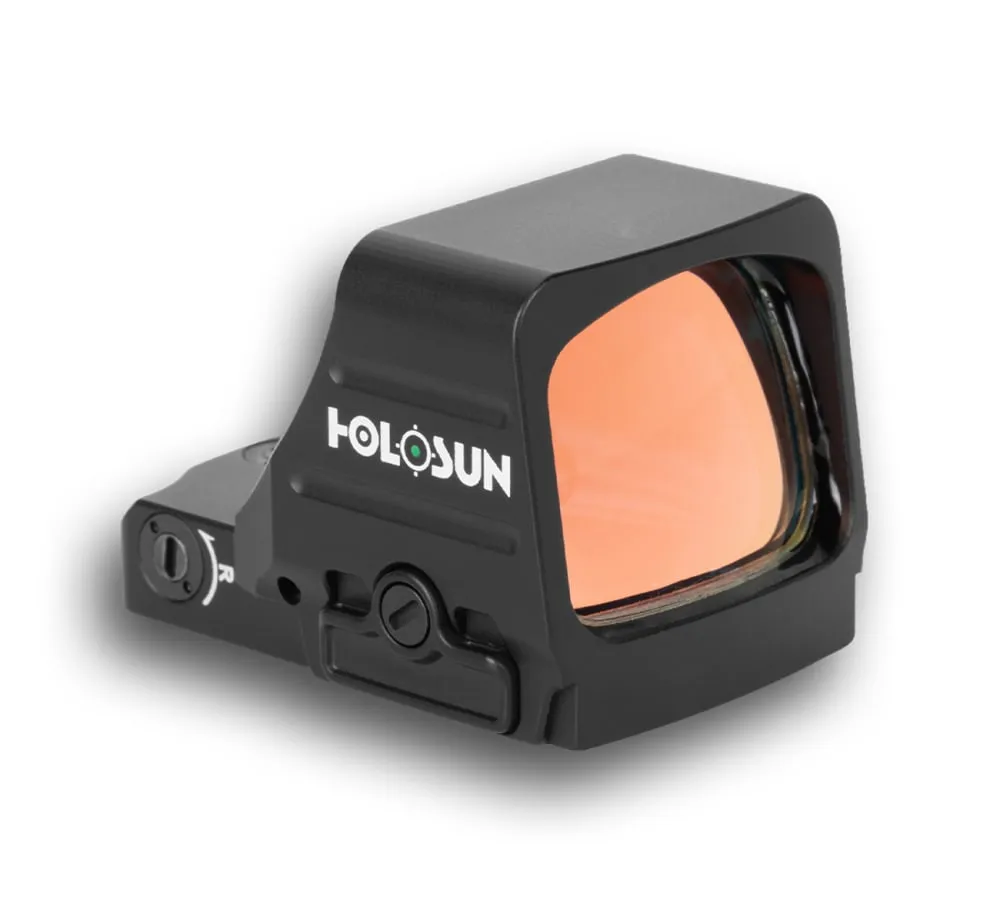
Holosun HS507K X2
First in our concealed carry ranking is the Holosun HS407K-X2 (1 oz, $264.69 list), ranked by reliability reputation and first-hand evidence, then weight, then list price. The 507K X2 below is a micro-pistol option too. Specifically designed for use with a micro pistol, the 507K sports a streamlined, compact size. Built with the same high-quality Holosun standards, the optics lightweight solid construction is perfect for every day carry.
Pros:
- Small form factor and low profile are perfect for keeping a tiny footprint.
- Shake Awake technology ensures the sight is on when you need it and saving power when you don’t.
- Side-mounted battery tray eliminating the requirement to remove and re-zero optic after change battery.
- Designed with the micro pistol in mind.
Cons:
- Buttons are small when manually adjusting reticle brightness is required.
- Limited application due to size.
MSRP: $348.22
Holosun HE508T-RD X2 for Duty-Grade Use
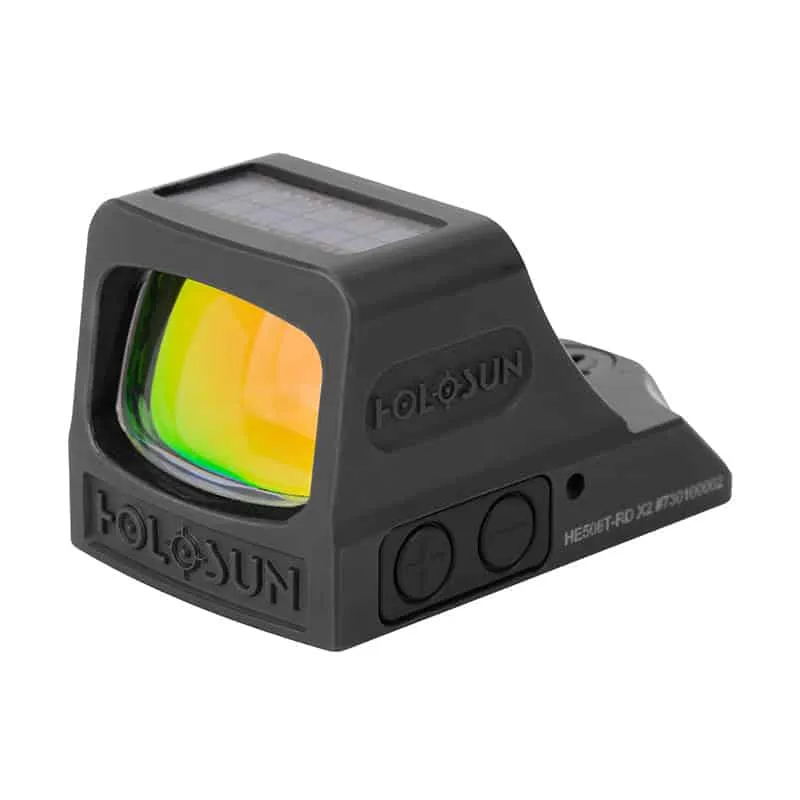
Holosun HE508T-RD X2
The 508T is a duty-grade micro red dot for a pistol. Fully capable in any handgun role, this reliable optic is a fit for law enforcement and military use along with personal defense applications. It gives up little to the RMR in toughness while adding a solar failsafe, shake awake, and a multi-reticle system at a lower price. Feature packed, rugged and reliable.
Pros:
- Rugged construction engineered to withstand the harshest conditions.
- Always on capability with a 50k hr battery life and Solar Failsafe.
- High-quality optics for a clear target picture and a crisp reticle dot.
- Auto/Manual modes, multi reticle tailorable to your unique requirements.
Cons:
- Buttons are small when manually adjusting reticle brightness is required.
Biggest Window on the RMR Footprint
Holosun HE507COMP-GR
Shooters who live on a timer keep asking for one thing: more glass. The 507COMP takes the RMR-footprint 507C and stretches the window to 1.1 by 0.87 inches, about two thirds more viewing area, without leaving the pistol dot category. The reticle stacks a 2 MOA dot with an 8, 20, or 32 MOA ring, giving four selectable sight pictures, so the same optic covers a fine aiming point for precision and a fast ring for close transitions.
Pros:
- The largest window of any RMR-footprint pistol dot we have reviewed.
- Four selectable sight pictures from one reticle system.
- Side-loading CR1632 rated up to 50,000 hours, IP67 sealed, 1.7 oz.
- Published zero retention across roughly 2,400 rounds of independent testing with no shift.
Cons:
- Drops the solar backup panel the standard 507C includes.
- A sample in independent testing cracked its glass in a fall from a short table, which the warranty treats as physical damage.
Read the full Holosun 507COMP review for the sourced testing detail.
Burris FastFire 3 Under $300
Burris FastFire 3
The Burris Fastfire 3 is a solidly built optic that is apparent when you have it in your hands. Constructed from steel and ionized aluminum, the optic is sturdy yet lightweight. This tried and true favorite maintains a loyal following for its performance. The Fastfire 3 is perfect for the shooter looking to get their feet wet at a reasonable price.
Pros:
- Quality construction makes it a durable solid performer.
- Automatic reticle brightness level adjustment.
- 3 MOA or 8 MOA reticle model options.
- Easy access to battery compartment for simple battery replacement.
Cons:
- Only three reticle brightness adjustment levels in manual mode.
- A smaller field of view.
Leupold DeltaPoint Pro for Competition
Leupold Deltapoint Pro
The Leupold DeltaPoint Pro is a competition-minded alternative to the SRO. It is a well-established, high-quality red dot sight with a large Field of View (FOV). The optic has an incorporated steel sheath to protect the sight from external impacts. Sight adjustments are accomplished through a single button for easy operation.
Pros:
- Motion sensing auto on/off that extends battery life.
- Battery compartment accessible from top for rapid power cell replacement.
- Clear viewing and crisp reticle.
- Several years in the market with thousands hours of proven operation.
Cons:
- Short battery life of 300 hrs continually running on the highest setting.
- Single-button operation.
Holosun HE509T-RD as a Closed Emitter
Holosun HE509T-RD
The first enclosed pistol dot in our enclosed pistol ranking is the Holosun EPS Carry (1.23 oz, $470.58 list), first of the 8 enclosed pistol dots we rank. The 509T is another closed-emitter option. Some handgun applications may call for a closed emitter. Whether it’s the environment or shooter preference, the Holosun 509T is a titanium closed-emitter optic. Many shooters prefer the closed design to ensure that foreign debris does not block the emitter.
Pros:
- Titanium housing construction for a strong yet lightweight optic.
- Versatile mounting options to support a wide variety of applications.
- Dual power system combining solar and conventional battery power.
- Water and dust resistant for uninterrupted operation in varying environments.
Cons:
- This style of optic can be bulky for some applications.
MSRP: $505.87
Used-Market Note: Vortex Venom (Discontinued)
Vortex Venom
Discontinued. Vortex no longer produces the VMD-3103, so what you will find now is used or new-old-stock. This note is for anyone shopping that market and it carries no ranking. Buying new in the same class? Look at the Burris FastFire 3 above, or the Holosun 507C if you can stretch the budget.
For a long stretch the Venom was the easy call for a casual shooter or a new pistol owner. It is a lightweight reflex sight with a built-in automatic adjusting reticle brightness feature, and a feature-packed one for the money. This optic proved sturdy and durable across repetitive handgun recoil punishment, and it was priced reasonably while it was in production.
Pros:
- Lightweight at 1.05 oz, with quality construction for a durable solid performer.
- 3 MOA red dot that will adjust automatically depending on surrounding light conditions.
- Lenses that provides clear edge to edge viewing that aids in easy target identification.
Cons:
- Not night vision compatible.
- Slightly wider body that may stick out on some pistol frames.
Also Reviewed Recently
The picks above are the list. These few pistol optics each answer a narrower question than “what should most people buy.”
If you want the emitter sealed behind glass, that is its own decision with its own guide: our best enclosed emitter pistol red dot roundup covers it, including the Trijicon RCR, which puts a closed optical channel on the standard RMR cut, and the Sig Sauer Romeo-X Pro Enclosed, which does the same on the Leupold DeltaPoint Pro cut.
Two more are worth knowing about, with caveats attached. The Sig Sauer Romeo3 Max Pro is a competition-oriented open reflex with a direct DeltaPoint Pro footprint and a 31mm lens, but it left the market after its first production run and returned as the Romeo3 Pro under the same part numbers, with no published explanation of what changed, so a used unit is hard to date. The Vortex Viper Red Dot is an ultra-low 1.03 oz sight built for cutout slides that co-witnesses with suppressor-height irons, though Vortex’s own troubleshooting page describes the uncapped bottom-load battery working loose if the optic shifts under recoil on some mounts. Both are worth a look for the right buyer, and neither is one of the picks above.
Specification Quick Comparisons
Not all red dots are alike. Housing material, power source and battery life, features, and reticle pattern, size and color can all matter to a specific need, so here is what varies between the picks above.
Most red dot optic bodies are machined from either a single piece of Aluminum or Titanium. Titanium can have an advantage due to its strength. The housing can be made with less material allowing the housing to be lighter with comparable or better strength than Aluminum.
A coin style lithium-ion battery powers most red dots sights with a few exceptions; some Holosun models include a solar array as part of a dual power system.
Battery life greatly depends on the internal components, brightness settings, and reticle size. With the addition of Super LEDs, some optics get 50K hrs of battery life.
Now when it comes to features and technologies, the options can be quite staggering. But for the most part, red dots can have an Automatic brightness adjustment, manual brightness adjustment, and motion detection that turns on the optic.
Another component that can have a lot of options is the reticle size, pattern and color. All of the sights come in red with a few having green and gold options. With respect to reticle size it can range from 1 MOA to 65 MOA.
The side-by-side numbers for the ranked picks are generated from the reviews and the data records rather than retyped here, in the two tables above the write-ups: the comparison table carries dot size, weight, battery type and battery life per optic, and the data table under it carries footprint, direct-fit count, warranty grade, reliability standing and MSRP. Follow any optic’s link for the rest of its review.
A Shooters Guide to Choosing the Best Red Dot Sight for a Handgun
When choosing the best pistol red dot sight, several key characteristics are paramount in selecting the proper optic for your intended application. The relevance of each of these features will depend on your situation and how you intend to employ your handgun platform, and for what reasons. You should consider the most crucial sight features concerning selecting a red dot sight for your pistol are durability, operation, reticle, battery life, mounting options, warranty, and price.
Pistol Red Dot Sight Durability
Durability is a significant factor when selecting a reflex sight for your handgun. Depending on your intended use, this feature may be the single most crucial factor in your selection. If your intended primary application includes on duty situations, military service, or self-defense, having the most durable optic should be at the top of the selection criteria list.
A red dot optic mounted on a pistol must withstand significant repetitive force acting upon it.
The sight must be able to withstand forces from two significant sources during pistol operation. The most significant force is the force generated from a slide ride firearm’s repetitive recoil, such as your handgun.
A common point of failure for most optics from handgun recoil is the internal electronic components and battery contacts. Nowadays, the most durable reflex sights encase electronics in resin to counter-recoil force and guard against moisture.
Additional design features that are intended to combat forces created from recoil is battery placement and battery contacts. The high-quality sights have repositioned battery location and orientation to reduce stress on battery contacts.
The second type of force a pistol mounted optic must guard against is external impacts to the sight’s chassis. Most red dot sights use chassis designed to channel impact forces away from the lens and internal components.
The most common failure to a sight often related to impact force is lens integrity. Most micro red dot sights utilize some external housing that separates the lens body from the site’s exterior.
One additional external factor that can cause failure in sight operation is the intrusion of moisture and dust. In general, most sites have attempted to overcome moisture intrusion via sealant or O-rings. It is common for red dot sight manufacturers to waterproof their optics equal to an Ingress Protection (IP) IPX7 or IPX8 rating.
IPX7: Can be submerged up to 1 meter in water for 30 minutes.
IPX8: Can be submerged deeper than 1 meter. The manufacturer specifies the exact depth.
When choosing a red dot sight for a pistol to protect life, durability and ruggedness should significantly influence your sight selection process.
Operations
Another factor when selecting the best pistol red dot sight to mount on your handgun is operation and control manipulation. Selecting a sight that is easy to operate and intuitive to use ensures that your pistol/sight combination is always ready for action.
Easy access to sight controls that power the optic on/off and adjust proper reticle brightness are design features most shooters should consider when selecting the appropriate sight.
Some manufacturers have incorporated motion-sensing capabilities that allow you to leave the sight on for uninterrupted continuous use. Other manufacturers have included automatic adjusting reticle brightness feature that increases or decreases the brightness level according to the existing light conditions.
Depending on your needs, these design features may play a significant role in your red dot sight selection process. Competition shooters, general handgun enthusiasts may not need to emphasize sight operation as an individual carrying a red dot sight outfitted handgun in an on-duty situation.
Red Dot Sight Reticle Options
The reticle is another critical consideration when selecting a red dot sight for your Pistol. Options such as dot size, color, and clarity may influence your sight selection depending on the situation and conditions you attend to utilize the optic. Red dot sights typically incorporate reticle dots from size 1 Minute of Angle (MOA) up to 16 MOA and may even include 32 MOA rings.
1 MOA equals 1 inch at 100 yards or 3 cm at 100 meters. The dot size will appear to be 1 inch in diameter on a target at 100 yards.
When anticipating utilizing your optic strictly for close-quarters engagements, you may prefer a larger reticle to aid in the rapid acquisition of the dot and target. Still, others may find it more beneficial to utilize a smaller dot for increased precision for target engagements at extended distances.
For someone like a competition shooter or even a hunter, engagement distance may be somewhat predictable, therefore making dot size selections at either end of the size spectrum easy.
When it comes to reticle color, pistol owners generally get to choose from a red, green, or gold in some cases. Reticle color may play more of a factor if you have color blindness or the environmental background you are operating, making one color easier to see than the other.
For some color-blind shooters, a gold dot may be visible when red or green is not. In addition to your vision, the environment may influence which reticle color is more visible and advantageous for easy, rapid acquisition.
Two additional factors concerning reticle preference are dot clarity and night vision compatibility. Quality reflex sight presents a clear, crisp dot that does not washout with increased brightness levels. A clear, crisp dot makes target acquisition an easier task for any red dot sight on a pistol application.
Some of you may need a red dot sight that is viewable through night vision goggles. Be sure to pay close attention to an optics specification as not all reflex sights are night-vision compatible.
Reflex Sight Battery Life and Maintenance
Battery life is another crucial factor you should consider when selecting the best red dot sight for your pistol. Longer battery life means less maintenance to keep the optic operational and ready. As mentioned before, some manufacturers have included motion-sensing technology that powers down the optic during extended periods of non-use to conserve battery life.
Another essential attribute related to battery life is access to the battery compartment. Eventually, all batteries need to be changed, and the more accessible the battery compartment makes maintenance a slightly more manageable task. Some optics require you to remove the site from your handgun to switch out the battery. This may be less than ideal for situations that require extended continuous use under high-stress conditions.
Mounting Your Pistol Red Dot Sight
When mounting a red dot sight to a pistol, there are generally five options. Of the five mounting options, the three most common options include a dovetail mounting plate, custom milled slide, and factory milled slide. The other two red dot sight pistol mounting options require the existence of a Picatinny rail system on your handgun.
If you already have a pistol and the slide is milled from the factory like the Glock MOS, Springfield OXP, or the Sig Sauer RX series. Then mounting an optic is straightforward and simple. In most cases, you will need an adapter plate for your specific red dot sight, provided it fits within the factory milled footprint.
If you already have a pistol and the slide is not milled from the factory, then you can have the slide custom milled for your specific application or purchase an aftermarket “mass-produced” custom milled slide. The factory milled and the custom milled is our most preferred method as they provide the best foundation for the sight and usually allow for co-witness with iron sights.
These first two options may not be for you. If this is the case, you can remove your rear sight and replace it with a dovetail mounting plate. There are many after sight manufacture and aftermarket mounting plate options. The downside to this mounting method is the loss of the ability to use the iron sights as a backup.
Mounting with a Picatinny rail requires a rail system on the top of the pistol slide or below in front of the trigger housing. When the rail is in front of the trigger housing, you can install a mounting frame that comes up and over the handgun, providing a platform for which to mount the sight. Using this option can make it challenging to find holster solutions and substantially increases your pistol footprint.
Warranty
Even the most rugged red dot sight can fail. There is just going to be a situation here or there that renders a sight inoperable. Most of the top red dot sight manufacturers offer excellent warranties covering a broad array of conditions and sight malfunctions. When selecting the best red dot sight for your pistol, make sure you read and understand the manufacturer’s warranty in full.
Some warranties may cover physical damage for a lifetime while only warranting the electronics for five years. Yet there are still others who offer a lifetime no questions asked warranty and will replace or repair the reflex sight as long as you own it. If you are unsure of some aspect of the warranty, make sure to contact the manufacturer before you buy and get all of your questions answered in writing.
How Much Should You Pay for a Red Dot Sight?
Red dot sights range from under $100 to over $1,000. We find that most of the quality sights are somewhere in the middle. As these red dot sights continue to grow in popularity, manufacturers will meet the market’s needs with quality, high performing optics for lower prices. In recent years we have seen several red dot sights that have proven great options for pistol owners in the $200 to $400 range.
Common Questions About Pistol Mounted Red Dot Sights
Q. Do I need to purchase a special mount to attach a red dot sight to my pistol?
Depending on your pistol model and red dot sight combination, you might have to purchase a special mounting plate or accessory. With some systems, the required mounting accessories are supplied, so be sure to check with your pistol and red dot sight manufacturers for specific requirements.
Q. How hard is it to shoot with a red dot sight on a pistol?
There is a small learning curve no different from when you learned to shoot with your pistol’s iron sights. The benefit here is that you have a high probability that you will increase your accuracy and speed once acquiring the reticle is part of your shooting muscle memory.
Q. Can I mount a red dot sight on something other than a pistol?
There are several red dots, and holographic sights suitable for just about any firearm application. Some red dot sights are designed specifically for handgun platforms but equally on shotguns, carbines, and rifles.
Q. Should I use a red dot sight for on-duty or self-defense situations?
Ultimately this decision is up to you. Red dot sights have been approved for service by many law enforcement agencies and the military both in the United States and abroad.
Q. Do I have to be an expert shooter to benefit from putting a red dot sight on a pistol?
No, any level of shooter can benefit from the addition of a red dot sight to their favorite handgun. Most red dot sights manufactured today are intuitive and easy to use.
Conclusion
There are many factors to consider when deciding which is the best red dot sight for a pistol. We have covered much of what you need to know when considering purchasing a reflex sight to mount on your handgun. Remember, just putting a red dot sight on your pistol won’t make you a better shooter; you will have to practice with the optic and make it muscle memory in your target acquisition routine.